
I’m watching Newton Protocol with patience, not excitement. I’m waiting to see whether it becomes something people truly use, or whether it becomes another smart idea that crypto talks about for a while and then forgets. I’m looking at it through the lens of many past cycles, where every season brought a new promise, a new category, and a new reason to believe that this time would be different. I’ve noticed that real crypto infrastructure usually does not need to shout. It slowly becomes useful because a real problem keeps showing up. I focus on that more than anything else now: not the branding, not the token attention, not the early noise, but the problem a project is trying to solve and whether that problem will still matter when the market becomes quiet again.
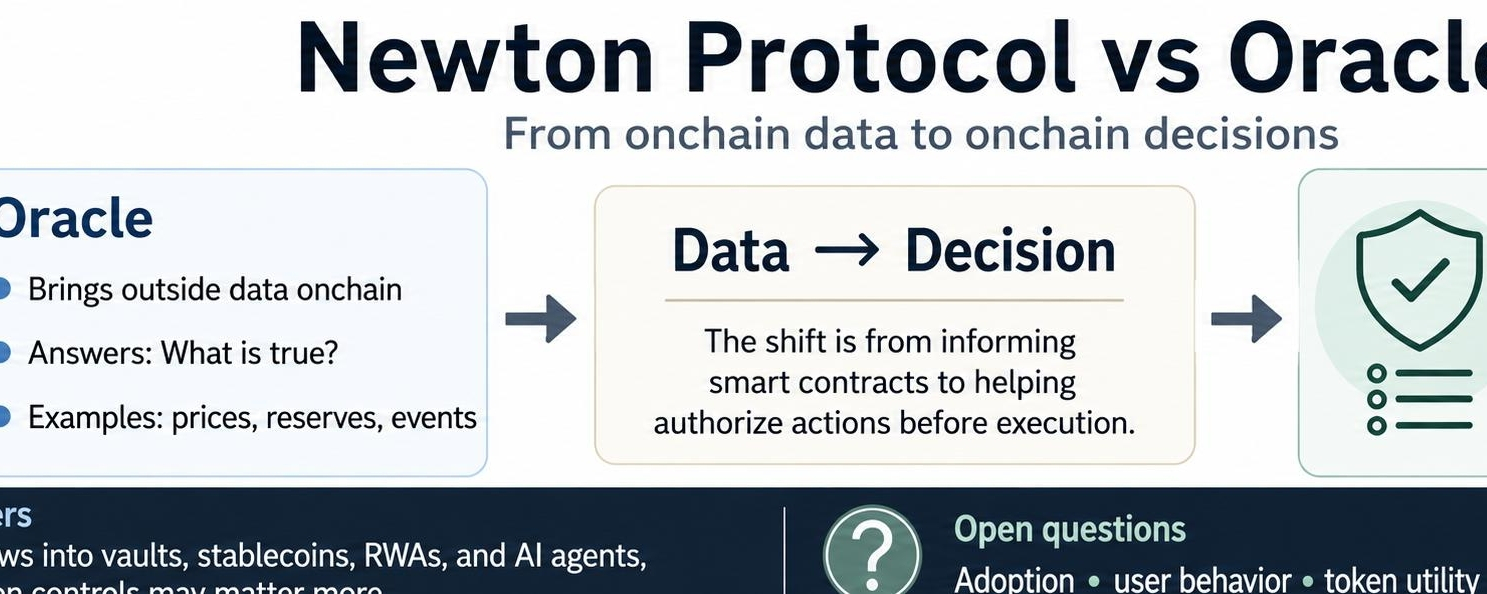
Newton Protocol is interesting because it is not trying to be just another oracle. An oracle helps a blockchain understand outside information. It can bring in a token price, market data, reserve information, identity signals, or other external facts that smart contracts cannot access on their own. That is already a very important role in crypto. Without oracles, DeFi would be much weaker because lending markets, derivatives, stablecoins, and trading systems need reliable information from outside the chain. But Newton Protocol is trying to do something different. It is not only asking, “What is the data?” It is asking, “Should this action be allowed?”
That is the main difference. An oracle gives information. Newton Protocol tries to turn information into a decision. A price oracle can tell a lending protocol what ETH is worth. Newton Protocol is more focused on whether a transaction, vault action, agent activity, or movement of funds follows a certain rule before it goes through. In simple words, an oracle helps a smart contract know something. Newton Protocol wants to help a smart contract approve or reject something.
That may sound like a small difference, but I think it matters a lot. Crypto has become very good at moving assets quickly. It has become good at creating markets, liquidity pools, vaults, bridges, and automated systems. But it is still not always good at controlling what happens before a transaction is executed. Many times, once something is signed and sent onchain, the damage is already done. Newton Protocol is trying to place a control layer before that moment. It wants to check the rules first, and only then allow the action to continue.
This is why the project feels connected to a bigger direction in crypto. The industry is moving beyond simple trading and speculation. More capital is entering stablecoins, real-world assets, DeFi vaults, payment systems, and automated strategies. AI agents are also becoming part of the conversation, especially agents that may one day manage transactions or interact with protocols for users. These systems need more than speed. They need limits. They need permissions. They need risk checks. They need a way to say, “This action is allowed,” or “This action should be blocked.”
Newton Protocol is trying to become part of that decision-making layer. Instead of only delivering data to a smart contract, it wants to help enforce policies around how transactions happen. A vault manager may be allowed to move funds only within certain limits. A wallet may need to pass a specific check before interacting with a protocol. An automated agent may be allowed to perform some actions, but not others. A protocol may want to prevent risky or unauthorized behavior before it reaches settlement. Newton Protocol is built around this idea of policy-based authorization.
That makes it different from a normal oracle network. Oracles are still important because Newton Protocol may depend on data from different sources. It may need information from risk providers, identity tools, compliance systems, blockchain analytics platforms, and existing oracle networks. But Newton’s role is not just to bring that information onchain. Its role is to help decide what should happen because of that information. That is where the project becomes more specific and more ambitious.
I like this direction because it points to a real weakness in crypto. A lot of crypto infrastructure is built around execution. Can the trade happen? Can the assets move? Can the smart contract run? Can the bridge transfer value? But as crypto becomes more complex, the better question may be: should this action happen under the rules the user, protocol, or institution has already chosen? That is where Newton Protocol becomes worth watching.
At the same time, I do not want to make it sound easy. The idea is strong, but strong ideas do not automatically become adopted products. Newton Protocol still has to prove that developers actually want to build with it. Developers already deal with smart contract risk, liquidity problems, audits, integrations, user experience, gas costs, and competition. Adding another layer of transaction authorization may be useful, but it also adds more complexity. If it feels too heavy, too expensive, or too difficult to explain to users, some teams may avoid it until they are forced to care.
User behavior is another question. Crypto users often say they want safety, but they also want freedom. They want protection, but they do not always want restrictions. If Newton Protocol blocks a transaction because a policy says it should not happen, one user may feel protected while another may feel controlled. That tension is important. Crypto was built around open access and permissionless movement. Newton Protocol is not trying to remove that completely, but it does introduce a more controlled way of thinking about transactions. Some parts of the market may welcome that. Other parts may resist it.
This is especially important because different users want different things from crypto. A regular DeFi trader may not care much about policy checks if all they want is fast execution. A vault manager may care a lot because they are responsible for other people’s funds. An institution may need these controls before it can participate more seriously. A protocol may want them to reduce risk. So Newton Protocol’s success may depend on finding the right users first. It may not be for everyone, and that is not necessarily a weakness. But it does mean adoption may be slower and more specific than the market expects.
The token side also needs honest thinking. NEWT may have roles in staking, security, permission management, operator incentives, fees, or governance. Those use cases sound reasonable, but the real question is whether the token is truly necessary. A token should not exist only because a project needs a market around it. It should exist because the system genuinely works better with it. For NEWT to matter over time, there needs to be real demand connected to real usage. Developers, operators, or users must need the token for something meaningful inside the protocol. If the token’s role becomes mostly speculative, then the project may still have good technology, but the token may not capture that value in a strong or necessary way.
That is something I always watch carefully now. Many projects create useful tools, but their tokens do not always become essential to those tools. Sometimes the software has value, but the token is only loosely connected to that value. Newton Protocol has to avoid that problem. If policy checks, staking, operator collateral, and governance become active parts of the network, then NEWT may have a clearer purpose. But if usage remains low, or if the token is not deeply needed for the system to function, then token utility could become one of the weaker parts of the story.
Market timing is another challenge. Newton Protocol may be early. That can be a good thing, because early infrastructure can become very important later. But being early can also be difficult. The market may not yet understand why policy-based transaction authorization matters. Developers may not feel urgent demand. Users may not ask for it directly. Institutions may move slowly. AI agents and real-world assets may take longer to grow than people expect. A project can be right about the future and still struggle in the present.
Competition will also matter. If Newton Protocol proves that this category is important, other teams will not ignore it. Oracle networks may expand further into policy and risk. Wallets may add stronger permission systems. Custody platforms may build their own controls. Compliance providers may offer similar products. DeFi protocols may create internal rule engines instead of using an external layer. Newton Protocol has to prove not just that the problem is real, but that its own solution is trusted, flexible, and worth integrating.
The hardest part is that this kind of technology has to work when conditions are bad. It is easy to imagine policy checks working smoothly when the market is calm, the data is clean, and the rules are simple. But crypto is rarely calm for long. Markets crash. Networks become congested. Data providers can fail. Risk signals can conflict. Rules can become unclear. A policy may block something that should be allowed, or allow something that later turns out to be dangerous. Newton Protocol has to handle those moments carefully, because transaction authorization is a sensitive layer. If it fails, users may lose trust quickly.
That is why I see Newton Protocol as a serious experiment rather than a guaranteed answer. It is trying to solve a problem that will probably become more important as crypto matures. More automation means more need for boundaries. More institutional activity means more need for controls. More tokenized assets mean more need for rules around movement and access. More AI-driven activity means more need to define what agents can and cannot do. Newton Protocol is positioned around those questions, and that makes it relevant.
But relevance is not the same as success. The project still has to earn adoption. It has to make developers care. It has to make users understand the benefit. It has to prove that the token has real economic purpose. It has to survive competition from larger infrastructure players. It has to work under pressure, not just under ideal conditions. And it has to do all of this in a market where attention moves quickly and patience is rare.
What I find most important about Newton Protocol is not only what it claims to build, but what it reveals about where crypto may be heading. The industry started with the idea that assets could move without permission. Then DeFi showed that markets could operate onchain. Now the next stage may be about controlled execution, where transactions do not only happen because they are technically possible, but because they match a defined set of permissions and rules. That is a major shift.
Newton Protocol sits inside that shift. It is trying to bring more structure to onchain activity without turning everything into a fully centralized system. That balance will not be easy. Too much control, and users may feel crypto is losing its original spirit. Too little control, and larger use cases may never feel safe enough to grow. The space between those two extremes is where Newton Protocol is trying to build.
For now, I am still watching. I see a real idea here, and I see a real problem behind it. I also see adoption risk, token risk, timing risk, competition, and the possibility that the market may not be ready. Newton Protocol may become an important layer for onchain authorization. It may struggle to move beyond early integrations. Or it may simply introduce a useful concept that other projects later refine. That uncertainty does not make it less interesting. It is the reason I keep paying attention.