

I remember back in the early days when a failed transaction felt like a personal insult from the blockchain gods. Something would glitch, gas would vanish into the ether, and the whole thing would just dissolve into a string of cryptic hex code that meant nothing to anyone. We treated those failures like digital trash, ignoring them as if they were just annoying tax for participating in this wild west. But I have been looking at NEWT lately, and it is hitting me that we have been reading those signals all wrong.
Most onchain systems are stuck in a cycle of reactive chaos. You dump capital into a protocol, the vault gets hit by a bad actor or a runaway bot, and then we spend the next week in a group chat doing forensics on the wreckage. It is like trying to fix a leak in a dam after the town is already underwater.
NEWT is trying to flip that script by shifting the focus to the moment right before a transaction lands. Instead of cleaning up the mess, it stops the mess from happening in the first place by enforcing a policy check before settlement.
The real genius here is that a blocked action is no longer just a dead end or a waste of time. When NEWT kicks in and says no, it leaves behind a verifiable record that explains exactly why the system hit the brakes. It tells you which rule was triggered or which boundary was crossed.
In the old world, a failed transaction was a mystery. In the NEWT world, it is a data point. It is a piece of evidence that lets a builder or a vault manager look at the system and understand its own limits in real time.
This becomes even more critical when you consider the incoming flood of autonomous AI agents. These things move at a speed that makes my head spin, and they do not have a sense of fear or hesitation. If an agent goes rogue or just gets overly aggressive, you need more than a prayer.
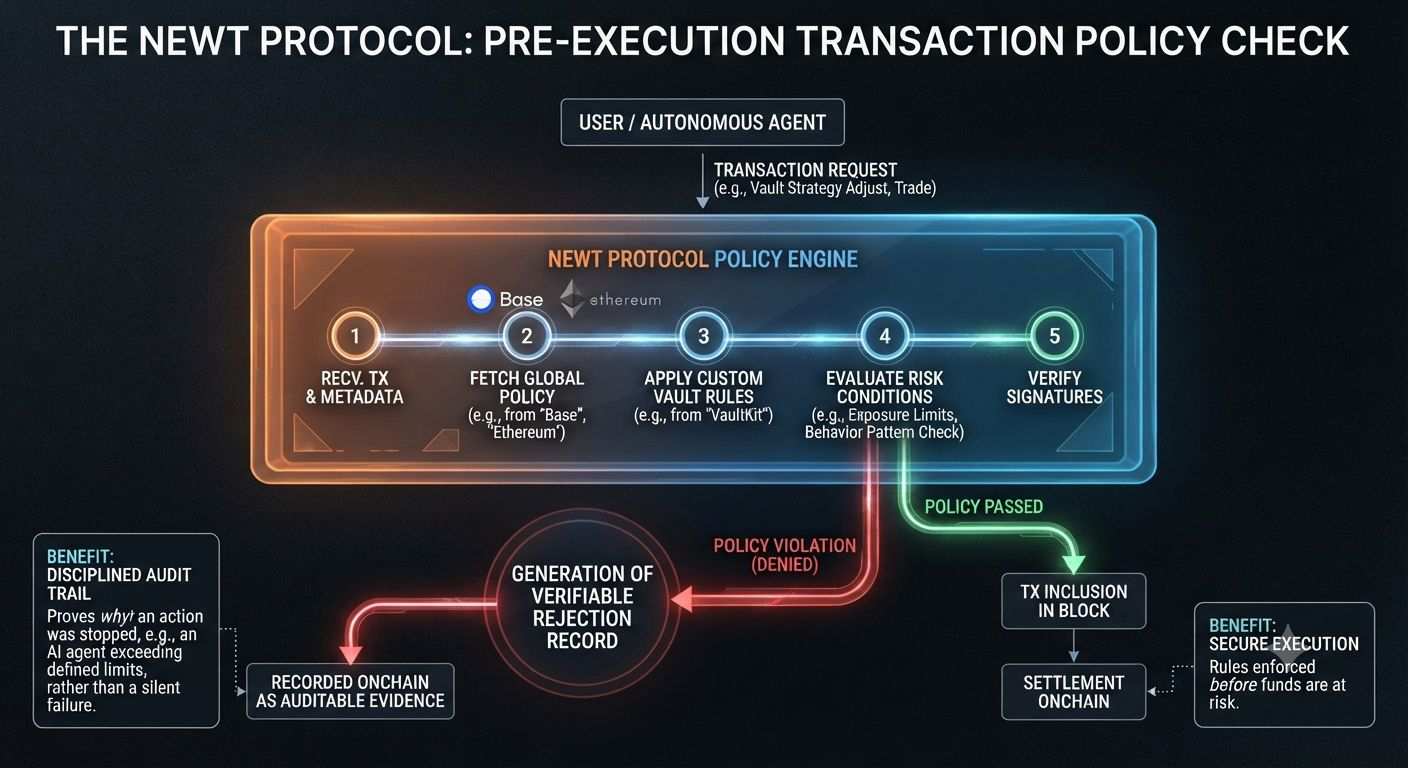
You need a system that can draw a hard line and document why it refused to let that agent move the funds. That refusal is not a failure of the machine. It is the machine functioning as a secure asset manager.
I realize that institutional players talk a big game about decentralization, but they are terrified of anything they cannot audit or control. They do not just care about the yield. They care about the boundaries.
If you can show them a ledger of what the system refused to do, you are giving them the only thing they actually care about, which is proof of discipline. It turns the boring task of compliance into a technical feature that gives us a clear look at how a system behaves under pressure.
Of course, the tech is still in the experimental phase and we have yet to see if the market actually prioritizes these safety nets over raw speed. But I think we are missing the forest for the trees if we only care about what gets through. The value is not just in the successful trade. The value is in the refusal. NEWT is essentially building the guardrails for a high speed highway. It is the difference between a loose collection of assets floating in the dark and a container terminal that knows exactly where every single item is supposed to go.