
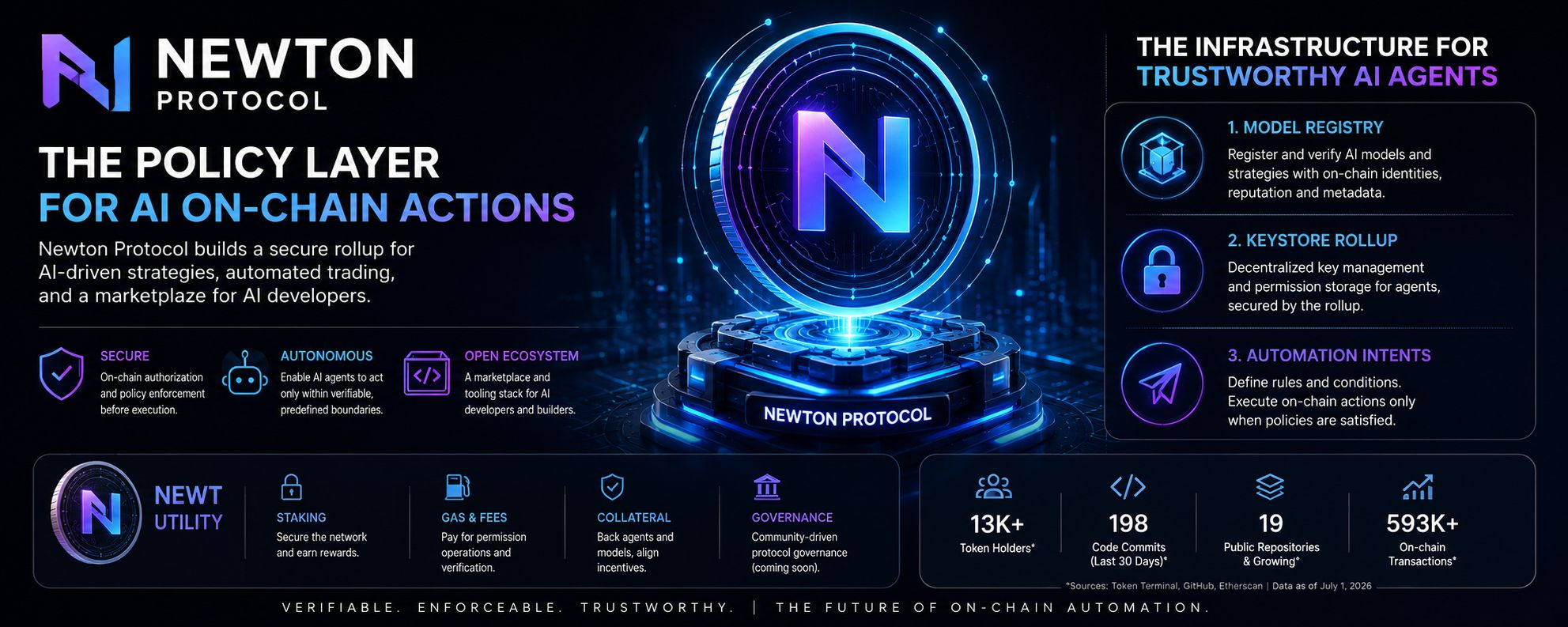
@NewtonProtocol Newton Protocol is easy to misread at first glance. On the surface, it sounds like another AI-and-crypto project. In practice, its sharper claim is narrower and more interesting: it wants to sit in front of transactions and decide whether they are allowed to execute at all. Newton describes itself as an onchain authorization layer that enforces policies before execution, while Binance Research frames it as a decentralized infrastructure layer for verifiable onchain automation and secure agent authorization. That distinction matters. A lot of crypto projects optimize for execution speed; Newton is trying to make execution conditional, auditable, and policy-aware.
That design is built around three pieces that make the project feel less like a single product and more like a coordination stack. Binance Research identifies a Newton Model Registry, a Newton Keystore rollup, and Automation Intents as the core components. Read together, those pieces suggest a system in which agent behavior is not merely automated but formally constrained: models are registered, permissions are stored and updated, and instructions are triggered only when predefined conditions are satisfied. My read is that this is Newton’s real bet. It is not trying to prove that AI agents can act; it is trying to prove that they can act safely enough to be delegated meaningful authority.
NEWT’s token design reinforces that same logic. Binance Research says the token will be used for staking to secure the protocol, as the native gas and fee token for permission operations, as collateral for agent/model operators, and eventually for governance. CoinGecko describes NEWT as an application utility token that supports protocol service fees for authorization and verification tasks. That mix is important because it gives the token a job beyond speculation: if the protocol gains real usage, demand should come from people needing permissions, verification, and network security rather than from traders chasing a theme. The weak spot, of course, is that utility tokens only become durable when the underlying action is frequent enough to justify using them.
The on-chain footprint shows that Newton is no longer just a concept paper. Etherscan lists the NEWT contract as a verified ERC1967Proxy on Ethereum, and the token contract has accumulated 593,453 transactions, with transfers still appearing on July 1, 2026. That volume is meaningful, but it should be read carefully: token transfers are not the same thing as protocol adoption. Still, the combination of a verified proxy contract and sustained transfer activity suggests that the asset has moved beyond the “announced and forgotten” stage that traps many new infrastructure tokens. It now has enough on-chain history to be analyzed as a living market object, not just a launch event.
The development side also looks active rather than dormant. GitHub shows the Magic Newton Foundation organization with 19 public repositories, including newton-contracts, newton-sdk, newton-policy-packs, regorus, and related tooling. Several of those repositories were updated recently, including newton-contracts on July 1, 2026, newton-sdk on June 25, 2026, and newton-policy-packs on June 22, 2026. That matters because infrastructure projects usually fail when the codebase stops expanding before the ecosystem does. Here, the repo structure suggests the team is still building the full surface area needed for policies, developer tooling, and agent-related integrations. In other words, the project still looks like a construction site, not a finished monument.
Tokenomics add another layer to the story. Binance Research says NEWT has a 1,000,000,000 maximum supply and had 215,000,000 tokens circulating at launch, or 21.5% of supply. Tokenomist says the next unlock is scheduled for July 24, 2026, and that it will be released to core contributors, while the unlocked share remains about 215,000,000 tokens. That future unlock is not just a calendar item; it is one of the clearest tests of market confidence. Infrastructure tokens often trade on roadmap belief, but unlock schedules reveal whether the market is being asked to absorb new float before usage is strong enough to justify it. For NEWT, the question is less “what is the narrative?” and more “can real protocol demand arrive faster than dilution?”
The most useful way to place Newton today is not alongside typical AI tokens, but alongside security and coordination infrastructure. Token Terminal’s project overview shows roughly 13,000 token holders and 198 code commits in the last 30 days, which points to a small but active base rather than a broad retail-driven community. That profile fits the project’s shape: Newton is trying to sell trust-minimized automation to builders, DAOs, and protocols, not to the broadest possible audience. The upside is that a successful policy layer can become deeply embedded once adopted. The downside is that adoption in this category tends to be slow, technical, and unforgiving. Newton therefore reads as a high-conviction infrastructure experiment: compelling if the agent economy grows, but dependent on whether developers actually prefer programmable enforcement over simpler, offchain automation.
The cleanest conclusion is that NEWT should be judged on usage density, not marketing breadth. Its architecture, token utility, developer activity, and supply schedule all point to the same thesis: Newton is trying to become the permissioning layer for autonomous onchain actions. If that thesis works, the token is not just a badge for an AI project; it is the economic rail for a system that decides which automated actions are allowed to happen in the first place. That is a much harder target than launching another AI-branded token, but it is also a far more defensible one.
