
The first time I came across Newton Protocol, I almost filed it away with the rest of the projects trying to combine AI and blockchain into one neat story. After enough years in crypto, you start recognizing the pattern. Every cycle finds a new set of words that everyone suddenly feels obligated to include. Before long, every roadmap starts sounding strangely familiar. AI is the latest one. Secure infrastructure. Autonomous agents. Smarter automation. It all blends together after a while.
Then I spent a little more time reading about what Newton is actually trying to build. It didn't immediately change my mind, but it did slow me down. That's becoming rare. Instead of treating AI as something that simply needs faster transactions or more throughput, the project seems more interested in controlling what automated systems are allowed to do before they do it. That feels like a different conversation. Maybe not revolutionary, but different enough to deserve a second look.
The funny thing about Layer 1 blockchains is that they almost always look strongest before anyone really uses them. Whitepapers age well. Testnets usually behave. Everything feels clean while activity is predictable. The difficult part starts later, when thousands of people begin pushing the system in directions the original designers probably never expected. Networks rarely fail because someone forgot a clever algorithm. They struggle because reality has a habit of creating situations that nobody simulated.
Solana is probably the easiest example. When conditions are good, it feels incredibly smooth. Transactions happen quickly and the user experience can be impressive. At the same time, periods of extreme demand have shown that speed alone doesn't solve every problem. Heavy traffic changes the conversation. Suddenly reliability becomes more interesting than raw performance. That's not really a criticism of Solana. It's just a reminder that every design eventually meets its own limits.
Maybe that's why I've become less interested in finding the chain that replaces everything else. That story has been repeated for years, and reality keeps refusing to cooperate. Instead, crypto seems to be drifting toward a world where different networks specialize in different jobs. Whether that actually becomes a sustainable model or simply creates more complexity is still unclear. More chains can mean more choice, but they can also mean more fragmentation, more bridges, more liquidity scattered across too many places. It's one of those ideas that sounds elegant until you start living with it.
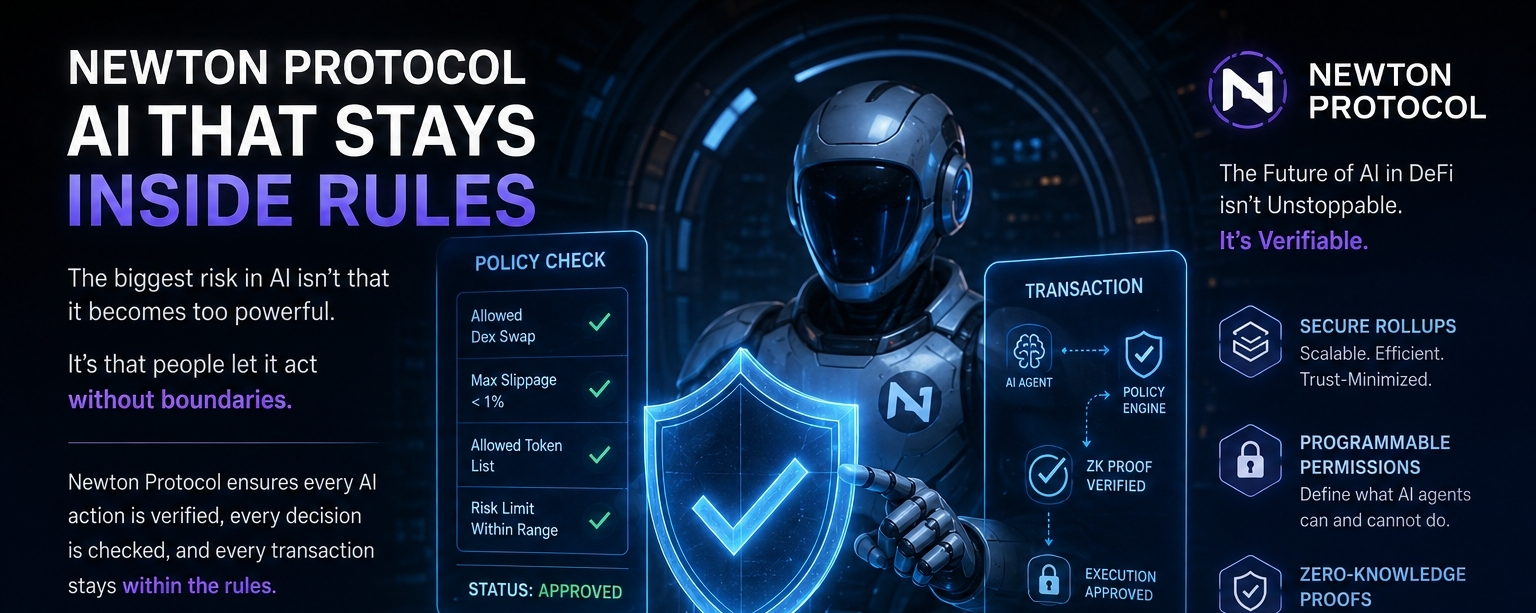
What Newton appears to notice is that automation itself is becoming part of blockchain infrastructure. AI agents making decisions on-chain sounds exciting until you remember that mistakes also scale. An automated system making one bad decision is manageable. An automated system making thousands of bad decisions per minute is something else entirely. Looking at policy enforcement before execution instead of relying only on audits afterward feels like a practical response to that problem. It's not glamorous, but practical ideas often age better than exciting ones.
Of course, every decision comes with trade-offs. Building around permissions, programmable rules, and secure execution might reduce flexibility in some situations. Developers who want complete freedom could see those boundaries as unnecessary friction. On the other hand, removing every restriction hasn't exactly produced a history of flawless decentralized applications either. Sometimes a little structure prevents much bigger problems later. Whether Newton has found the right balance is impossible to know this early.
The harder question has very little to do with technology. Adoption has always been crypto's quiet obstacle. Users rarely migrate just because a network is technically better. Liquidity is stubborn. Developers follow users, users follow applications, and applications often stay where the liquidity already exists. Breaking that loop has defeated plenty of well-funded projects before. Newton won't escape that reality simply because the architecture sounds thoughtful.
I also think people underestimate how difficult AI infrastructure will become once real money starts depending on it. Marketing presentations usually assume intelligent systems behave rationally. Markets don't. People don't. Unexpected situations arrive much faster than software updates. Any project building around AI will eventually face moments where theory collides with behavior no one anticipated. That's where confidence gets tested.
Still, I can't completely dismiss what Newton is attempting. There is something refreshing about focusing less on making AI more powerful and more on making automated behavior easier to trust. That doesn't guarantee success, and it certainly doesn't guarantee adoption, but it feels like a problem worth solving instead of another attempt to win the transaction-per-second race.
I'm still cautious. Experience tends to do that. Crypto has a long history of convincing itself that every new architecture changes everything, right before attention shifts somewhere else. Newton could end up following that same path. Or maybe it quietly builds something useful while everyone is distracted by louder stories.



$NFP