
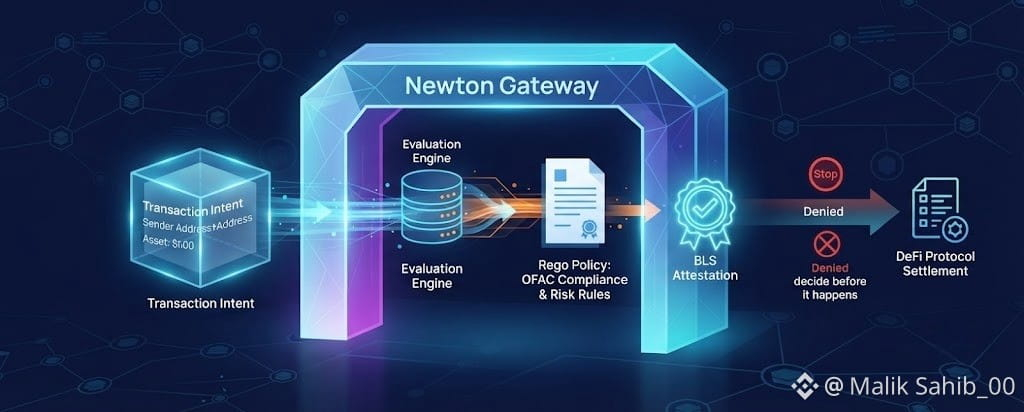
I've explored many blockchain projects over the past few years, but very few made me stop and actually build something before asking me to believe their vision. Newton Protocol was one of those rare exceptions. Instead of reading endless documentation, I decided to follow the Quickstart guide and simulate my first policy evaluation using the TypeScript SDK. I wanted to understand how authorization could happen before a transaction ever reached the blockchain.
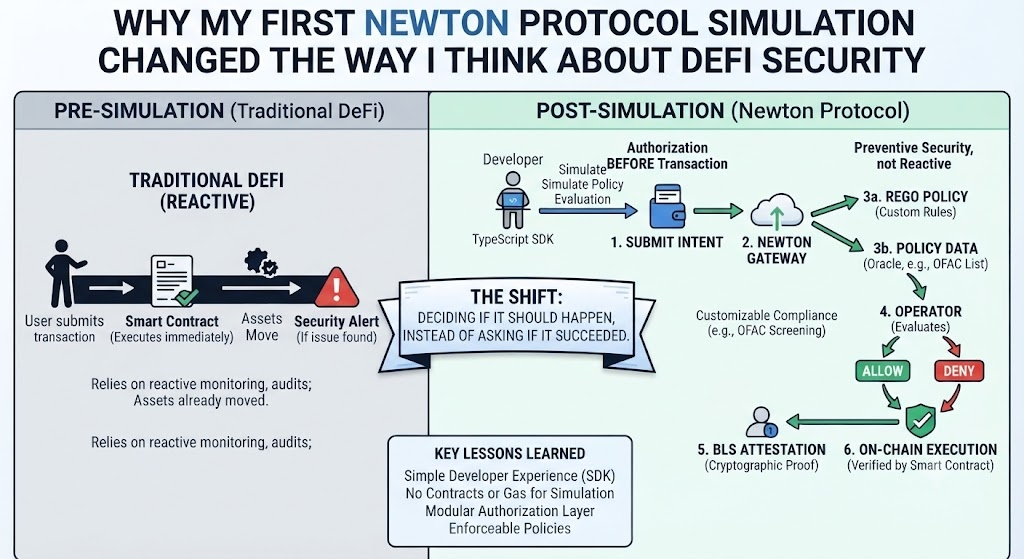
The setup surprised me with its simplicity. After installing the SDK and running the simulation, I wasn't deploying contracts or spending gas. I was simply testing how Newton evaluates a transaction using a policy. The example focused on OFAC sanctions screening, where the sender's address is checked against a sanctions list before the transaction is allowed to continue.
Watching the simulation complete gave me a much clearer understanding than reading technical diagrams ever could. My script submitted an Intent to the Newton Gateway, which forwarded it to an available operator. The operator executed the Rego policy together with PolicyData from the oracle and returned an allow or deny decision. Since it was only a simulation, nothing happened on-chain, yet the entire authorization flow became easy to visualize.
What really convinced me was what happens in production. Instead of returning a simple simulation result, Newton generates a BLS attestation. That cryptographic proof is later verified by a smart contract before any transaction executes. This completely changed how I think about blockchain security. Most systems tell you after something has gone wrong. Newton focuses on deciding whether the transaction should happen at all.
I chose to spend time learning Newton because I believe decentralized finance needs preventive security instead of reactive monitoring. Billions of dollars move through smart contracts every day, and relying only on audits or dashboards isn't enough anymore. Policies should actively enforce rules before assets move.
Another reason I kept experimenting with Newton is its developer experience. I didn't need a complicated local blockchain or multiple deployed contracts to understand the architecture. Within minutes, I had a working simulation that demonstrated the complete authorization lifecycle. That lowered the learning curve significantly and encouraged me to explore deeper concepts like intents, policies, attestations, and operator execution.
After completing the Quickstart, I realized Newton isn't trying to replace existing DeFi protocols. Instead, it introduces an authorization layer that many protocols have been missing. Every transaction can now be evaluated against customizable policies before settlement, making compliance, risk management, and governance far more practical.
My first experience with Newton wasn't about writing hundreds of lines of code. It was about understanding a different philosophy. Instead of asking whether a transaction succeeded, Newton asks whether it should have been allowed in the first place. That single shift in thinking is exactly why I decided to keep learning and building with the protocol.
