
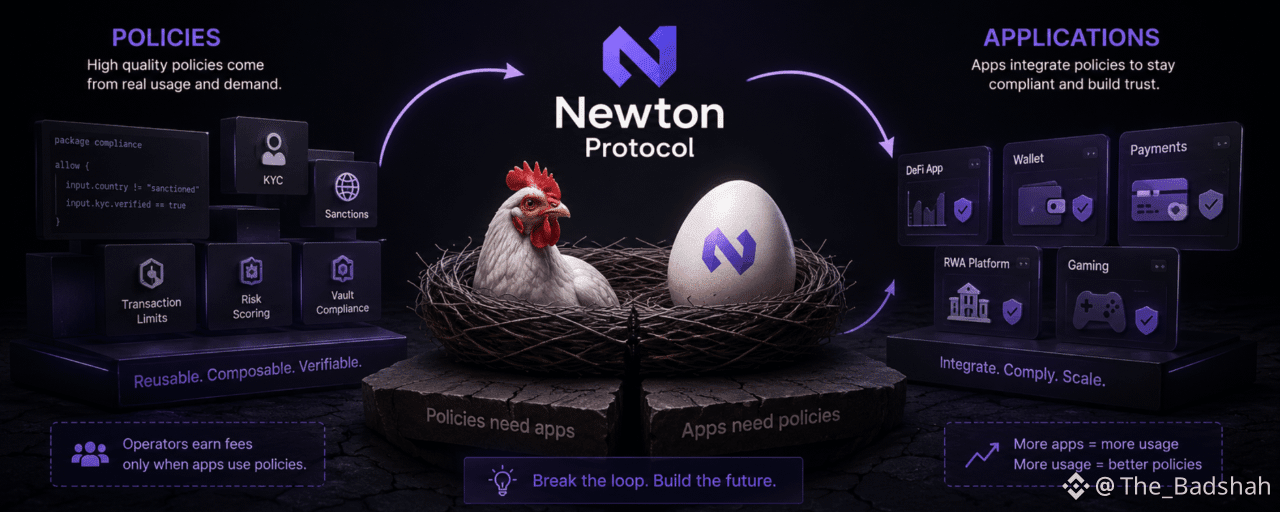

One thing I kept thinking about while reading Newton Protocol's documentation had very little to do with cryptography or compliance. It was adoption.
Newton's idea is straightforward. Developers shouldn't have to build compliance logic every time they launch an application. Instead, they can choose from reusable policy modules and integrate them into their products. That sounds efficient until another question appears. Where do those reusable policies come from if very few applications are using the network in the first place?
It feels similar to opening a new marketplace. Shop owners wait for customers before renting a space. Customers wait for enough shops before visiting. Both sides have a good reason to hesitate.
What caught my attention was that Newton doesn't seem to pretend this problem doesn't exist. The vision is a self-serve ecosystem where developers compose policies like building blocks. The current strategy looks much more practical. The team offers pre-built policies, direct technical support, and even encourages projects to book calls for their first integration. That tells me they understand network effects have to be earned before they become automatic.
The comparison with payment networks makes this even more interesting. Visa is often used as the example of a successful network, but people forget how difficult those businesses were to build. Merchants wanted customers first. Customers wanted merchants first. The cycle only started moving when companies focused on a small, well-defined market instead of trying to serve everyone.
I see the same pattern here. Newton already has access to Magic Labs' wallet ecosystem, which gives it an audience many new protocols don't have. Products like VaultKit also show a narrow starting point instead of a broad promise to solve every compliance problem on day one. Building one successful workflow creates stronger evidence than launching a platform with endless possibilities but very little activity.
Something else stood out during my research. Older sources describe Newton as an AI automation protocol, while the latest documentation puts much more emphasis on authorization and programmable compliance. I don't see that as a contradiction. It looks more like the project has refined where it believes long-term demand will come from. Plenty of successful infrastructure projects have adjusted their positioning before finding product-market fit.
For me, the chicken-and-egg problem isn't a criticism of Newton Protocol. Every network business faces it. What matters is how that gap is crossed. Right now, Newton seems to be doing it the old-fashioned way by helping early partners, focusing on a specific use case, and building real adoption before expecting network effects to appear on their own.
I'm curious whether that approach will eventually create the kind of ecosystem where developers join because the policies already exist, and policy creators contribute because the developers are already there. That's usually the point where infrastructure stops looking like an experiment and starts looking like a standard.
@NewtonProtocol #Newt $NEWT $BIRB $TAIKO