
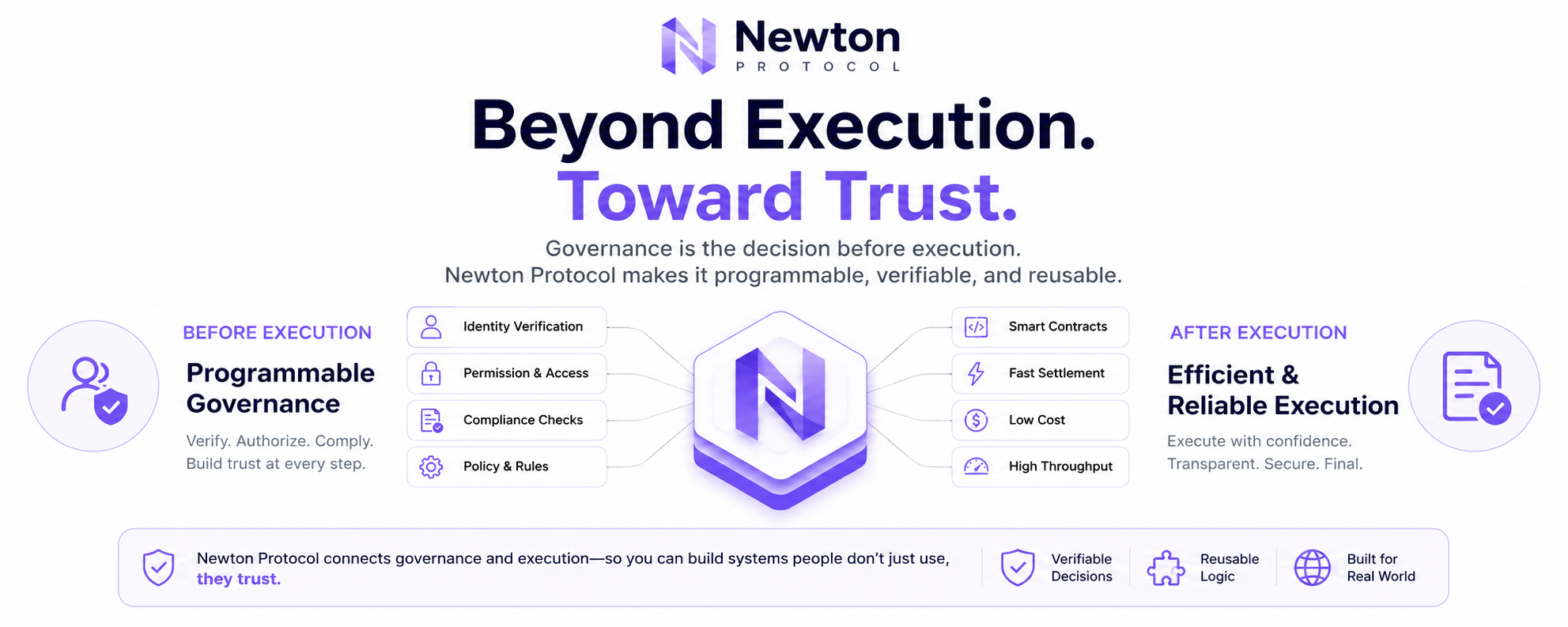
Most discussions about blockchain begin with performance. Faster finality, lower fees, higher throughput, better virtual machines. Every new protocol seems eager to prove that it can execute transactions more efficiently than the last. For years, that made perfect sense. The industry was still solving engineering problems, and engineering naturally became the benchmark for success.
But I have started wondering whether we are measuring the wrong thing.
History suggests that technologies rarely become mainstream because they become slightly faster. They become indispensable because they become more trustworthy. Speed attracts early adopters. Confidence attracts institutions.
That distinction feels increasingly important as blockchain moves beyond speculative assets and into industries where every transaction carries legal, financial, or regulatory consequences.
Think about how businesses actually operate.
A payment is rarely just a payment. Before money moves, someone verifies identities. Someone checks permissions. Someone ensures compliance with local regulations. Someone confirms that the parties involved are authorized to participate. These decisions happen before software ever executes.
Yet when people evaluate smart contracts, most conversations begin after those decisions have already been made.
Execution has become the headline.
Governance remains the footnote.
That imbalance may have made sense during crypto's early years, but it becomes harder to defend as decentralized infrastructure starts supporting lending markets, institutional finance, tokenized assets, payroll systems, and global supply chains.
The more valuable the transaction becomes, the more valuable the decision behind that transaction becomes as well.
This is where Newton Protocol caught my attention.
Not because it promises another generation of smarter contracts. Every cycle introduces projects that claim to improve execution in one way or another. What feels different is the possibility that Newton is addressing something that has quietly remained outside the blockchain conversation for years.
Governance itself.
More specifically, programmable authorization.
Today's smart contracts are remarkably reliable at following predefined instructions. Once the conditions inside the contract are satisfied, execution happens exactly as intended. That reliability is one of blockchain's greatest strengths.
But those conditions rarely appear out of nowhere.
Before execution, somebody already decided who qualifies, who has access, what rules apply, and whether a transaction should happen in the first place.
Those decisions usually live outside the chain.
Banks maintain compliance databases. Enterprises operate identity management systems. Governments issue licenses and certifications. Financial institutions spend enormous resources maintaining approval processes that differ across jurisdictions.
Blockchain has optimized execution.
It has not fully optimized decision-making before execution.
Imagine two organizations launching nearly identical tokenized financial products.
Their smart contracts perform equally well. Security audits are successful. Settlement is efficient. Costs remain competitive.
Yet one institution spends months rebuilding governance workflows every time regulations change or it enters a new market. The other relies on reusable authorization logic that can adapt while remaining transparent and verifiable.
From the user's perspective, both applications may appear almost identical.
Operationally, they are worlds apart.
That difference may not produce dramatic headlines, but it could produce meaningful long-term advantages.
Developers have spent decades building reusable software components because solving the same engineering challenge repeatedly is inefficient. Governance, however, has rarely benefited from that philosophy.
Every organization creates its own permission models.
Its own approval chains.
Its own compliance procedures.
Its own identity verification framework.
Much of that effort is duplicated across industries.
Perhaps the next efficiency breakthrough is not executing contracts faster.
Perhaps it is avoiding the need to rebuild trust every time a new application is deployed.
Of course, that introduces difficult questions.
Governance inevitably creates friction.
Crypto has traditionally celebrated permissionless participation, while institutions often require layers of verification before allowing assets to move. Those priorities do not always align comfortably.
Developers may view additional governance as unnecessary complexity.
Users may prefer convenience over stronger controls until a costly mistake exposes the value of those controls.
Privacy introduces another challenge.
Effective authorization frequently depends on sensitive information. Public blockchains prioritize transparency. Finding a balance between verifiable governance and confidential data is considerably more difficult than describing it in theory.
Too little privacy discourages enterprises.
Too much privacy may discourage regulators.
Neither outcome represents an ideal solution.
Technology alone also cannot guarantee adoption.
Infrastructure evolves gradually.
Organizations rarely replace governance systems overnight. Instead, they integrate new capabilities one process at a time, often beginning with the least disruptive workflows before expanding into more critical operations.
That slow pace can make infrastructure projects appear unremarkable for years.
Then, almost without warning, they become foundational.
Whether Newton Protocol reaches that point remains uncertain.
What interests me is not the prediction itself but the possibility that it represents.
If governance becomes programmable, reusable, and verifiable, blockchain projects may eventually compete on entirely different criteria.
Execution quality will still matter.
Security audits will still matter.
Performance will always matter.
But confidence in how decisions are made before execution could become equally important.
That would represent a meaningful shift in how decentralized systems are evaluated.
Developers may continue refining elegant code, as they should.
Institutions, however, may increasingly reward systems that reduce operational uncertainty rather than simply reducing transaction latency.
The contract that executes the fastest is not always the contract people trust the most.
As blockchain matures, those two qualities may no longer be treated as the same thing.
And if that happens, the future of smart contracts may depend less on how efficiently they execute instructions and more on how intelligently they establish trust before execution ever begins.