
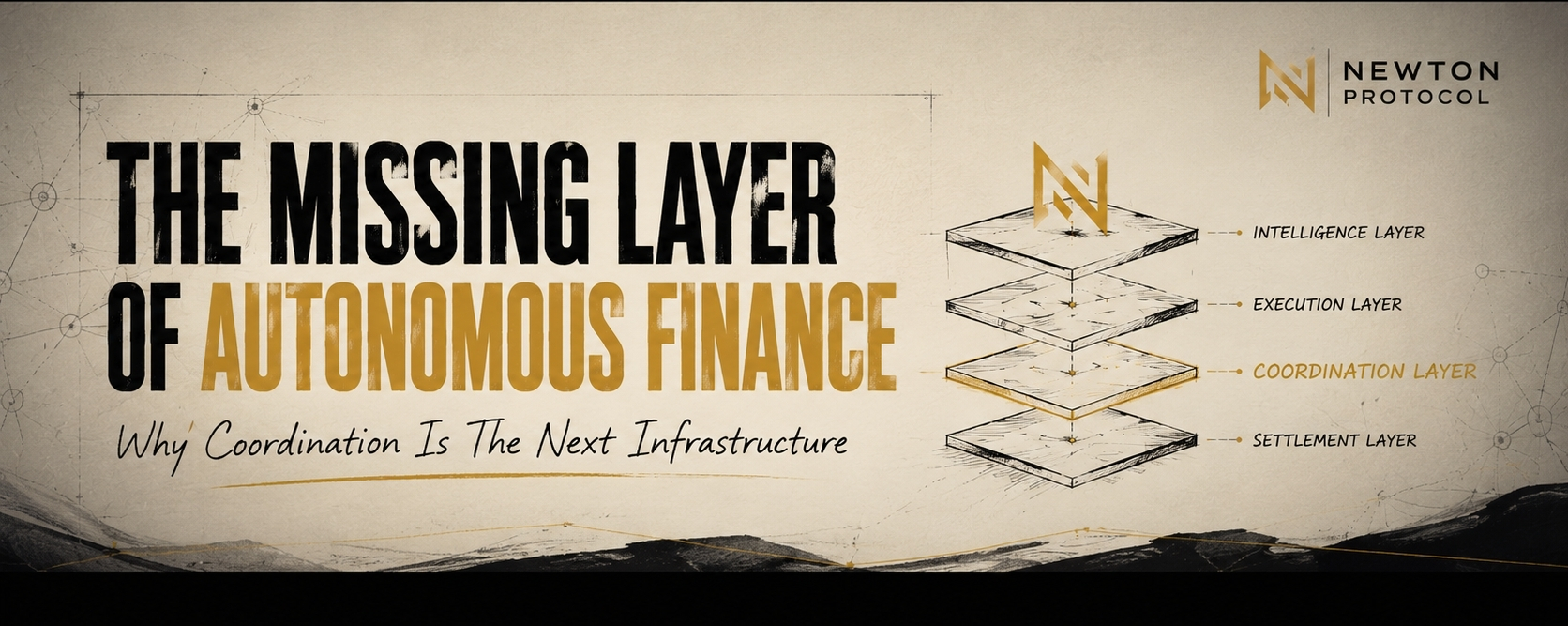
The more I explored autonomous finance, the more one question refused to leave my mind.
Every new breakthrough promised smarter systems.
Better models.
Faster execution.
More capable autonomous agents.
For a while, that felt like the entire story.
If autonomous systems continued becoming more intelligent, wouldn't the ecosystem naturally become stronger as well?
It sounded like a reasonable assumption.
Yet the bigger the ecosystem became, the less complete that explanation started to feel.
Not because intelligence was the wrong direction.
But because intelligence alone could never explain what happens between independent systems.
That single observation quietly changed the way I started looking at autonomous infrastructure.
For a long time, I believed the next generation of decentralized finance would emerge simply by making autonomous systems smarter.
The logic seemed straightforward.
If every participant could reason better, react faster, and make more informed decisions independently, the entire network should naturally become stronger.
But the deeper I explored that assumption, the more another question replaced it.
What happens when independent systems have to work together?
That question appears simple.
The answer is not.
A remarkable decision inside one autonomous system does not automatically become a remarkable outcome for the ecosystem around it.
Every participant may optimize perfectly for its own objective.
Every decision may be rational.
Every action may be technically correct.
Yet the collective result can still become fragmented.
Because decisions are made individually.
Outcomes are created collectively.
That distinction became impossible to ignore.
The real challenge was no longer improving intelligence inside a single system.
The real challenge was understanding what happens when many intelligent systems must coexist, interact, and coordinate without sharing identical assumptions.
Capability makes individual systems stronger.
Coordination makes an ecosystem possible.
That realization completely changed the direction of my thinking.
For the first time, I stopped asking how intelligent autonomous systems could become.
Instead, I found myself asking a different question.
How can independent autonomous systems remain autonomous while still creating shared outcomes?
That single question changed the way I viewed the entire ecosystem.
At first, the answer still seemed obvious.
Build smarter autonomous systems.
Improve reasoning.
Increase execution efficiency.
Refine decision-making.
Everything else should naturally follow.
It sounds logical.
Until intelligence is no longer confined to a single participant.
Autonomous finance is not built around one intelligent system.
It is built around many.
Each operating independently.
Each pursuing different objectives.
Each following different policies.
Each interpreting the same environment through a different set of assumptions.
That is where the real challenge begins.
Not inside intelligence.
But between intelligences.
The hardest failures are rarely created by bad decisions.
They often emerge when good decisions fail to work together.
A system can reach the correct conclusion and still contribute to a fragmented ecosystem.
Not because it failed to think.
But because every other participant was thinking differently.
The more I reflected on that contradiction, the more one realization became impossible to ignore.
An ecosystem does not become intelligent simply because every participant becomes more intelligent.
It becomes intelligent when independent participants can create shared understanding without sacrificing their independence.
That may be the difference between isolated capability and collective progress.
Perhaps the next stage of autonomous finance is not another race toward smarter autonomous systems.
Perhaps it is a transition toward coordinated intelligence.
A future where independent systems continue making their own decisions, yet remain capable of producing meaningful outcomes together.
That was the point where I stopped evaluating projects only by the intelligence they promised.
I started paying closer attention to the infrastructure that could make independent intelligence work collectively.
That shift completely changed what I was looking for.
From that point forward, I found myself evaluating autonomous infrastructure from a completely different perspective.
I was no longer searching for projects that simply promised smarter autonomous systems.
I became interested in projects asking a different question.
How can independent systems coordinate without sacrificing autonomy?
That was the moment @NewtonProtocol caught my attention.
Not because it promised more intelligent autonomous systems.
But because it approached a different layer of the problem.
A layer that exists between independent participants.
A layer where policies, coordination, and shared understanding become just as important as intelligence itself.
The more I explored that perspective, the clearer one realization became.
Autonomous finance may never be limited by a shortage of intelligence.
It may instead be limited by a shortage of structured coordination.
Because intelligence can continue improving indefinitely.
Without a shared framework for interaction, however, every improvement remains local rather than collective.
The challenge is no longer teaching autonomous systems how to think.
The challenge is enabling independently intelligent systems to move in compatible directions while preserving their autonomy.
That is a fundamentally different problem.
And solving a different problem requires a different kind of infrastructure.
The longer I reflected on this shift, the less I believed autonomous finance was simply evolving toward smarter systems.
It may be evolving toward something far more demanding.
Not building intelligence.
Building alignment.
Because intelligence can exist independently.
An ecosystem cannot.
An ecosystem only becomes meaningful when independent participants are capable of producing outcomes together.
Perhaps that is the missing layer autonomous finance has been moving toward all along.
The future may not be shaped by intelligence alone.
It may be shaped by how intelligence learns to cooperate.
That realization left me with a different question.
Not:
How intelligent can autonomous systems become?
But:
How intelligently can autonomous systems work together while remaining truly autonomous?
Perhaps the next breakthrough will not come from teaching machines to think more efficiently.
Perhaps it will come from enabling independently intelligent systems to understand one another, coordinate naturally, and move forward together.
There was a time when I believed the future of autonomous finance would be decided by intelligence alone.
I'm no longer convinced that's the whole story.
The more I explore this space...
The more I return to one simple question.
When autonomous systems become intelligent enough to act independently...
Will the future be defined by how well they think...
Or by how well they learn to work together?
The answer may not arrive overnight.
It may emerge gradually, as autonomous systems become more capable, more connected, and increasingly responsible for decisions that extend beyond a single participant.
That is why coordination feels less like an additional feature and more like foundational infrastructure.
It is the layer that transforms individual capability into collective progress.
The conversation around autonomous finance is no longer only about building systems that can operate independently.
It is becoming a conversation about building an ecosystem where independence and cooperation can exist at the same time.
Perhaps that is the real evolution taking place.
Not replacing intelligence.
Giving intelligence a common language for interaction.
The strongest ecosystems of the future may not be the ones with the smartest individual participants.
They may be the ones where independently intelligent systems can understand one another, adapt together, and create outcomes that no single participant could achieve alone.
That possibility is what continues to make this space worth exploring.
Because every major technological shift eventually reaches a point where individual capability is no longer enough.
The next leap comes from connection.
Maybe autonomous finance is approaching that moment now.
And maybe the question that matters most is no longer how intelligent our systems can become.
Maybe the better question is whether they can grow intelligent enough to move forward together.
The future may not belong to the systems that think the fastest.
It may belong to the systems that learn how to think together.