
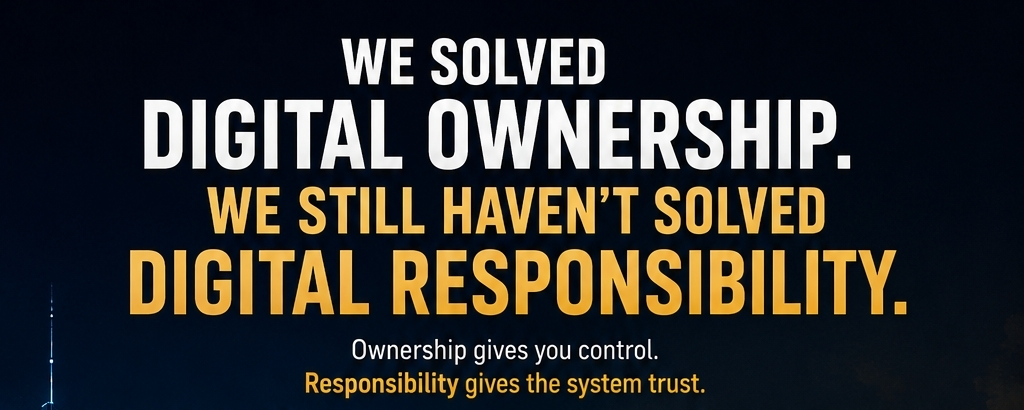
The more I think about it, the more I feel crypto answered one question while quietly avoiding another. We proved that people can truly own digital assets without relying on intermediaries. That was a remarkable shift. But somewhere along the way, ownership became the destination instead of the beginning. We celebrated control over assets without asking what happens when that control starts making decisions that affect everyone else.
For a long time, I assumed ownership naturally created responsibility. If you control the wallet, you bear the consequences. Simple. Lately, that assumption feels incomplete. The moment I look at institutions, autonomous AI agents, DAOs, and even multi-chain ecosystems, responsibility becomes strangely difficult to locate. Everyone owns something, yet accountability seems increasingly distributed across systems, software, governance processes, and invisible assumptions that no single participant actually controls.
That realization made me reconsider what decentralization has quietly optimized for. We often describe it as removing trusted intermediaries, but perhaps what it really removed was the familiar place where responsibility used to live. Banks, brokers, platforms, and custodians didn't just move assets. They also carried the burden of explaining, approving, rejecting, or absorbing consequences. Blockchain replaced ownership. It never fully replaced that coordination.
Halfway through thinking about this, I noticed something else. Maybe responsibility isn't an individual property anymore. Maybe it's becoming infrastructural.
Projects like Newton Protocol feel interesting for that reason alone. Not because they promise another layer in crypto's growing stack, but because they seem to reflect an uncomfortable market realization. As financial activity becomes increasingly automated and globally distributed, responsibility can no longer depend on a single institution, a single jurisdiction, or even a single human decision. It has to emerge from shared systems that different participants can independently trust without needing to trust one another personally. �
Newton_Protocol_Whitepaper.pdf
What's fascinating is how AI accelerates this tension. An autonomous agent doesn't experience hesitation, reputation, or social pressure the way humans do. It follows incentives with remarkable consistency. That sounds efficient until you realize efficiency amplifies every ambiguity embedded inside the rules themselves. If responsibility isn't clearly expressed before execution begins, intelligence simply scales uncertainty faster than humans ever could.
That changed how I think about infrastructure. I used to believe infrastructure existed to move information or capital more efficiently. Increasingly, it feels like its deeper purpose is reducing ambiguity before information or capital moves at all. Those aren't the same thing. Faster systems don't necessarily create better markets. Clearer expectations often do.
Maybe that's why conversations around trust, verification, and coordination are becoming more important than conversations around ownership itself. Ownership answers the question of who controls the asset. Responsibility asks something much more difficult: who carries the consequences when increasingly autonomous systems begin acting on behalf of that owner?
I'm not convinced the industry has solved that question yet. In fact, I suspect we're only beginning to notice it because ownership finally works well enough that its hidden counterpart has become impossible to ignore. Perhaps the next chapter of Web3 won't be remembered for giving people more control. It may be remembered for quietly redefining what control actually requires.