
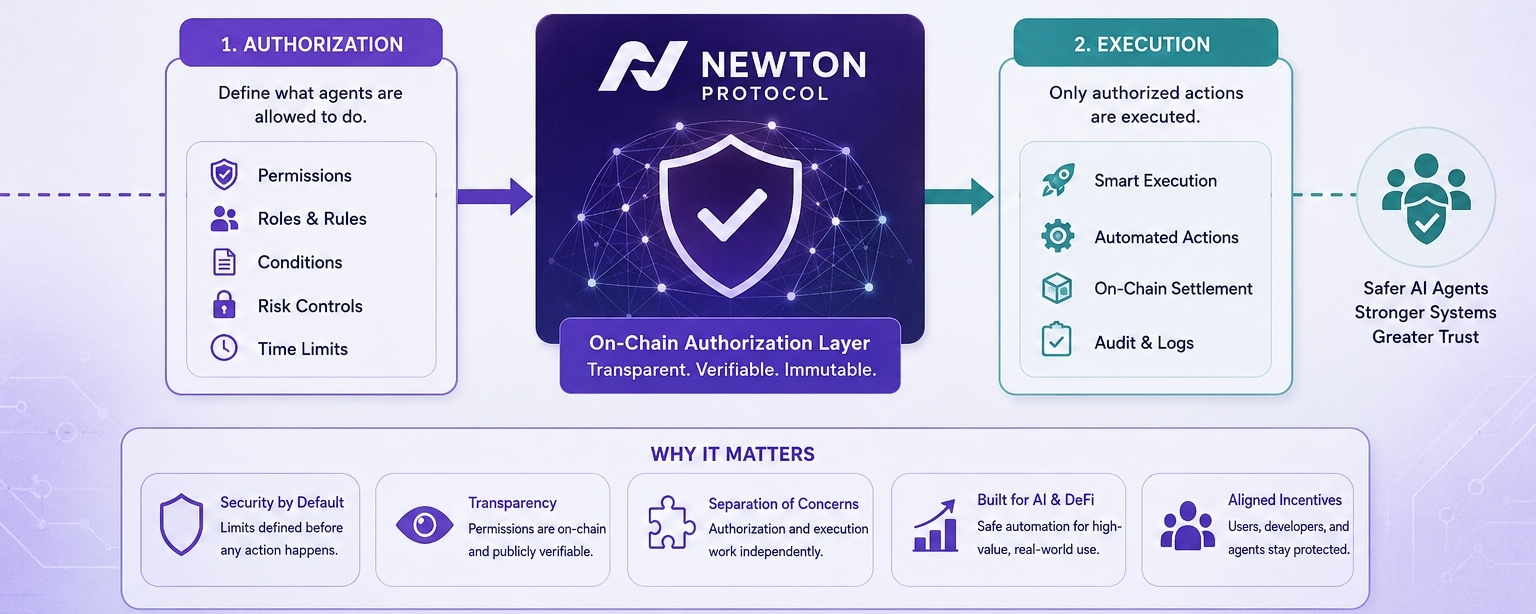

I was reading more about Newton Mainnet Beta today, and I found myself spending less time thinking about transaction speed and more time thinking about permission. That surprised me because most blockchain discussions eventually drift toward throughput, lower fees, or bigger numbers. Newton Protocol seems to nudge the conversation somewhere else. I kept looking at the way it separates authorization from execution, and I couldn't help wondering whether that design choice could become more important than raw performance over time. Looking from the outside, it feels like an attempt to acknowledge that intelligent systems will eventually need clear boundaries instead of unlimited freedom. I'm not completely sure if that assumption will prove correct, but it makes me think about where decentralized infrastructure might actually be heading.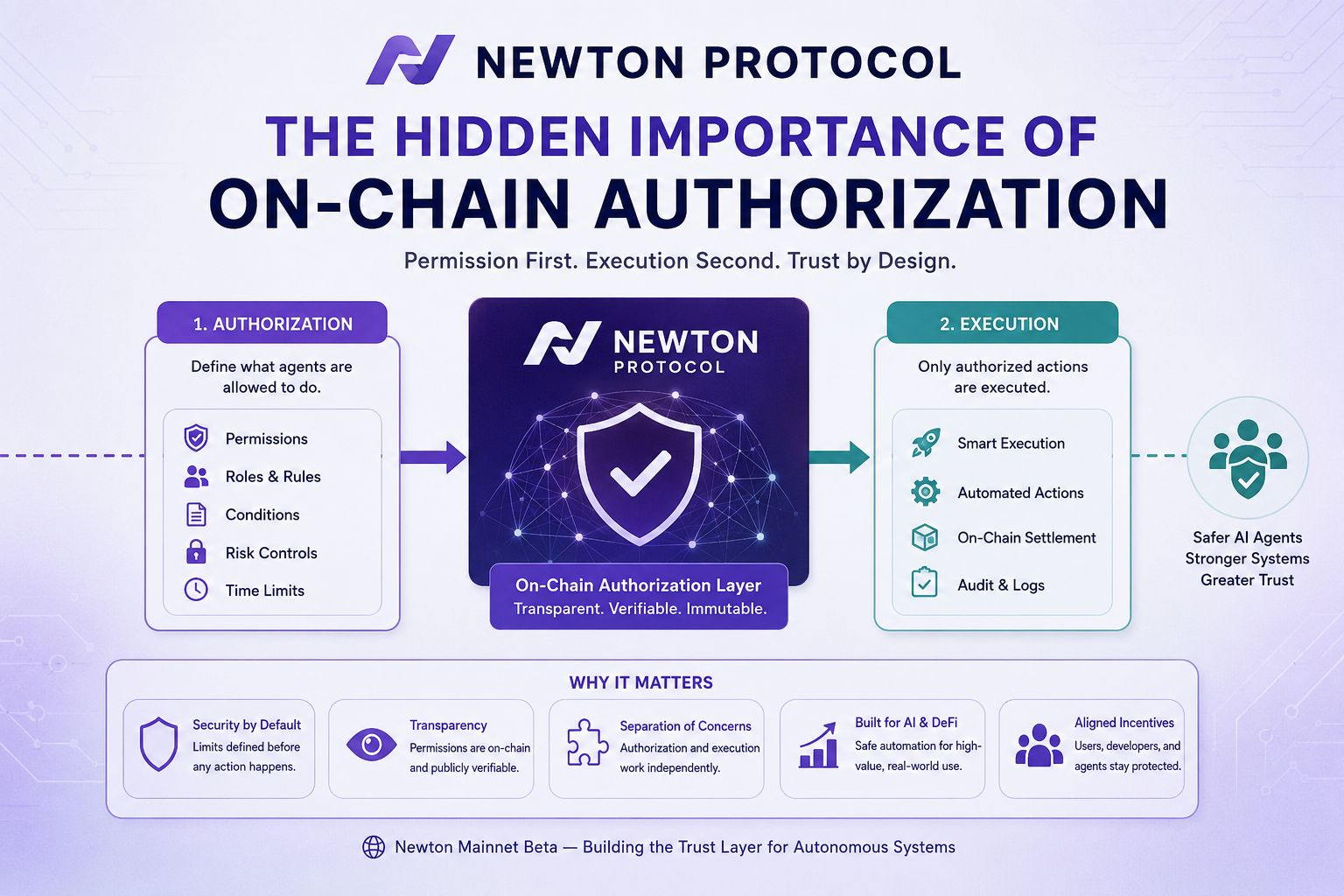
What seems interesting is that Newton Mainnet Beta doesn't appear to treat AI agents as independent decision-makers that should simply be trusted once deployed. Instead, there seems to be an effort to define exactly what an agent is permitted to do before any action is executed. That distinction feels subtle at first, yet the more I thought about it, the more meaningful it seemed. If automated systems begin handling assets, contracts, or everyday financial decisions, isn't the question of permission just as important as the question of execution? I sometimes wonder whether many existing systems quietly assume that automation itself is enough, while Newton Protocol seems to ask whether automation without explicit authorization is actually sustainable. Maybe that difference only becomes visible when these systems are used under real pressure rather than in controlled environments.
At the same time, I don't think separating authorization from execution automatically solves every problem. Every additional layer of control can also introduce additional complexity. The question that comes to mind is whether developers and users will naturally adapt to a framework that asks them to define rules before actions happen. Will they see that process as valuable, or will they consider it unnecessary friction? I'm not completely sure. Looking from the outside, there always seems to be a delicate balance between stronger security and a smoother user experience. History shows that people usually prefer convenience until something goes wrong, yet overly restrictive systems often struggle to gain adoption as well. That contradiction feels impossible to ignore. Perhaps Newton Mainnet Beta is trying to find a middle ground, but whether that balance holds outside testing environments remains uncertain.
Another thought stayed with me while I was reading. We often describe AI as something that will eventually manage increasingly complex digital activities, yet very little attention seems to be given to who defines the limits of those actions. Newton Protocol appears to place those boundaries closer to the protocol itself instead of leaving everything to external trust or manual oversight. It makes me think about whether infrastructure like this could quietly become more important than the applications built on top of it. After all, if confidence in autonomous systems eventually depends on transparent permissions rather than promises, wouldn't the underlying framework deserve just as much attention as the AI itself? Or is that giving infrastructure more credit than it ultimately deserves?
I also find myself wondering how this architecture will evolve once more developers begin experimenting with it. Test environments often reveal ideas that look elegant in theory but require unexpected compromises in practice. Sometimes entirely different challenges emerge only after thousands of independent users interact with a system in unpredictable ways. Newton Mainnet Beta feels like it's entering exactly that stage, where assumptions begin meeting reality. That doesn't necessarily point toward success or failure, but it does make the next phase more interesting to observe.
For now, the overall structure feels carefully designed, yet its long-term impact will probably depend on how people choose to use it rather than how impressive it appears on paper. Maybe that is the real test ahead... anyway, time will tell👍
