@NewtonProtocol Everyone's talking about AI in crypto right now.
AI trading bots. AI portfolio managers. AI agents that can interact with apps on your behalf. Every week there's another project promising that AI will handle everything while you sit back and watch.
Sounds great.
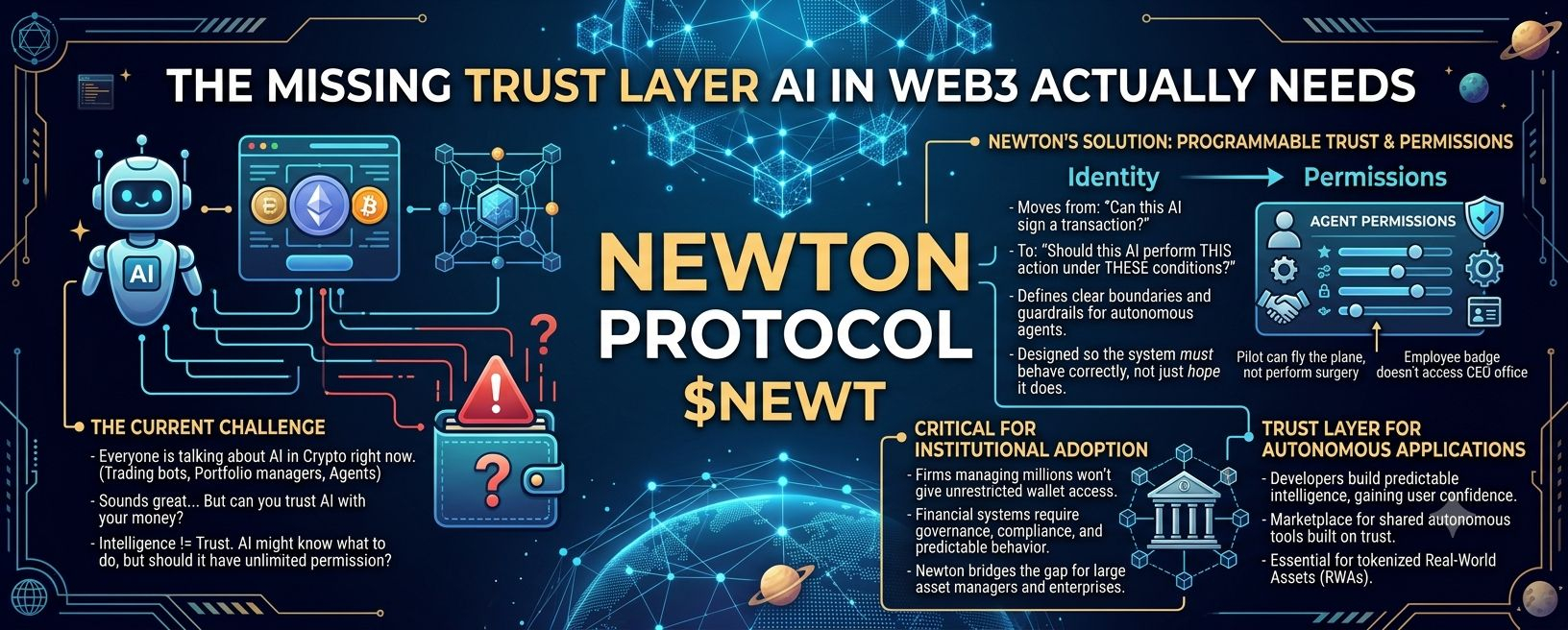
But here's the thing nobody talks about enough: can you actually trust AI with your money?
Honestly, that's the real question. Not how smart the AI is. Not how fast it makes decisions. Just... should it have that much power in the first place?
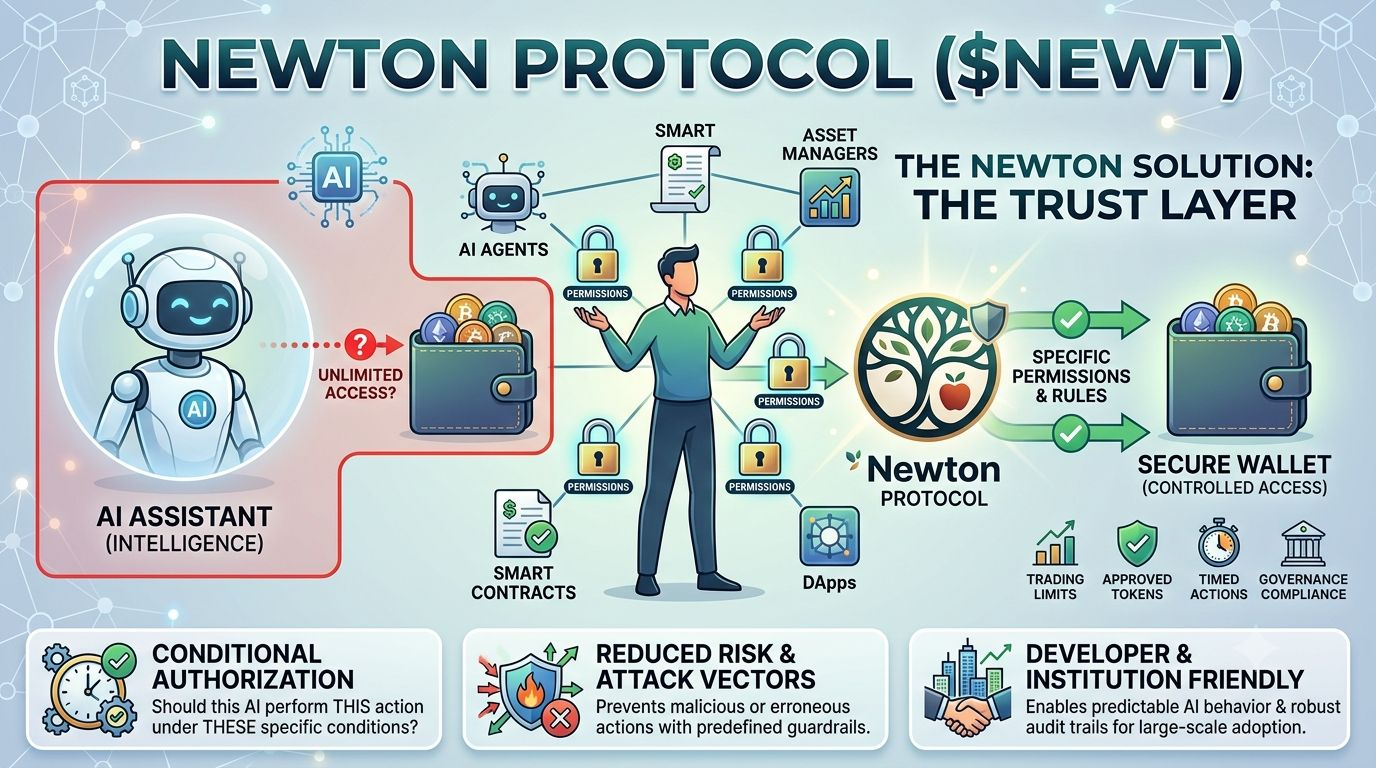
That's exactly the problem Newton Protocol ($NEWT) is trying to solve.
Look, AI is getting really good at making decisions.
It can scan markets around the clock, spot opportunities in seconds, rebalance portfolios automatically, and react much faster than any human ever could.
That's impressive.
But intelligence doesn't automatically equal trust. People mix those two up all the time.
An AI might know what to do.
That doesn't mean it should have unlimited permission to do it.
And once you start talking about real money on-chain, that difference suddenly matters a lot.
Think about your own house.
Giving someone your house keys doesn't mean you're okay with them opening every drawer, moving your furniture, or inviting strangers inside.
The key gets them through the front door.
Common sense tells them what comes next.
Or think about work.
Your employee badge lets you into your office.
It doesn't magically give you access to the CEO's office or the company's financial records.
Same story with pilots.
They can fly a commercial jet carrying hundreds of passengers.
Nobody expects them to perform surgery halfway through the flight.
See the pattern?
Identity tells people who you are.
Permissions decide what you're allowed to do.
That's how every system in the real world works.
Blockchain, though, works a little differently.
A wallet signature proves ownership.
That's it.
It doesn't ask whether the action makes sense.
It doesn't ask whether the AI is acting inside limits you originally intended.
And honestly... that's where things get tricky.
Right now, a lot of AI-powered trading systems work with a pretty dangerous assumption.
Once the AI gets wallet access, it often gets access to almost everything.
That might be fine when you're experimenting with a small wallet.
Who cares if you're testing with fifty bucks?
But imagine an institution managing millions.
Completely different conversation.
What happens if the AI reads bad data?
What if someone manipulates the information it's using?
What if the software hits a bug?
Or someone slips a malicious instruction into the workflow?
These aren't imaginary scenarios. I've seen enough technology cycles to know that mistakes always happen eventually.
The problem with blockchain is simple.
You usually don't get a second chance.
Once a transaction lands on-chain, that's the end of the story.
No undo button.
Now zoom out for a second.
Where's all of this heading?
We're moving toward a world where thousands—maybe even millions—of AI agents operate across blockchain networks.
Some will trade.
Some will manage liquidity.
Others will rebalance portfolios, execute investment strategies, buy digital assets, or interact with decentralized applications without anyone clicking a button.
Sounds exciting.
It also sounds like a nightmare if nobody builds proper guardrails.
People love talking about smarter AI.
I think smarter permissions matter just as much.
Maybe even more.
That's where Newton Protocol comes in.
And honestly, I like the way it frames the problem.
Instead of asking a simple question like:
"Can this AI sign a transaction?"
Newton asks something much more important:
"Should this AI perform this specific action under these specific conditions?"
Small wording.
Huge difference.
Instead of giving an AI unlimited authority, you define clear boundaries around what it can actually do.
That changes the entire trust model.
You're no longer hoping the AI behaves correctly.
You're designing the system so it has to.
I think that's especially important because crypto isn't just building for crypto anymore.
Institutions are showing up.
Real-world assets keep moving on-chain.
Large asset managers want automation.
Financial firms want AI.
But none of them will hand billions of dollars to software with unrestricted wallet permissions.
Let's be real.
That would never pass internal risk reviews.
These firms already live inside governance rules, compliance frameworks, approval processes, and audit requirements.
Automation has to fit inside those rules.
Not replace them.
Newton Protocol tries to give them that missing layer.
Developers run into the exact same issue.
Building AI applications is getting easier every month.
Building trustworthy AI?
That's the hard part.
If you're creating an AI trading strategy, users need confidence that it won't suddenly decide to do something completely unexpected.
If you're building autonomous blockchain applications, they need predictable behavior.
And if there's going to be an AI marketplace where developers share autonomous tools, trust becomes even more important.
Nobody wants software that has unlimited power over their assets.
People want control.
They just don't want to manage every tiny action themselves.
That's the balance Newton is aiming for.
For everyday users, the benefits feel pretty obvious.
You shouldn't have to wonder whether an AI suddenly has access to everything in your wallet.
You should know exactly what it's allowed to do.
That's how trust works.
Not through assumptions.
Through rules.
Here's something people often overlook.
History usually rewards infrastructure more than flashy applications.
The internet exploded because networking standards worked.
Cloud computing took off because reliable infrastructure already existed underneath it.
Global payments became normal because companies built trusted payment networks long before people thought about tapping a phone to buy coffee.
Infrastructure rarely gets the headlines.
But it quietly carries everything else.
I think AI in Web3 is heading down the same path.
Everyone's chasing smarter models.
Bigger agents.
Better automation.
That's exciting.
But somebody still has to answer the uncomfortable question:
How do you keep autonomous software accountable?
That's the piece Newton Protocol focuses on.
Not building another AI assistant.
Not competing with every chatbot.
Building the trust layer underneath autonomous finance itself.
This becomes even more important when you think about tokenized real-world assets.
Banks.
Investment firms.
Payment providers.
Large enterprises.
These organizations already understand automation.
What they don't accept is uncontrolled automation.
There's a big difference.
Reliable systems always beat unpredictable ones.
Every time.
I also think developers will appreciate this approach over time.
If you're building autonomous applications, you don't just want intelligence.
You want predictable intelligence.
You want users to know your application operates inside clearly defined limits.
That makes adoption easier.
It builds confidence.
And confidence is usually what separates interesting technology from technology people actually use.
The easiest comparison might be Visa.
Visa never tells you what to buy.
It doesn't make financial decisions for you.
It provides the infrastructure that allows billions of transactions to happen safely every year.
People trust the network because they trust the rules behind it.
Newton Protocol wants to build something similar for autonomous AI operating inside Web3.
Not smarter intelligence.
Better trust.
Those aren't the same thing.
At the end of the day, I don't think the biggest winners in AI-powered crypto will simply build the smartest agents.
Somebody else will always build a smarter model next year.
The projects that last will probably build the systems people feel comfortable trusting with real value.
That's a much harder problem to solve.
The first generation of blockchain proved decentralized networks could manage digital assets.
The next generation has a different challenge.
Can autonomous AI manage those assets responsibly?
That's the question Newton Protocol is trying to answer.
And honestly, I think that's one of the most important infrastructure conversations happening in Web3 right now.