
The first time I read about AI agents handling financial decisions, my reaction was probably the same as everyone else's.
The technology sounded impressive.
The idea of software reacting faster than humans, managing positions around the clock and removing emotional decisions from the process seemed difficult to argue against.
After a while though, I found myself thinking about a completely different problem.
Not performance.
Not speed.
Responsibility.
Traditional finance spends an enormous amount of time deciding who is allowed to do what. There are approval flows, spending limits and controls that often feel frustrating until the day they prevent a mistake.
Crypto never really developed that habit.
Most systems care whether a transaction is valid. Very few care whether it should happen in the first place.
That difference feels small on paper.
I don't think it stays small once automated systems start interacting with larger amounts of capital.
An agent following instructions perfectly can still create a bad outcome if the instructions themselves are wrong or the surrounding conditions change faster than expected.
The more I thought about it, the less this started looking like an intelligence problem.
It started looking like a permissions problem.
That was the point where Newton finally began to make sense to me.
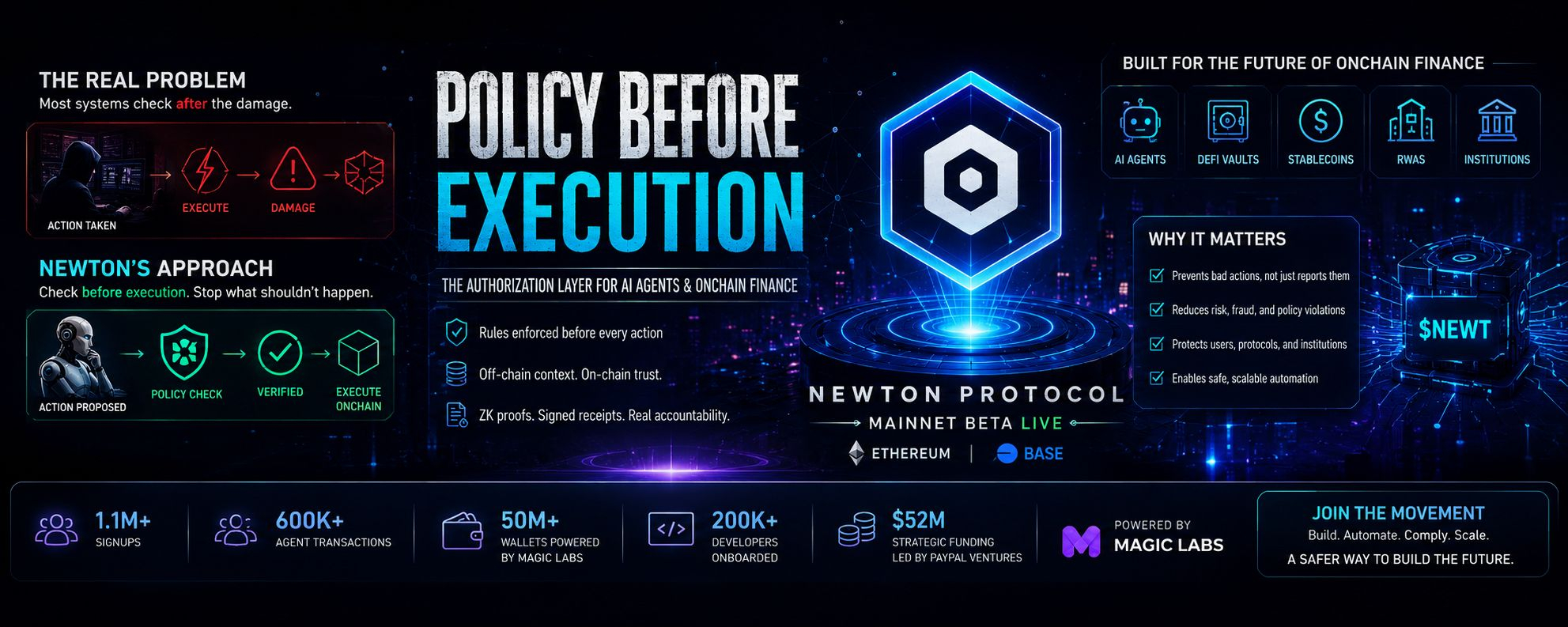
The protocol sits in front of the transaction rather than behind it.
Instead of waiting for a mistake and dealing with the consequences afterwards, the idea is to evaluate the action before anything reaches settlement.
That changes the conversation.
The discussion moves away from recovery and towards prevention.
Maybe the destination wallet requires additional approval.
Maybe a policy has changed.
Maybe a jurisdiction restriction suddenly matters.
The reason almost becomes secondary.
The important part is that there is still an opportunity to stop and ask whether the action belongs inside the rules that were originally agreed upon.
That approach feels surprisingly familiar.
Banks do it.
Payment processors do it.
Large companies do it internally every day.
Crypto mostly decided to skip directly to automation.
Newton seems to be arguing that automation without boundaries is not really progress.
It is just acceleration.
The timing probably matters as well.
AI agents are becoming more capable every year and the industry seems increasingly comfortable with giving software access to financial tools that used to require human approval.
Eventually those systems will need rules that are enforceable rather than optional.
Otherwise trust becomes entirely dependent on the person operating the system.
Maybe that is enough for small experiments.
It probably isn't enough for institutions.
I still think most people entering AI finance are paying attention to the intelligence layer.
Newton appears more interested in the decision layer sitting underneath it.
Personally, I suspect that layer ends up becoming more important than people expect.
Not because it is exciting.
Because the boring parts of financial infrastructure usually matter the most when things stop going according to plan.