
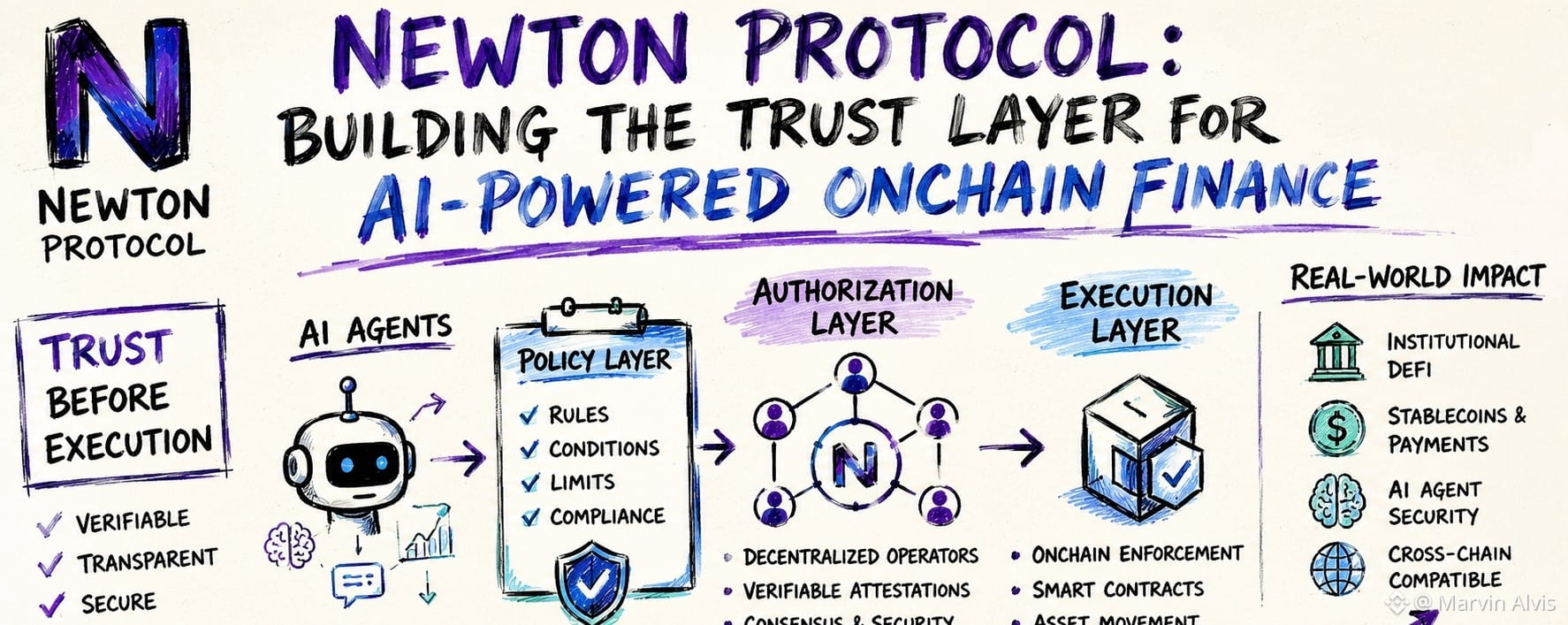
I've been watching Newton Protocol for a while, and the part that keeps pulling me back is how stubbornly it focuses on permission. Not trading. Not hype. Permission. The project keeps coming back to the same idea: before money, agents, or vaults move, there should be a clear rule about whether they’re allowed to move at all. That sounds simple until you try to do it onchain, where smart contracts usually know very little about the world outside the chain. Newton’s own materials frame that gap as the problem they’re trying to close.
A project built around authorization, not just execution
Newton describes itself as an authorization layer for onchain finance, and that wording matters because it tells you where the project thinks the missing piece is. The whitepaper says onchain finance now moves hundreds of billions of dollars each month, but that transaction authorization still happens offchain or not at all; it also lays out a “Visa-like” authorization model, a Rego/OPA policy engine, EigenLayer-backed security, and cross-chain design as the core of the system. Binance Research independently described the project as a decentralized infrastructure layer for verifiable onchain automation and secure agent authorization.
That framing is more serious than the usual “AI + crypto” pitch. Newton is not just saying agents should be able to do things automatically. It is saying they should do them only when the right conditions are met, and that those conditions should be checked in a way users can verify. The docs are blunt about why this matters: smart contracts are blind to offchain context such as sanctions status, hallucinating AI agents, or corporate spending rules, and frontend filters or centralized API checks are easy to bypass.
What the stack actually does
The cleanest way to understand Newton is as three layers. The first defines policy, the second evaluates it through an operator network, and the third enforces the result onchain. The docs break this into a policy layer, a compute-and-consensus layer, and a verification-and-execution layer. Policies are written in Rego, policy data can come from WASM oracles, operators run evaluation offchain, and a BLS attestation is what the contract ultimately checks before a transaction can proceed.
That architecture is more interesting than it looks at first glance because it tries to separate three things that are usually tangled together: the rule itself, the computation needed to check it, and the final enforcement step. Newton says policies are stored on IPFS and referenced by CID, while a PolicyClient contract validates the attestation before execution. In plain English, that means the rule can be inspected, the evaluation can happen with outside data, and the contract can still block or approve the action without trusting a single centralized server.
The developer experience is built around that same idea. Newton’s docs point builders to a TypeScript SDK, an RPC API, a CLI, and guides for writing policies and data oracles in JavaScript, Python, and Rust. The quickstart is deliberately practical: it walks through a sanctions-screening example that can be simulated in five minutes without deploying a smart contract. That tells you something about the team’s priorities. They seem to want this to feel like infrastructure builders can actually use, not just a whitepaper people admire from a distance.
Why this matters for stablecoins, vaults, and AI agents
Newton’s use cases make its ambitions clearer. The docs focus on stablecoins and payments, institutional DeFi, and AI agent security. For payments, the pitch is transaction-level compliance without giving up speed or decentralization. For institutional DeFi, the pitch is compliance guardrails, exposure limits, counterparty restrictions, auditability, and multi-party authorization. For AI agents, the underlying concern is simple: if an autonomous system can move assets, it needs boundaries that are harder to bypass than a UI warning or a backend filter.
The practical examples are easy to picture. A stablecoin issuer might block sanctioned addresses before minting or transfer. A fund might cap exposure to a protocol. A payment app might enforce daily limits or jurisdiction rules. Newton’s docs say all of those checks can be expressed in Rego and evaluated by EigenLayer operators, with a BLS attestation proving the decision. That is the core of the project: not automation for its own sake, but automation with a rulebook attached.
There is a small but important design choice here that feels very different from ordinary software. Newton keeps saying that the policy should live at the transaction layer, not just in the app. That’s the difference between putting a note on a door and actually locking the door. A browser can be skipped. A frontend can be bypassed. A contract that refuses to settle unless the policy passes is a much harder thing to route around.
The parts that look genuinely thoughtful
One of the strongest signs that Newton is trying to build something real is the amount of attention it gives to data sources. The project has published or announced integrations with Etherscan, Veriff, Persona, Neynar, Human Passport, Massive, and others, each of them feeding a different kind of signal into policy evaluation. Etherscan contributes gas and network data for transaction guardrails, Veriff and Persona add identity and jurisdiction checks, and Human Passport and Neynar add signals around humanity and Farcaster identity. That ecosystem approach matters because the usefulness of a policy engine is only as good as the quality of the inputs it can evaluate.
The privacy model is also more substantial than the usual crypto gloss. Newton’s glossary says sensitive data can be protected with HPKE, and the docs say the privacy layer encrypts secrets client-side so they are not exposed onchain or to unauthorized parties. The architecture and glossary both describe BLS aggregation, operator attestations, and privacy-preserving evaluation, while the Veriff post says sensitive identity data stays offchain in privacy-preserving environments such as TEEs. That combination is not a magic shield, but it is a coherent attempt to avoid the common trap where compliance systems become data leaks with a blockchain wrapper.
Another thing that stands out is the cross-chain design. Newton says its operators run on Ethereum as the source chain, while PolicyClient contracts can be deployed on destination chains like Base and Base Sepolia. The docs even spell out how a BN254 certificate is produced and verified across chains, and the architecture page says the system is meant to work across supported EVM networks. That kind of detail matters because many “multichain” systems are really just single-chain tools with a bridge somewhere in the background. Newton seems to be trying to make verification portable by design.
How the project has evolved
Newton’s public timeline is starting to look less like a concept and more like a product buildout. In June 2025, the token launch materials laid out the role of NEWT, the fixed supply, the allocation split, and the vesting structure. The foundation said NEWT has four primary uses: staking, gas and fees, the model registry, and governance. It also published a disclosure packet and said the point was to set a higher standard for transparency in token launches. That is not the same thing as saying the token model is perfect, but it is a real attempt to explain the machinery instead of hiding it in vague language.
The supply and allocation details are worth pausing on because they say a lot about the project’s structure. The token materials say NEWT has a fixed supply of 1 billion, with 215 million circulating at launch, and the official token blog says 60% of supply is allocated to community categories and 40% to internal categories, with different unlocking and vesting schedules. Binance Research also said the foundation had received $1 million from Magic Labs for near-term expenses and had not raised from investors as of that report. That combination suggests a project that is still closely steered by its founding ecosystem, even while it talks openly about decentralizing over time.
By late 2025 and early 2026, the project had moved from broad claims into more concrete integrations. The blog added compliance and identity oracles, then data-driven guardrails for gas conditions, vault management, and human verification. By June 23, 2026, Newton announced mainnet beta and said it was live on Base and Ethereum. The same day, the team also said the infrastructure was live in mainnet beta, the SDK was on npm, and open-source policy packs were ready to build on. That sequence matters because it shows a project that is not standing still in branding mode; it is trying to accumulate real integration surface.
Adoption signals, and the caution that comes with them
There are signs of early momentum, but they need to be read carefully. Binance Research reported that the first verifiable agent demo on newton.xyz had over 1.1 million user sign-ups, 600,000 verified agent transactions, and 350,000 activated agents at the time of launch. That sounds substantial, and it does suggest the idea caught attention early. Still, launch-period metrics are not the same thing as durable usage, and a project like this still has to prove that activity like that survives after the first wave of curiosity.
The docs also show that Newton is not yet fully open in the “anyone can deploy anything anywhere” sense. The deployment guide says mainnet policy usage requires allowlisting by the Newton team, and the docs say more chains are on the way. That is not unusual for infrastructure at this stage, but it does mean the protocol’s credibility will depend partly on how quickly it can move from a guided, curated rollout to broader, trust-minimized participation.
There is also a more basic question of stress. Newton claims sub-second authorization decisions and parallel evaluation, but those are still the project’s own performance claims, not an independent public benchmark. The harder test will be how consistently the system behaves when more policies, more data sources, and more value are flowing through it at the same time. A policy engine is easy to admire when it is cleanly documented; it is harder to trust when every extra rule adds latency, complexity, and room for failure.
What seems to be working, and what still needs time
What Newton seems to have done well so far is make a fuzzy idea concrete. “Verifiable automation” can sound abstract until you see it turn into Rego policies, operator attestations, IPFS-referenced policy files, and onchain PolicyClient contracts. The project’s docs are unusually legible for this kind of infrastructure, and the developer material is broad enough to show the team is thinking about builders, not just observers. The open-source policy packs, SDK, CLI, and integration guides suggest a project trying to become a working layer rather than a slogan.
At the same time, some of the hardest parts are still the hardest parts. A protocol like this has to prove that its operator network can stay honest, that its privacy layer actually protects sensitive data without weakening enforcement, and that its governance model can evolve without becoming a bottleneck or a fiction. The project says it uses EigenLayer restaking, BLS aggregation, challenge windows, and slashing to keep operators aligned, and that is a serious security story. But no architecture escapes the need for real-world trust once value starts moving at scale.
The part that feels most interesting to me
What keeps me interested in Newton is that it is trying to make permission a first-class object onchain. Not a pop-up. Not a backend check. Not a promise in a product brief. A real rule, checked before motion, with a trace you can inspect afterward. That is a very old idea in finance and software, but it has rarely been easy to do well in crypto, where openness and automation often outrun control. Newton is trying to pull those things back together without pretending the tradeoff has disappeared.
I think that is why the project feels more durable than a lot of AI-themed crypto stories. It is not asking whether automation is exciting. Of course it is. It is asking a more awkward question: who decides what the automation is allowed to do, and how can everyone else check the answer? That is the question that will matter if onchain finance keeps moving toward vaults, agents, tokenized assets, and regulated flows that ordinary users never see but still depend on. Newton’s next stage will tell us whether that kind of discipline can stay open, practical, and trustworthy when the easy path would be to soften it until it feels simpler.