
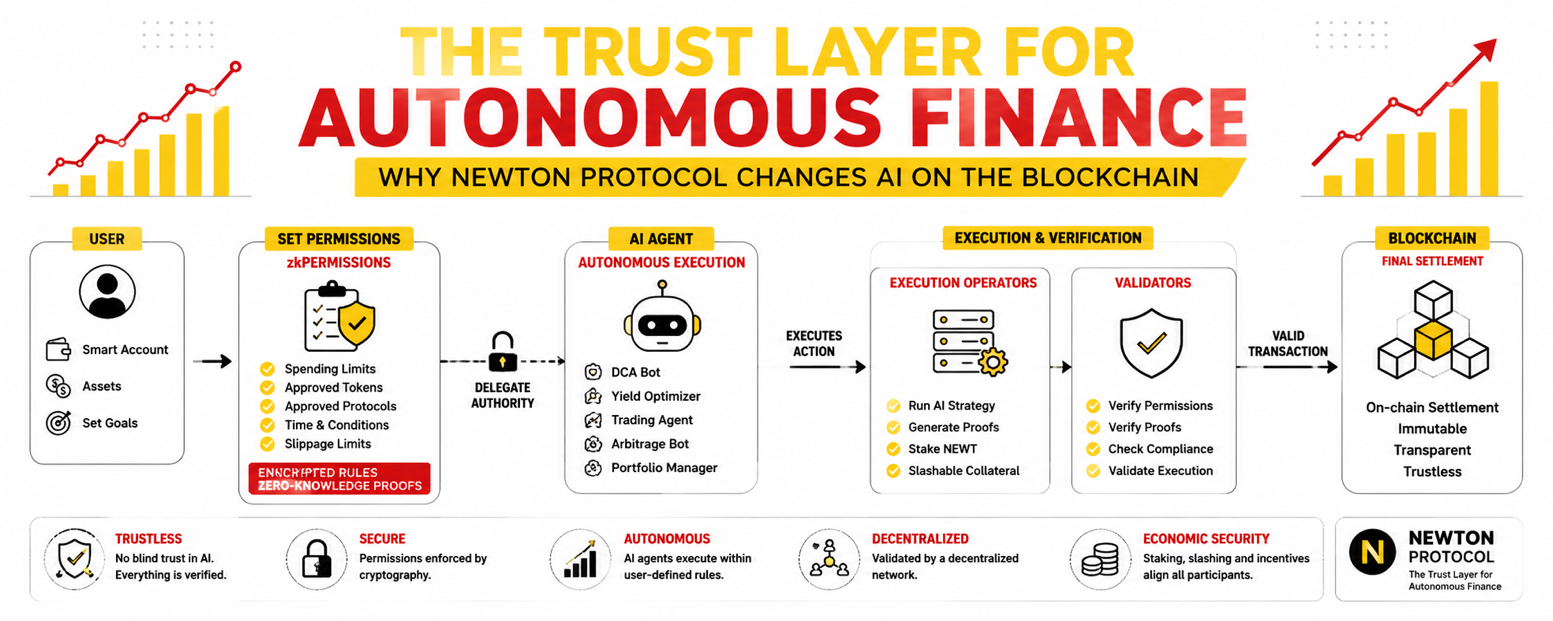
Artificial intelligence is becoming increasingly capable of managing portfolios, optimizing yields, and executing trades. Yet one challenge remains unsolved: how can users trust AI with financial decisions without handing over complete control of their assets? Newton Protocol approaches this problem from a different angle. Instead of building a more intelligent AI, it builds the infrastructure that makes AI actions verifiable.
At the heart of Newton Protocol is the concept of verifiable automation. Rather than granting an AI agent unrestricted wallet access, users create programmable permissions through zkPermissions. These permissions define exactly what an AI can and cannot do-such as transaction limits, approved tokens, supported protocols, execution timing, and slippage thresholds. Every action must satisfy these predefined rules before it can be executed, reducing reliance on blind trust.
Another aspect that stands out is Newton’s combination of Trusted Execution Environments (TEEs), zero-knowledge proofs, and a decentralized validator network. AI agents perform computations off-chain, while validators verify that every execution complies with the user’s permissions before transactions are finalized on-chain. This architecture aims to provide both efficiency and accountability without exposing sensitive user data.
Beyond automation, Newton Protocol is also building an ecosystem for AI developers. Its planned marketplace allows developers to publish AI-powered strategies ranging from automated portfolio management and yield optimization to cross-chain execution and risk management. Users can choose strategies that fit their goals, while operators execute them and validators ensure compliance. This creates an incentive structure that rewards developers, operators, and network participants while maintaining security through staking and verification.
What makes Newton Protocol particularly interesting is that it does not present AI as something users should simply trust. Instead, it assumes AI can make mistakes or behave unpredictably and designs safeguards around that reality. In my view, this is a far more sustainable approach than relying on promises of smarter algorithms alone.
Of course, technology alone does not guarantee success. The protocol’s long-term value will depend on adoption by developers, users, and DeFi applications. A thriving marketplace, reliable validator participation, and real-world demand for AI-powered automation will ultimately determine whether Newton becomes a foundational infrastructure layer or remains a promising concept.
From my perspective, Newton Protocol represents a shift in how autonomous finance should evolve. The future of on-chain AI is not just about making better decisions-it’s about making every automated decision transparent, permissioned, and cryptographically verifiable. If decentralized finance continues moving toward autonomous execution, protocols that prioritize trust through verification rather than assumption may play an increasingly important role.