
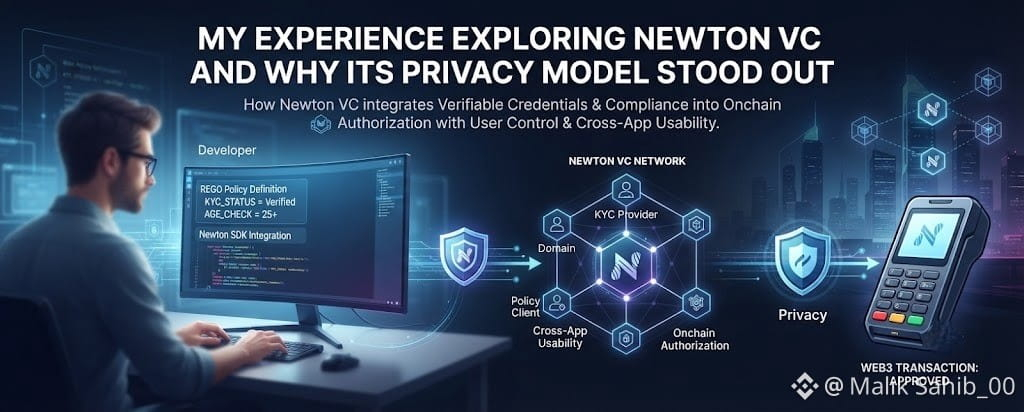
Whenever I evaluate a new blockchain infrastructure project, I usually ask one question first: does it make life easier for both developers and users? That question led me to spend time understanding Newton Verifiable Credentials, and I found myself appreciating its design much more than I initially expected.
In many Web3 applications I've explored, compliance usually means building separate identity systems, managing sensitive user information, and repeating verification across different platforms. The more I looked at this process, the more inefficient it seemed.
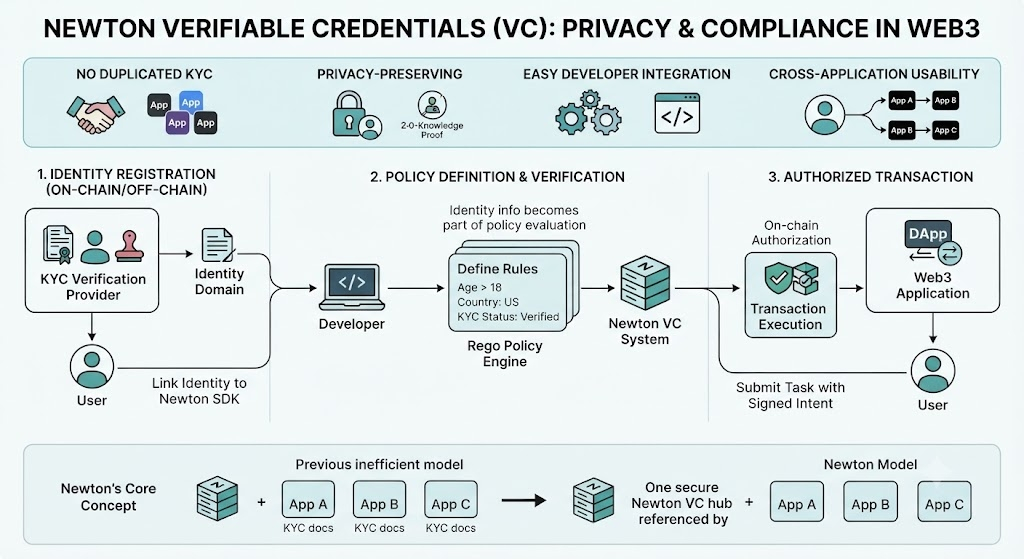
Newton VC introduced a different perspective that immediately made sense to me. Rather than treating identity as an external requirement, it allows verified identity information to become part of policy evaluation itself. Developers can define rules in Rego that automatically check whether a user satisfies requirements such as minimum age, approved country, or KYC approval before authorizing a transaction.
What really convinced me was seeing how structured the workflow is. First, KYC information is collected using an existing verification provider. That information is then registered through the Newton SDK within an identity domain. Users explicitly link their identity to the policy client, after which applications submit tasks containing signed intents. Finally, Newton evaluates every policy before determining whether the requested action satisfies all compliance conditions.
I especially liked that users remain in control throughout the process. Instead of exposing their personal information to every application, they can prove they satisfy policy requirements while keeping sensitive details private. That creates a much better experience than repeatedly uploading documents across multiple platforms.
Another feature that impressed me was cross-application usability. If another developer has already verified a user's identity, my application can rely on that verification without directly accessing confidential information. This significantly reduces duplicated KYC efforts while preserving privacy, something I believe many blockchain ecosystems have been missing.
As I continued studying Newton's implementation, I appreciated that the developer requirements encourage standardized integration. Registering the Policy Client, inheriting from NewtonPolicyClient and EIP712, and configuring the identity domain all contribute to a predictable and secure authorization process. It demonstrates that compliance doesn't need to be added as a patch later, it can be built into the foundation of every transaction.
After exploring Newton Verifiable Credentials in depth, I came away believing that the future of decentralized applications depends on solutions that combine privacy, compliance, and automation without creating unnecessary friction. Newton VC showed me that identity verification can become a seamless part of onchain authorization instead of being a separate obstacle, and that's exactly why it left such a positive impression on me.
