
I've stopped getting excited every time crypto discovers a new buzzword.
Maybe that's what happens after you've watched enough cycles. One year it's DeFi, then NFTs, then the metaverse, then layer twos, and now AI seems to be everywhere. Every new story arrives with people claiming everything is about to change forever. Most of the time, it changes something. Just not as much as we were promised.
So when I saw Binance talking about Newton Protocol, I almost scrolled past it.
Not because it looked bad. Just because I've trained myself to be careful whenever I see the words "AI" and "crypto" in the same sentence. Those two words have become magnets for attention, and attention isn't the same thing as value.
Still, something about it stayed with me.
Maybe it was the thought behind it more than the technology itself.
The truth is, money really is moving on-chain now. That doesn't feel like a prediction anymore. Stablecoins settle billions of dollars. People borrow, lend, trade, and move assets without touching a bank. Whether we like it or not, that shift is already happening.
The strange part is that we're still doing so much of it by hand.
Every transaction needs another click. Every strategy needs another confirmation. Every opportunity disappears if you're asleep or simply away from your screen. If crypto really wants to become financial infrastructure, eventually software has to do more than wait for humans to press buttons.
That's where Newton Protocol starts to become interesting.
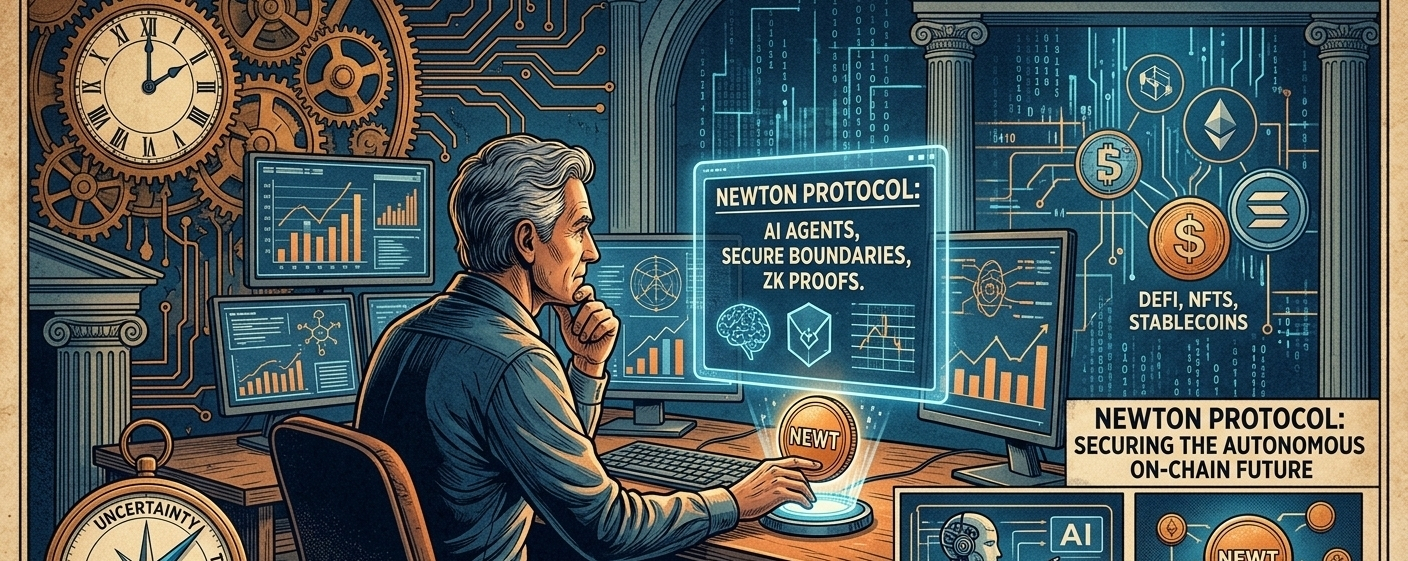
Its idea isn't that AI should replace people. It's that people should define the boundaries, and AI agents should operate only within those boundaries. By combining trusted execution environments with zero-knowledge proofs, the protocol aims to let autonomous agents carry out tasks while proving they're following the rules they've been given instead of asking users for blind trust.
I've seen enough ambitious whitepapers to know that good ideas don't automatically become good products.
That's why I kept asking myself another question.
Does the NEWT token actually matter?
Too many crypto projects create a token because that's simply what crypto projects do. Remove it, and the product barely changes.
Newton seems to be trying to avoid that trap. The token is designed to secure the network through staking, pay protocol fees, provide collateral for operators running AI agents, reward developers building automation, and eventually participate in governance. If operators behave dishonestly, they risk losing their stake. Whether those incentives actually work in practice is something only time can answer, but at least the token appears connected to the system instead of floating beside it.
What I still can't decide is whether we're solving a genuine problem or simply arriving too early.
AI has become the easiest label to attach to almost anything. Sometimes it's deserved. Other times it feels like the latest marketing trend dressed up as innovation.
Newton Protocol sits somewhere between those two feelings for me.
I don't see enough to believe.
But I don't see enough to dismiss it either.
Maybe that's the most honest place to be.
After years of watching crypto swing between impossible optimism and unnecessary cynicism, I've become suspicious of certainty itself. Projects deserve time. They deserve scrutiny. They deserve real users instead of loud communities repeating the same promises.
Binance may be right when it says capital has already moved on-chain. Looking around today's crypto landscape, it's hard to argue otherwise. The bigger question is what happens next. If software is eventually trusted to manage parts of that capital, then the infrastructure behind those decisions will matter just as much as the capital itself.
Whether Newton Protocol becomes part of that future, I honestly don't know.
For now, it remains something far more interesting than another token launch. It's a question worth keeping an eye on.
And after enough years in this space, I've learned that the projects worth watching aren't always the ones making the most noise. Sometimes they're the ones that quietly leave you thinking long after you've closed the page.
