
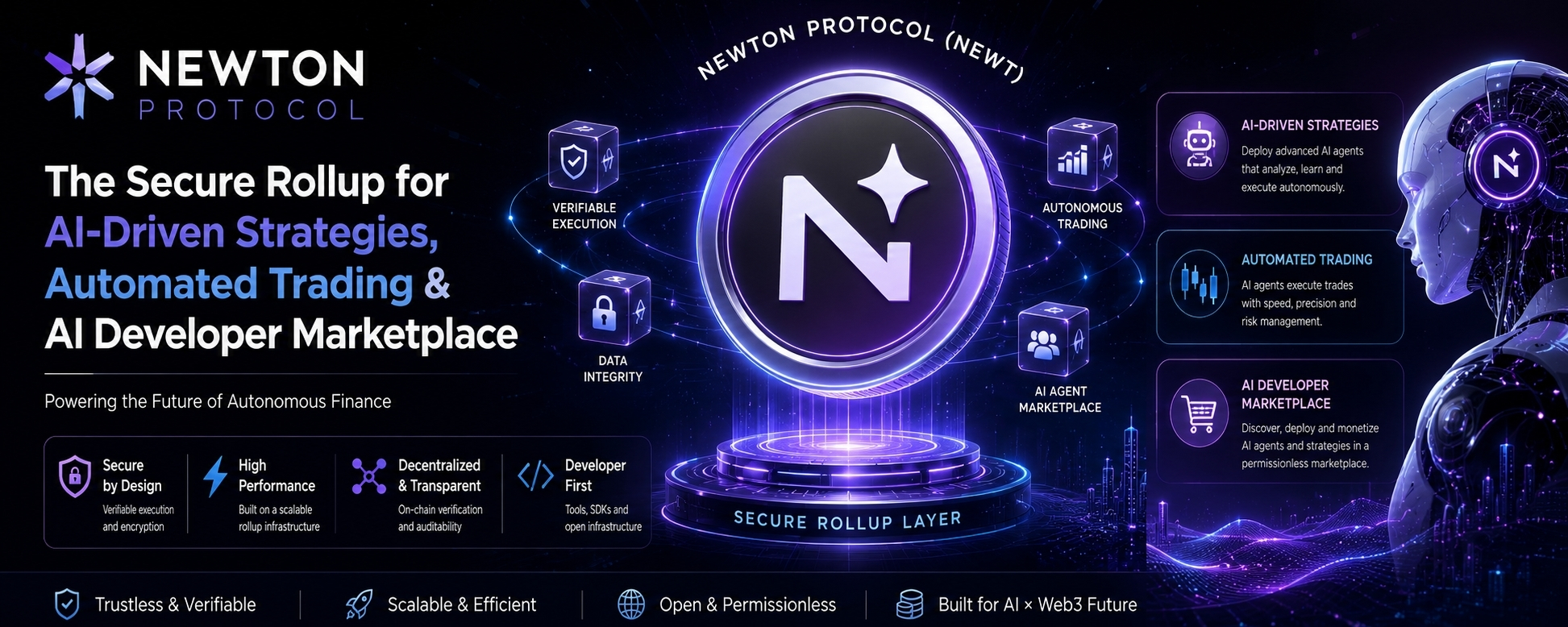
The conversation around AI in crypto often focuses on one question: How smart can AI become? I think the more important question is different: How can we trust AI when it starts managing real assets and making decisions on our behalf? That challenge is exactly why Newton Protocol (NEWT) has caught my attention. Rather than competing to build another AI application, the project is working on the infrastructure needed to make AI-powered blockchain activity more secure, transparent, and verifiable.
Newton Protocol is building a secure rollup designed specifically for AI-driven strategies, automated trading, and a marketplace where developers can create and deploy AI agents. The idea is straightforward but ambitious. As autonomous software becomes more capable of executing trades, managing portfolios, or interacting with decentralized applications, users need confidence that every action can be audited and verified instead of relying on blind trust. Infrastructure that provides accountability may prove just as valuable as the intelligence behind the AI itself.
One of the most interesting aspects of Newton Protocol is its focus on verifiable execution. AI systems can process information far faster than humans, but speed alone is not enough when financial decisions are involved. If an AI agent makes a mistake or behaves unexpectedly, users need a reliable way to understand what happened. By combining blockchain transparency with AI automation, Newton Protocol aims to create an environment where autonomous decisions leave an immutable record that participants can review. This could help reduce uncertainty while encouraging broader adoption of AI-powered financial tools.
The project's marketplace for AI developers also deserves attention. Many blockchain ecosystems have succeeded because they attracted builders rather than simply launching a token. A dedicated marketplace could encourage developers to create specialized AI strategies, automation tools, and decentralized services that users can access more easily. If the ecosystem attracts high-quality contributors, network effects could become one of its strongest competitive advantages over time.
That said, the road ahead is far from guaranteed. AI infrastructure is becoming an increasingly competitive sector, with multiple blockchain projects exploring autonomous agents, decentralized AI, and secure computation. Technology alone does not ensure success. Newton Protocol will need to demonstrate reliable performance, attract developers, build user trust, and encourage meaningful adoption across decentralized finance and other blockchain applications. These challenges require consistent execution over a long period rather than short-term excitement.
Another factor worth considering is regulation. As AI systems gain greater control over financial activity, governments and regulators are likely to pay closer attention to transparency, accountability, and consumer protection. Projects that are designed with verification and auditability from the beginning may be better positioned to adapt as regulatory expectations evolve. While no protocol can eliminate regulatory uncertainty, building accountability into the infrastructure appears to be a practical direction.
From my perspective, Newton Protocol represents an important shift in how the industry approaches AI. Instead of asking only whether autonomous systems can become more intelligent, it asks whether they can also become more trustworthy. That distinction may prove increasingly important as AI agents handle larger amounts of capital and perform more complex on-chain activities. Reliable infrastructure often receives less attention than consumer-facing applications, yet it frequently becomes the foundation upon which successful ecosystems are built.
Whether Newton Protocol ultimately becomes a leading platform will depend on adoption, execution, and the strength of its developer community. Still, its emphasis on secure AI execution, verifiable automation, and developer participation addresses genuine challenges facing the next generation of decentralized applications. As AI and blockchain continue to converge, projects that prioritize transparency alongside innovation may have the greatest opportunity to create lasting value.
What do you think will matter more over the next few years: building smarter AI agents, or building infrastructure that makes every AI decision transparent and verifiable?