I sometimes notice failed transactions more than successful ones. Not because they cost gas or interrupt the flow, though that matters, but because they reveal something clean execution usually hides. When a transaction goes through, the market treats it as activity. When it fails, most dashboards treat it like noise. I am not sure that is always the right instinct.
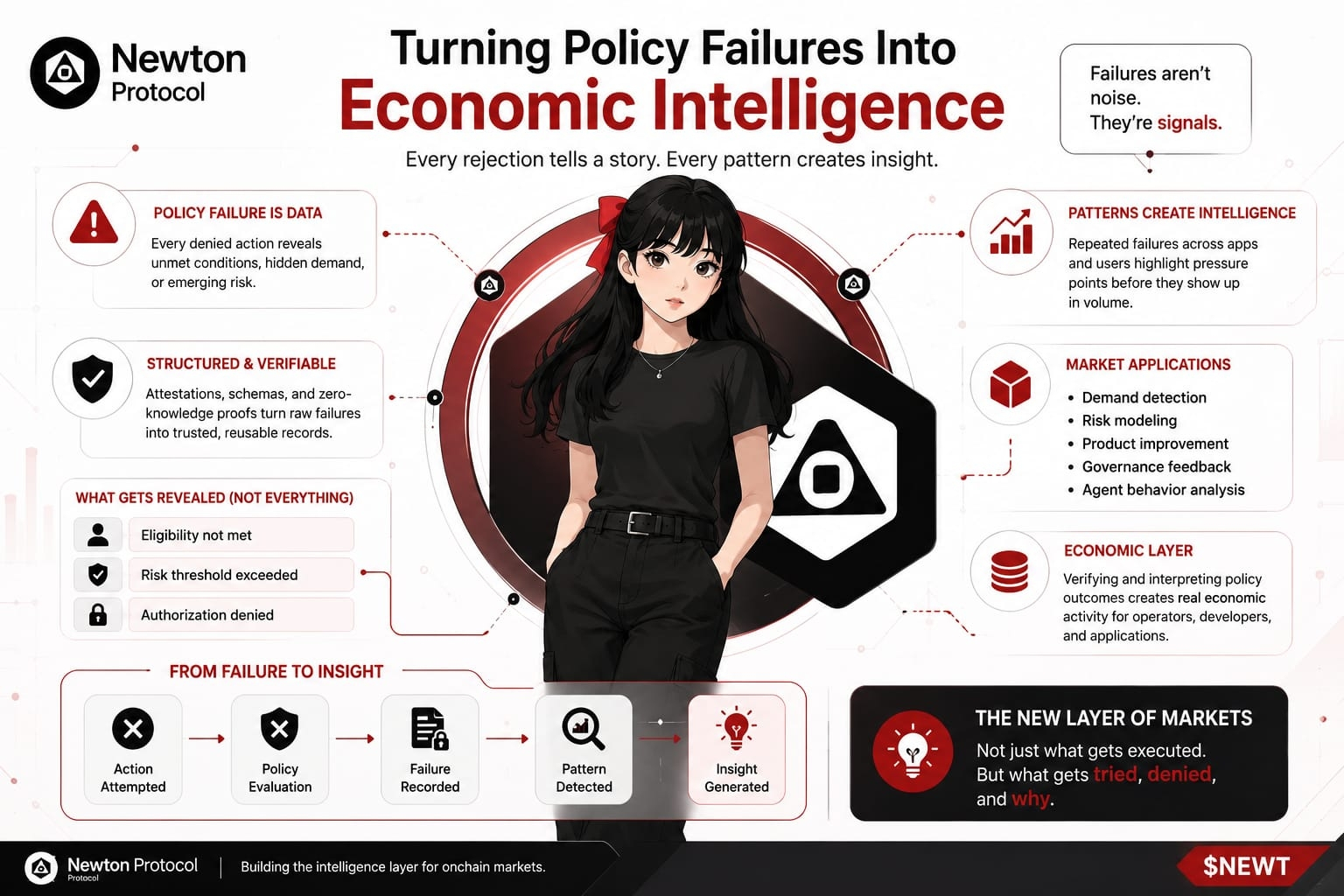
This is where Newton Protocol becomes interesting to me, not as another execution layer, but as a place where failed policy checks could start carrying information. A policy, in simple terms, is a rule that decides whether something should be allowed. It might check wallet behavior, eligibility, risk limits, compliance conditions, or whether an AI agent is authorized to act. If that policy rejects an action, the rejection is not just a dead end. It is evidence that something inside the market tried to move and could not.
Onchain markets already read success very aggressively. Volume, swaps, deposits, bridges, liquidations, approvals. These become signals. But success is only one side of behavior. Failure may tell us something more subtle. A wallet that repeatedly fails eligibility checks is different from a wallet that never tries. A strategy that keeps hitting risk limits is different from one with no demand. A group of agents denied by the same rule may point toward pressure building around a product before visible transaction volume appears.
That sounds useful, but it is also dangerous if handled poorly. Raw failure data can become messy very fast. Some failures are honest mistakes. Some are spam. Some are adversarial testing. Some are incentive farming disguised as demand. This is why the structure around the failure matters more than the failure itself. If Newton can turn policy rejections into structured records, not just error logs, then the market may start reading them as economic signals.
The word “attestation” matters here. An attestation is basically a signed claim that something happened or was checked. It does not have to reveal everything. It can say, for example, that a wallet failed a certain eligibility condition without exposing every private detail behind that decision. A schema is the format that makes these claims readable, so different apps do not interpret the same event in random ways. That sounds boring, but markets often become smarter when boring records become standardized.
I keep thinking about this through the lens of demand. Usage is what appears on a dashboard. Demand is what keeps returning when rewards fade. If policy failures repeat naturally across different apps, then they may show hidden demand before it turns into approved activity. Maybe users want access but do not meet conditions yet. Maybe agents are attempting actions that governance rules still block. Maybe liquidity is not absent; maybe permission is the bottleneck. That is a different market picture.
There is also a token-economic angle, though I would be careful with it. A network should not reward failure blindly. That would create the worst kind of activity, where people are paid to be rejected. But if verifying, recording, and selectively disclosing policy outcomes creates recurring demand for operators, developers, and applications, then failures become part of the economic surface. Not because rejection is valuable by itself, but because reliable interpretation of rejection has value.
Selective disclosure is important in this setup. It means proving only the part that matters, instead of exposing the full background. Zero-knowledge proofs can support this by letting someone prove a condition was checked without revealing all the underlying data. In plain language, the market gets confidence without getting the whole file. That distinction matters if policy failures involve compliance, identity, risk scoring, or agent permissions.
The more I sit with it, the more I think the real question is whether onchain markets are ready to price negative signals properly. Crypto is very good at celebrating movement. It is less mature at reading blocked movement. Yet in traditional systems, declined loans, rejected trades, failed compliance checks, and risk-limit breaches all shape internal intelligence. They tell institutions where pressure, fraud, demand, or fragility may be forming. Onchain markets usually throw that layer away.
Newton Protocol could make that layer more visible, but visibility alone is not intelligence. Raw disclosure can create noise. Proof without context can still mislead. A failed policy check only becomes useful when the market can compare it across time, across applications, and across repeated behavior. One failure says little. A pattern of failures may say a lot.
This is where the idea starts feeling less like analytics and more like infrastructure. If protocols stop restarting from zero and begin depending on reusable policy records, then markets may begin judging systems not only by what they allow, but by what they consistently reject. That is uncomfortable, because rejection is usually treated as friction. But sometimes friction is the first sign that a real economic boundary exists.
I do not know yet whether Newton can turn this into a durable intelligence layer. The incentive design has to be careful. The records have to be credible. The failures have to be filtered from spam. And the market has to learn how to read denied activity without overreacting to it. Still, I keep coming back to the same thought: maybe the next useful market signal is not only where capital moved, but where it tried to move and was stopped.