


Newton Protocol’s real difference is not that it gives DeFi another way to see risk.
It gives smart contracts a way to act on risk before execution.
That is the part I think matters most.
A normal monitoring system can detect a problem, label it and alert someone.
Newton changes the path.
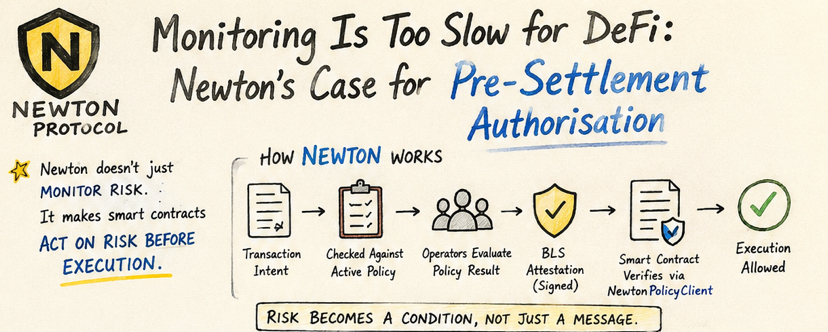
A transaction intent is checked against an active policy. Operators evaluate the policy result. That result can be signed as a BLS attestation. The smart contract can verify the attestation through NewtonPolicyClient before the action continues.
That turns risk from a message into a condition.
This is the angle that made Newton clearer for me.
The weak part of monitoring is not only that it happens after something.
The deeper weakness is that monitoring still depends on a human or a team to react.
Someone has to see the alert.
Someone has to understand it.
Someone has to decide if it matters.
Someone has to pause, block, update or respond.
That creates delay.
In DeFi, delay is expensive.
A vault can rebalance in seconds.
An agent can send a transaction instantly.
A bot can call a contract directly.
A risky wallet can interact without touching the frontend.
A market condition can change before a team even opens the dashboard.
This is why monitoring alone cannot become the control layer for serious onchain finance.
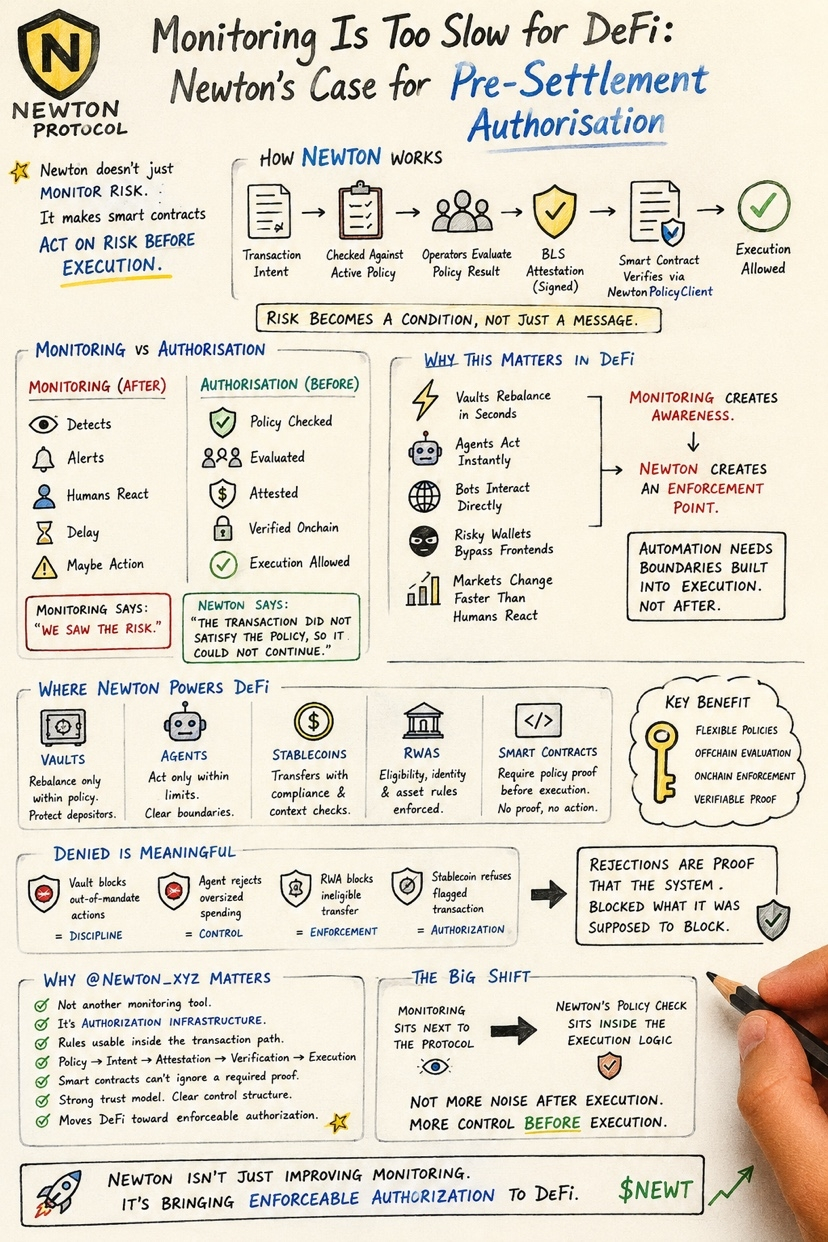
Monitoring creates awareness.
Newton creates an enforcement point.
That difference is not cosmetic.
It changes the responsibility of the system.
In a monitoring-first setup, the system says:
We saw the risk.
In a Newton-style setup, the system can say:
The transaction did not satisfy the policy, so it could not continue.
That is a different level of control.
For me, this is where @newton_xyz becomes more than a safety narrative.
Newton is not trying to replace every security tool or every risk dashboard.
It is solving a different problem:
how to make rules usable inside the transaction path.
A risk signal is only powerful if it can influence execution.
If a dashboard says a wallet is risky but the contract still accepts the transaction, the signal has limited force.
If a vault report says exposure is too high but the vault can still move further into that exposure, the report is weak.
If an agent has a spend limit in a document but the contract does not require proof of that limit, the limit is mostly trust.
Newton pushes these checks closer to the place where they matter.
The policy defines what is allowed.
The intent describes the exact action.
The operator network evaluates that intent against the policy.
The BLS attestation records that the policy evaluation was approved.
NewtonPolicyClient verifies the attestation at the smart-contract level.
Execution becomes dependent on policy proof.
That is the core mechanism.
This matters because DeFi has entered a phase where actions are becoming more automated, more composable and harder to supervise manually.
Old DeFi was mostly user-driven.
A person connected a wallet, clicked buttons, confirmed transactions and watched positions.
That model still exists, but the market is moving beyond it.
Vaults manage pooled capital.
Curators make allocation decisions.
Smart accounts automate flows.
Stablecoin systems move value like payment rails.
RWA platforms bring eligibility and compliance rules.
Agents can act on behalf of users or protocols.
Once systems become automated, monitoring becomes weaker as a control method.
Automation does not wait politely for a human to review every action.
It needs boundaries already built into execution.
That is where Newton’s policy model fits.
It creates a way for automation to move, but not blindly.
An agent can act, but only if its intent passes policy.
A vault can rebalance, but only if the action stays inside the rule set.
A stablecoin flow can continue, but only if the required check passes.
An RWA transfer can proceed, but only if eligibility conditions are satisfied.
The important point is not that every app uses the same policy.
The important point is that each app can define its own policy and require a verifiable result before execution.
That is more flexible than hardcoding every complex rule into one contract.
It is also stronger than leaving rules in offchain processes.
This is the middle path Newton is building.
Offchain context can be evaluated.
Onchain contracts can verify the result.
Execution can depend on that proof.
That design matters because real financial rules are not simple.
A vault rule may need market data, oracle health, risk ratings, protocol allowlists, counterparty checks or exposure limits.
A stablecoin rule may need compliance inputs, blocked-address checks, transfer context or jurisdiction logic.
An RWA rule may need eligibility, identity, permission status or asset-specific restrictions.
An agent rule may need spend limits, approved actions, session boundaries, contract allowlists or time-based limits.
Putting all of this directly into every application contract would be heavy and hard to maintain.
Keeping all of it outside the contract would be too soft.
Newton lets the evaluation happen through a policy layer while enforcement still lands at the contract through NewtonPolicyClient.
That is why I see Newton as authorization infrastructure.
Not monitoring infrastructure.
Monitoring looks at activity.
Authorization decides whether the activity can become execution.
That is a much stronger position in the stack.
The fresh way to think about it is this:
monitoring creates a second system beside DeFi, but Newton tries to become part of DeFi’s operating path.
A monitoring tool may sit next to the protocol.
Newton’s policy check can sit inside the protocol’s execution logic.
That changes adoption quality.
A project can ignore a dashboard.
A user can bypass a frontend.
A bot can skip warning screens.
A contract cannot ignore a required proof if the function is written to demand it.
That is why NewtonPolicyClient is so important.
It is the point where Newton stops being an external opinion and becomes a contract-level condition.
This also changes how trust is built.
A team saying we monitor risk is not the same as a system proving this action cannot execute unless it passes policy.
The first still asks users to trust the team’s reaction speed.
The second gives users a clearer control structure.
This is especially important for vaults.
A vault may have a strong curator and a good strategy, but depositors still need to know how the vault is controlled when decisions happen quickly.
A curator can be honest and still move into a bad position.
A strategy can be profitable and still drift outside its expected risk box.
A market can look safe until the data changes.
Monitoring may explain the movement later.
Newton can make the movement depend on policy first.
That makes vault design more mature.
It moves vault trust away from reputation alone and toward enforceable behavior.
The curator still matters, but the curator works inside rules that the transaction path can check.
That is a better model for depositors.
It also helps good curators because a strong policy system makes discipline visible.
A curator no longer has to rely only on words.
The vault can show that protected actions require policy approval before execution.
That is a stronger form of confidence.
For agents, the same idea may become even more important.
An agent should not be judged only by what it can do.
It should be judged by what it cannot do.
The best agent wallet is not the one with the most freedom.
It is the one with the clearest boundary.
Newton’s policy layer can turn that boundary into a signed execution requirement.
If the agent tries to move outside the policy, the action can fail before it becomes a state change.
That makes agent finance more realistic.
Because nobody serious wants autonomous capital with no guardrails.
Stablecoins also need this type of thinking.
A stablecoin system without authorization logic is only a transfer system.
Transfer speed is useful, but payment-like infrastructure also needs rules around who can move value, under what conditions and in what contexts.
Newton can help make those checks part of execution rather than post-transfer review.
For RWAs, the difference is even more direct.
Real-world assets bring rules with them.
Eligibility, identity, jurisdiction, transfer limits and asset-specific restrictions cannot just be marketing text.
They must influence execution.
Newton’s model allows private or external conditions to be evaluated through policy, then represented onchain as a verifiable attestation.
The contract does not need to expose every detail.
It needs to verify that the policy approved the exact action.
That is how real-world constraints can become onchain control without turning every contract into a messy compliance database.
This is the part that gives Newton project depth.
It is not only saying DeFi should be safer.
It is designing a path where risk, compliance, identity and security checks can become conditions for execution.
That is a more serious claim.
The market often rewards loud narratives early, but long-term infrastructure usually wins through dependency.
The real question for NEWT is not only how much attention Newton receives.
The deeper question is whether apps start depending on Newton policy checks to execute important actions.
That is the metric I would watch.
Vaults requiring Newton attestations before allocations.
Agent wallets requiring policy checks before spending.
RWA platforms using attestations before transfers.
Stablecoin systems adding policy enforcement to sensitive flows.
Smart contracts treating NewtonPolicyClient as a normal gate before execution.
That is where Newton becomes difficult to ignore.
A monitoring tool can be optional.
An authorization layer becomes harder to remove once contracts depend on it.
That is the strongest NEWT story to me.
Not speculation first.
Not hype first.
Dependency first.
If policy enforcement becomes part of real transaction flow, Newton’s value becomes tied to usage, not only attention.
This is also why the denied side of Newton matters.
A denied policy check is not wasted activity.
It can be proof that the system blocked something it was supposed to block.
That is a new kind of signal.
In most DeFi analytics, people celebrate volume, transactions, TVL and activity.
With Newton, another metric may become meaningful:
what was refused.
A vault that blocks out-of-mandate actions is showing discipline.
An agent wallet that rejects oversized spending is showing control.
An RWA product that blocks an ineligible transfer is showing rule enforcement.
A stablecoin system that refuses a flagged transaction is showing authorization in practice.
Those rejections may not look exciting, but they are exactly what serious infrastructure should produce.
The best safety system is not always the one with the most alerts.
It is the one that reduces the number of emergencies in the first place.
That is why authorization matters more than monitoring.
Monitoring is still useful.
It helps teams understand, learn and improve.
But it cannot be the only control layer for fast-moving onchain systems.
Newton is aiming at the earlier point.
The moment where intent is still just intent.
The moment where the smart contract has not accepted the action yet.
The moment where a rule can still prevent a bad transaction from becoming a final result.
That is the real difference.
Not more noise after execution.
More control before execution.
My personal view is that DeFi has already proven it can move assets.
The next phase is proving it can move assets under rules that applications can enforce and users can verify.
That is where Newton is positioned.
It gives builders a way to turn policy into a required step, not a background note.
It gives contracts a way to verify authorization, not just execute blindly.
It gives vaults, agents, stablecoins, RWAs and serious DeFi apps a cleaner control path.
That is why newton feels relevant to me.
Newton is not simply improving monitoring.
It is moving DeFi toward enforceable authorization.
And if NEWT becomes connected to that execution dependency, the project story becomes much stronger than a short term narrative.