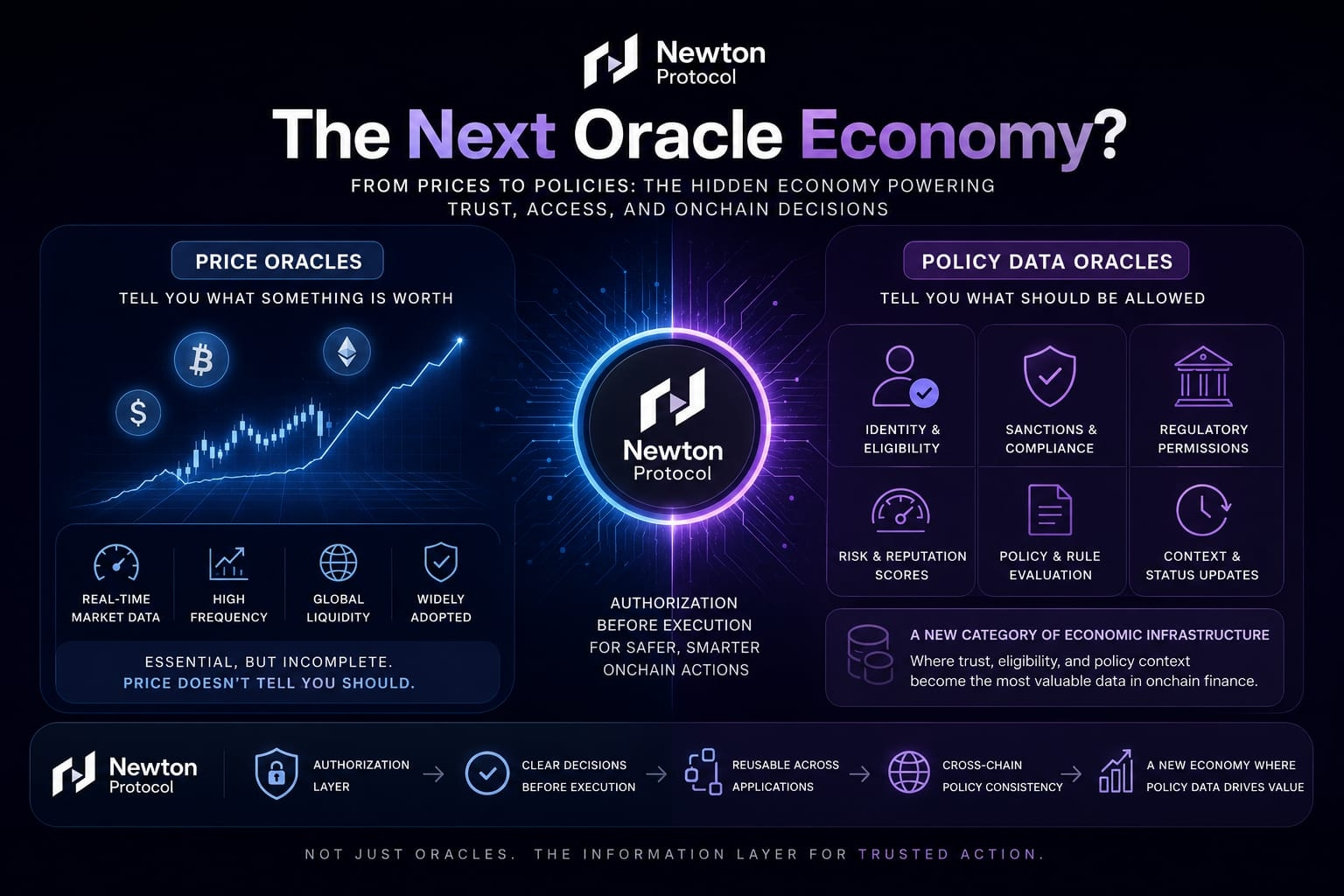
I didn't expect this question to stay with me for so long. At first it sounded like one of those interesting thought experiments that disappears after a few minutes. Price oracles have been such a basic assumption in crypto that I almost stopped questioning them. Markets need prices. Protocols need prices. Everyone seems to agree on that. But the more I looked at what Newton Protocol is actually trying to coordinate before a transaction ever reaches execution, the more I started wondering whether I've been paying attention to the wrong layer all along.
Price tells a protocol what something is worth. It doesn't tell the protocol whether something should happen in the first place. Those are completely different questions, although we've become used to treating them as if they belong to the same system. Maybe they don't.
I keep thinking about how many financial decisions fail for reasons that have nothing to do with valuation. A transfer gets blocked because of jurisdiction. A vault refuses collateral because of policy. An institution cannot interact with a wallet because eligibility changed overnight. None of those failures happen because ETH or BTC suddenly moved a few percent. They happen because the surrounding conditions changed.
That started making price feel strangely incomplete. Important, obviously. But incomplete.
Price oracles answer, "What is this asset worth right now?" Policy data oracles seem to answer something much less visible: "Given everything we currently know, should this action even be allowed?"
Those aren't competing answers. They're answers to different problems. Yet I can't help wondering which one becomes economically heavier if onchain activity keeps moving toward institutional participation, automated agents, tokenized real-world assets, and systems that carry legal consequences instead of just financial ones.
The strange thing is that policy information behaves differently from market information. A price becomes old almost immediately because markets never stop moving. Policy data ages differently. Sometimes it stays valid for months. Other times it becomes worthless in minutes because someone's status changes, a sanction list updates, a risk score shifts, or a permission quietly disappears. That creates a different kind of urgency. Not trading urgency. Decision urgency.
I don't think people naturally appreciate that difference because policy usually feels invisible when everything works. You only notice it when something breaks.
That's probably why price feeds receive most of the attention today. They are visible. Everyone watches charts. Nobody celebrates an authorization decision that quietly prevented a costly mistake.
But incentives have a habit of moving toward whatever reduces expensive uncertainty.
That part keeps bothering me.
If Newton Protocol succeeds in making policy verification reusable across applications, then the valuable asset may no longer be the individual authorization itself. The valuable asset could become the infrastructure that continuously supplies trustworthy policy information.
Suddenly the oracle isn't just reporting facts.
It's competing to be trusted before money moves.
That feels like a different business entirely.
I also wonder how this changes competition between data providers. Price oracles mostly compete on speed, uptime, decentralization, and accuracy. Policy data providers might compete on freshness, legal coverage, jurisdictional understanding, reputation, source diversity, and historical consistency. Those are harder qualities to measure. They're also much harder to fake over long periods.
And once reputation enters the picture, incentives begin changing again.
A single inaccurate price feed is usually noticed immediately because markets react. A weak policy signal might not reveal itself until weeks later when regulators, counterparties, or institutions start questioning decisions that were already made. Accountability stretches across time instead of appearing instantly.
That's a different kind of pressure.
The more I think about it, the more policy data starts looking less like infrastructure and more like memory. Not memory in the technical sense. Memory about who qualifies, who changed, what permissions expired, which identities remain valid, which risk assumptions quietly shifted. It isn't storing value. It's storing context.
Maybe that's the hidden resource.
Markets don't just run on prices. They run on continuously updated assumptions about participants.
If those assumptions become machine-readable and reusable across applications, then policy itself starts behaving almost like a shared economic resource rather than isolated compliance work performed separately by every protocol.
I find that idea strangely unsettling because it changes what infrastructure is optimizing for.
Instead of asking who has the fastest oracle, protocols may begin asking whose understanding of reality they trust enough to inherit.
That's a much heavier responsibility.
It also introduces a new dependency that isn't discussed very often. If many applications inherit policy decisions from the same trusted sources, diversity may quietly shrink. Coordination becomes easier, but independence becomes harder. Everyone follows the same interpretation until that interpretation proves incomplete.
We've seen similar patterns in finance before. Standardization creates efficiency. It also creates shared blind spots.
I'm not sure crypto has really solved that tension.
Maybe Newton isn't replacing price oracles at all. Maybe it's exposing that markets have always depended on another category of information that remained mostly invisible because humans handled it manually. Automation simply forces those hidden judgments into infrastructure where everyone can finally see their economic weight.
And once those judgments become infrastructure, someone has to maintain them.
Someone has to compete over them.
Someone has to earn trust for them.
I keep coming back to that thought because it quietly shifts where value might accumulate. Perhaps the next important oracle market isn't competing to know what an asset costs. Perhaps it's competing to know whether the conditions surrounding that asset are still true. The difference sounds small when written down.
I'm just not convinced the consequences stay small once entire financial systems begin inheriting those answers.