
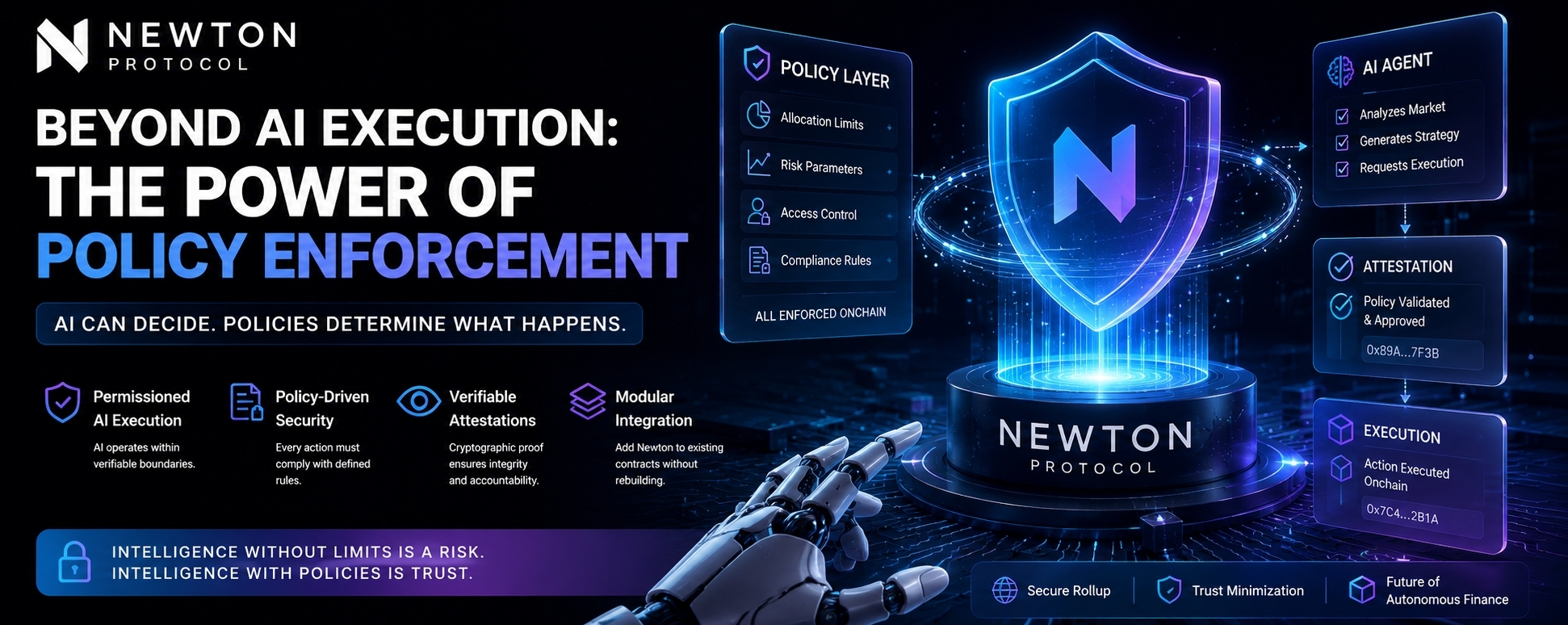
@NewtonProtocol I spent some time reading through Newton Protocol's architecture because I wanted to understand whether its security model depended on trusting AI or restricting it. I used to assume that once an AI system became accurate enough, the infrastructure around it would matter less. The more I read, the more I noticed Newton is built around the opposite assumption.
When I start examining the protocol, I noticed that AI is not treated as an authority. Instead, it operates within predefined policies that determine what actions are permitted before execution is accepted. That changes the role of AI from an unrestricted decision-maker into a participant operating inside verifiable boundaries.
At first, this seemed like a small implementation detail.
The longer I thought about it, the more significant it became.
Most discussions around AI focus on making models more intelligent. Newton appears to focus on making intelligent systems predictable. Those are not the same objective. An AI capable of making profitable decisions can still become a security risk if it is free to ignore operational limits.
That is where policy enforcement becomes more interesting than automation itself.
Every meaningful financial system already depends on rules. Investment funds have allocation limits. Banks have compliance requirements. DAOs define governance permissions. Newton brings a similar concept into AI execution by allowing policies to become part of the execution flow rather than external guidelines that developers simply hope are followed.
I noticed another implication that receives very little attention.
Security is no longer measured only by whether a transaction succeeds. It is also measured by whether the transaction should have been allowed in the first place. That shifts verification closer to intent instead of only validating technical correctness. $S
This creates an important distinction between execution and authorization.
Execution answers whether an action can happen.
Authorization answers whether that action is permitted under the defined policy.
Many blockchain systems solve the first problem exceptionally well. Newton is attempting to strengthen the second.
I started wondering what this means as autonomous AI agents become more common across decentralized finance. If AI eventually manages liquidity, treasury operations, or automated trading strategies, users may care less about how advanced the model is and more about whether every decision remains inside transparent and verifiable limits. $DN
That could become one of the biggest requirements for institutional adoption. Organizations rarely reject automation because it is too intelligent. They reject it because they cannot demonstrate control, accountability, or compliance.
Newton's architecture seems to acknowledge that reality.
The protocol does not remove the need for trust entirely. Instead, it attempts to reduce the amount of blind trust required by placing enforceable policies between AI decisions and on-chain execution.
I'm noticing that this may be the deeper story behind Newton Protocol.
The future of autonomous finance may not belong to the AI that makes the boldest decisions.
It may belong to the infrastructure that can prove those decisions never exceeded the boundaries they were supposed to respect.