
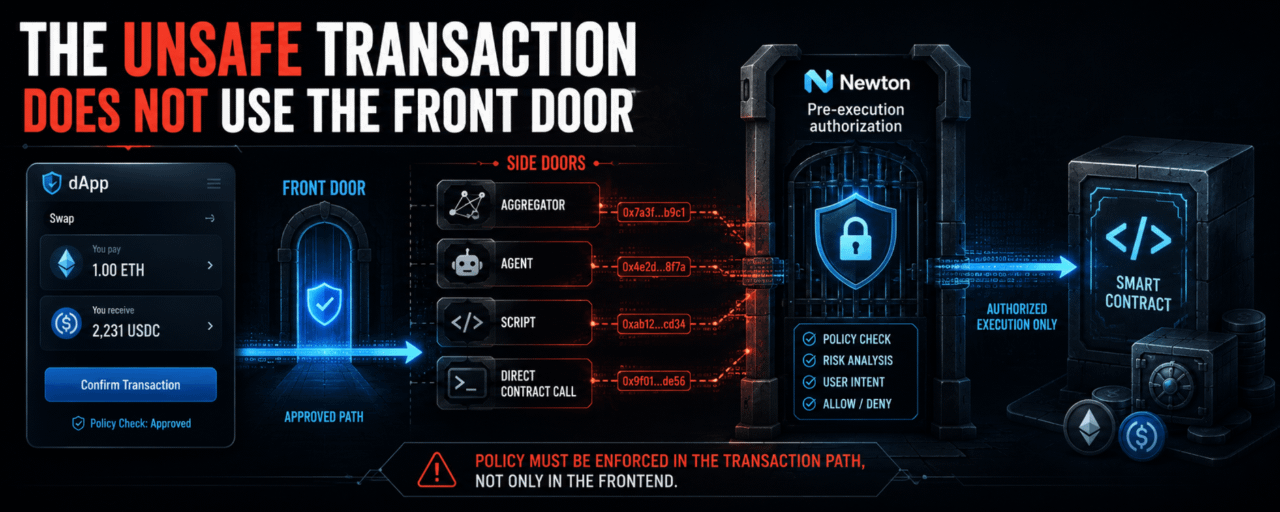

I kept thinking Newton was about making onchain actions smarter.
Then I noticed the uglier test.
The bad transaction does not ask for permission from the clean app screen. It does not care which dashboard explained the rules. It does not care that the transfer looked compliant in the intended flow. It just arrives at the contract and asks to execute.
That is where Newton got more interesting to me.
A policy is easy to believe when everyone uses the front door.
A wallet opens the right page. A user clicks through the approved flow. A frontend checks the rule. The app says the action is allowed. The transaction moves.
From the outside, that looks like safety.
But that is the false signal. The protected path is not the same thing as a protected asset. The real test is what happens when the same action comes from a route the builder did not polish.
That can be an aggregator.
That can be an autonomous agent.
That can be a script.
That can be a direct contract call.
That can be another app building on top of the same asset.
The contract does not see the nice story around the transaction. It sees calldata, sender, receiver, value, and function. If the only serious check happened before that, somewhere in the interface, the rule can disappear the moment the transaction takes another road.
This is the specific Newton pressure point I care about.
Not whether a project can describe a policy.
Not whether an app can block one bad click.
Whether the rule still exists when the transaction skips the polite route.
I started following one transfer request through the system.
A regulated asset or vault action has a rule around it. Maybe the receiver has to be eligible. Maybe the payee has to be approved. Maybe the amount has to stay under a limit. Maybe a risk score has to be clean. Maybe the action must not touch a blocked counterparty. The user or issuer sees the rule and assumes the movement is controlled.
Then the transfer is built somewhere else.
Not in the original app.
Not inside the flow where the first check lived.
Some other route prepares the call and sends it to the contract.
This is where the project-native burden starts. Newton is not valuable because it writes a rule in a nicer place. It is valuable only if that rule can sit close enough to execution that the route stops mattering.
The transfer should not be allowed just because it found a side entrance.
That sounds obvious, but onchain systems make this hard. Composability means assets and contracts are meant to be touched from many places. That is the strength. It is also the hole. The more useful an asset becomes, the more paths appear around it. Each new path can create another place where the original safety check is absent.
A frontend gate works until the user does not use that frontend.
An API check works until the transaction comes from somewhere else.
A manual review works until the action is already settled.
A policy statement works until the contract accepts a call that violates it.
Newton’s answer is to move the decision into the transaction path. The action becomes an intent. The policy evaluates that intent. The operator network checks the rule with the context it needs. A signed result comes back. The smart contract verifies that result before execution.
The workflow matters because it turns the question from “did this app approve the action” into “did this action carry authorization at the point it tried to settle.”
That is a much stricter question.
It also changes who feels the burden. The builder cannot only secure the happy path anymore. The builder has to think about every valid-looking route that might touch the contract.
If a stablecoin transfer needs screening, the check has to follow the transfer.
If a vault has position limits, the limit has to follow the rebalance.
If an agent has a spending cap, the cap has to follow the agent action.
If a policy depends on outside context, that context has to be brought into the decision before execution.
The moment the rule stays behind in one app, the system creates a gap.
This is where I think Newton Mainnet Beta is worth watching. The beta is not interesting to me as a launch label. It is interesting because it puts the project in front of the worst kind of user behavior: real integrations, real routing, and actions that do not always come from the neatest flow.
A demo can show one clean pass or fail.
A live system has to survive messy entry points.
That is the difference.
The native failure condition is not just that an attacker does something dramatic. It can be more ordinary than that. A third-party route gets popular. A builder integrates quickly. A check is assumed to happen somewhere else. A contract accepts a call because the attestation requirement was not enforced on that path.
The result is ugly because everything still looks technically valid.
The transaction settled.
The transfer succeeded.
The vault moved funds.
The app may even show the final state correctly.
But the policy was not actually in the path that mattered.
That is the kind of failure Newton is trying to make harder. It is not only blocking “bad users.” It is closing the distance between a rule and the actual place where money moves.
I like this angle because it does not require a grand speech about the future of agents or compliance. It sits inside one small question.
Where does the rule live?
If it lives in the interface, the interface becomes the security boundary.
If it lives in a centralized service, that service becomes the security boundary.
If it lives as a statement beside the product, the statement becomes mostly comfort.
If it is verified before the contract executes, the rule has a chance to survive the route.
That does not make Newton effortless. It actually makes the builder’s job more exacting.
The policy has to be specific enough to judge a real transaction.
The data feeding the policy has to be current enough to matter.
The operator response has to arrive before execution loses relevance.
The contract has to reject actions that lack a valid authorization result.
Those are not side details. They are the whole spine. Newton only works if each handoff keeps the rule alive until the final call.
This is why I do not read the project as just a safer wrapper around onchain activity. A wrapper can be removed. A wrapper can be bypassed. A wrapper can make the good route look safer while the risky route remains open.
Newton’s harder ambition is to make authorization a condition of execution.
That is a different burden.
It means a transaction should have to prove it is allowed, not just prove it is well formed.
The visible consequence lands on the user who trusted the policy. They do not care which route created the failure. They do not care whether the app screen was correct. They care that the asset moved when it should not have moved.
That is what makes route bypass so dangerous. It hides behind normal settlement.
No exploit banner.
No broken UI.
No obvious panic.
Just a transaction that looked valid to the contract because the rule was sitting somewhere the contract did not ask.
Newton’s value lives in forcing that ask.
Before the asset moves, the transaction has to bring the permission with it.
Before the vault acts, the rebalance has to satisfy the mandate.
Before the agent spends, the action has to fit the session.
Before the transfer settles, the route has to stop being an excuse.
That is also the only place where I would tie in $NEWT. If the token is going to matter in this workflow, it should be because protected actions keep requiring real network work: policy checks, operator coordination, staking incentives, permission updates, and verification. The token line only makes sense if transactions keep pulling Newton into the authorization path. Otherwise it becomes decorative.
For me, that is the proof-of-life.
Not that Newton can describe a policy.
Not that the first integration looks clean.
Not that an app can block a bad click.
The real proof is the transaction that tries to come in sideways and still has to answer the rule.
That is the pressure Newton has chosen for itself. The more useful onchain assets become, the more routes they attract. The more routes they attract, the weaker frontend safety becomes. The more frontend safety weakens, the more important pre-execution authorization gets.
The unsafe transaction will not use the front door.
Newton only matters if the side door asks the same question.
@NewtonProtocol #Newt $NEWT
#BitcoinReboundsAbove$61K
#BitcoinFalls44%FromJanuaryPeak