
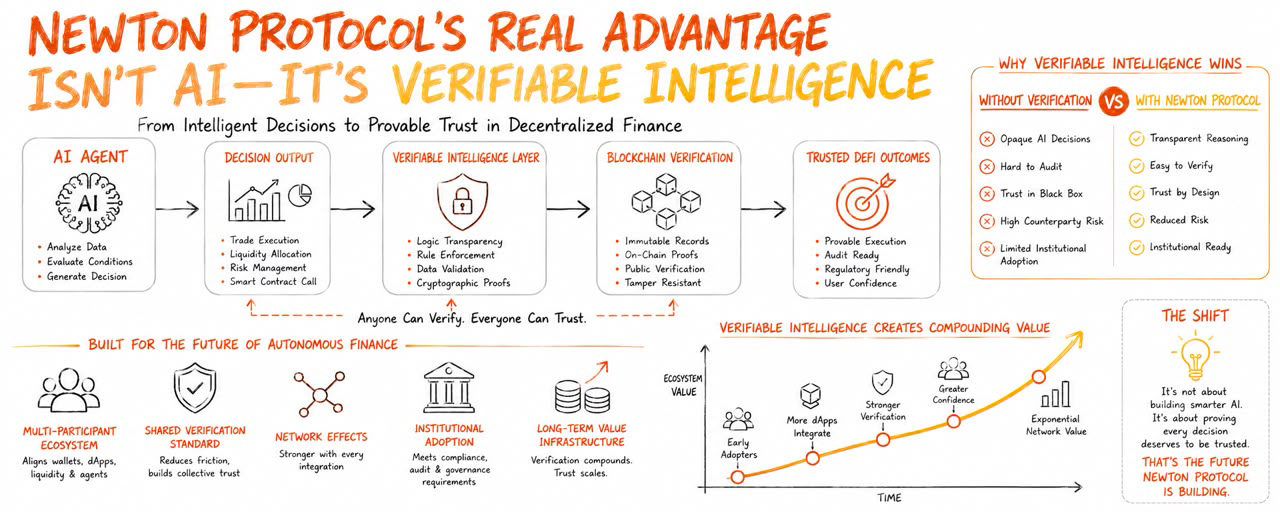
The market has become obsessed with artificial intelligence, but history suggests that infrastructure, not intelligence itself, creates the most durable value. The internet did not transform the world because computers became smarter; it transformed the world because protocols made information trustworthy and transferable at global scale. I believe Newton Protocol is pursuing a similar objective. Its real competitive advantage is not building another AI-powered application but creating a framework where every important AI decision can be independently verified. That distinction may appear subtle today, yet it could become one of the defining requirements of the next generation of decentralized finance.
The biggest misconception surrounding AI in crypto is that better models automatically create better financial systems. They do not. Even the most capable AI agent can still make errors, manipulate data, or produce outputs that users cannot independently validate. As AI agents begin managing wallets, executing trades, allocating liquidity, and interacting with smart contracts without constant human supervision, intelligence alone becomes insufficient. Markets require accountability. Newton Protocol addresses this gap by treating verification as a fundamental layer rather than an optional feature.
This changes the discussion from "Can AI make decisions?" to "Can anyone prove why those decisions were made?" That is a far more important question for financial infrastructure. Trust based solely on reputation eventually breaks down under scale, while trust supported by cryptographic verification becomes significantly more resilient. Newton Protocol appears to recognize that autonomous finance will not be adopted widely unless users, developers, institutions, and regulators can inspect and verify the reasoning behind automated on-chain actions.
This approach also solves a coordination problem that receives far less attention than AI performance benchmarks. Decentralized ecosystems involve multiple participants who often do not know or trust one another. Wallet providers, decentralized applications, liquidity protocols, and AI agents all interact across different environments. Without a common verification framework, every participant must either blindly trust external systems or repeatedly duplicate security checks. Newton Protocol reduces this friction by making verifiable intelligence a shared standard instead of a private promise.
From an economic perspective, this creates network effects that are difficult to replicate. Competing AI projects may improve model quality over time, but verification standards become stronger as more participants adopt them. Every additional application integrating verifiable execution increases confidence across the broader ecosystem. In that sense, Newton Protocol resembles foundational internet protocols more than a consumer-facing AI product. Infrastructure often compounds value more slowly than applications, but its competitive position can become considerably stronger over the long term.
There are also meaningful implications for decentralized finance. Today, many automated trading systems operate as opaque black boxes. Users frequently evaluate performance without understanding the decision-making process behind it. Verifiable intelligence introduces a different model where execution records, authorization mechanisms, and cryptographic proofs become part of the product itself. Instead of asking whether an AI agent generated profits, users can ask whether it followed predefined rules throughout execution. That distinction could significantly improve confidence in autonomous asset management.
Institutional adoption may depend on this capability even more than retail adoption. Financial institutions generally face compliance, audit, and governance requirements that traditional AI systems struggle to satisfy because their internal reasoning is difficult to explain. If autonomous blockchain agents can produce transparent, verifiable evidence for every significant action, integrating AI into regulated financial workflows becomes considerably more realistic. Newton Protocol therefore addresses not only a technical challenge but also an institutional trust challenge that many AI-focused blockchain projects overlook.
None of this guarantees success. Building verifiable intelligence introduces additional computational complexity and may reduce execution speed compared with less transparent systems. Adoption also depends on whether developers view verification as essential rather than optional. Infrastructure projects frequently face the classic bootstrap problem: they become valuable only after ecosystems embrace shared standards. Newton Protocol must therefore demonstrate that the benefits of transparency outweigh the costs of implementation.
For investors, the practical lesson is straightforward. Instead of evaluating AI crypto projects solely by model sophistication or automation capabilities, examine how they establish trust between independent participants. Sustainable blockchain infrastructure has historically rewarded projects that solved verification, coordination, and security problems rather than those chasing the latest technological trend. If AI is ultimately responsible for controlling meaningful on-chain value, then intelligence alone will never be enough. The systems that endure will likely be those capable of proving, not merely claiming, that every autonomous decision deserves to be trusted. That is where Newton Protocol's long-term opportunity appears most compelling.#Newt