
I wasn't planning to spend half my day reading about Newton Protocol.
It started the way most of my research does. I opened a few tabs, skimmed the documentation, read what other people were saying, and assumed I'd understand the project within half an hour.
That didn't happen.
The more I read, the less interested I became in the AI itself. Instead, I found myself thinking about something that almost nobody seems excited to talk about—trust.
Not the kind of trust people mention in marketing posts. I mean the uncomfortable question that appears the moment software is allowed to make decisions instead of just giving advice.
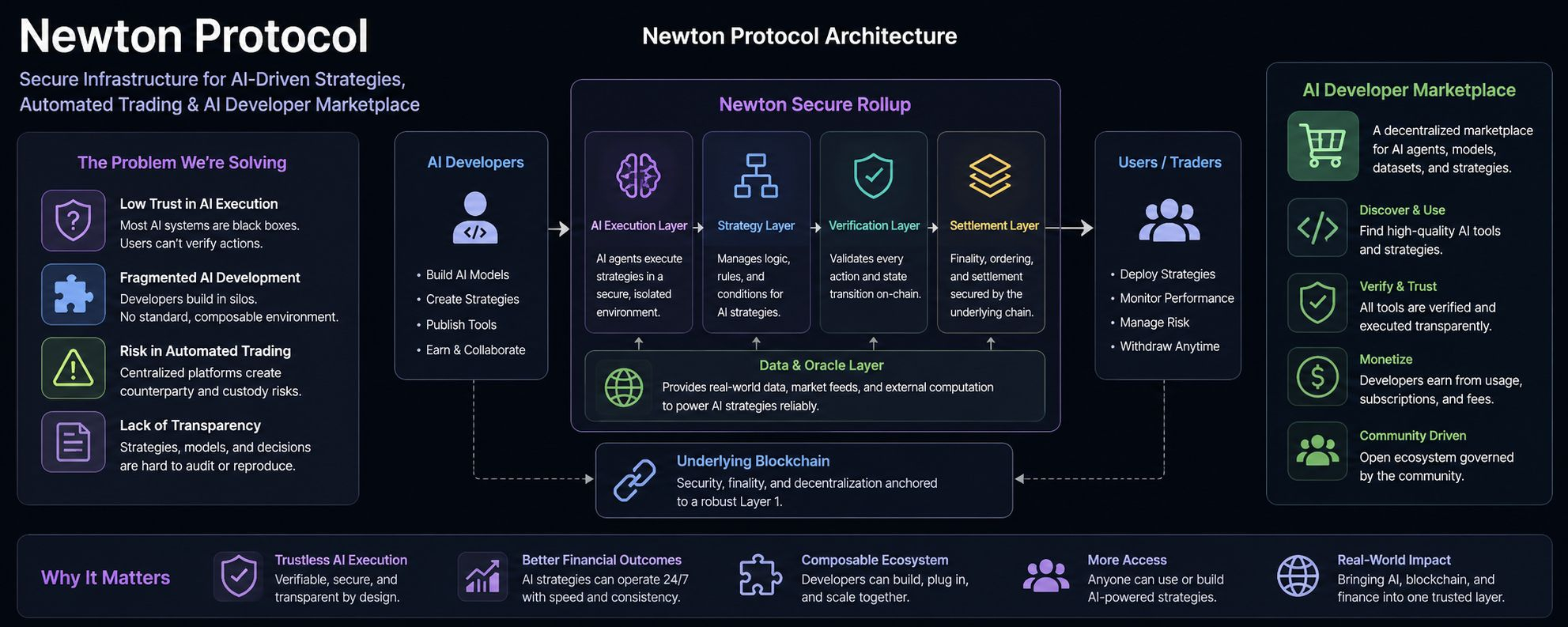
From what I understood, Newton Protocol is building a secure rollup designed for AI-driven strategies, automated trading, and a marketplace where developers can create and share AI applications.
At first glance, it sounds like another project trying to combine AI with blockchain.
Honestly, that's exactly what I thought.
But after sitting with it for a while, I realized that description doesn't really explain why the project exists.
The technology isn't the part that kept my attention.
The problem is.
Today, AI can already write emails, summarize reports, generate code, and answer questions better than many people expected just a few years ago.
We're getting used to asking AI what it thinks.
The next step is very different.
We're beginning to let AI do things on our behalf.
That changes everything.
The moment software can execute trades, interact with financial systems, or follow instructions without someone approving every single step, intelligence stops being the biggest concern.
Instead, the questions become much more practical.
Who gave permission?
Can those actions be verified?
What happens if something goes wrong?
Can anyone explain why a decision was made?
Those questions aren't nearly as exciting as talking about smarter AI models, but I think they're much closer to the real challenge.
That's why Newton Protocol kept my attention longer than I expected.
It seems less focused on making AI more powerful and more focused on creating rules around how AI should operate.
That feels like a healthier direction.
Of course, I don't think building good infrastructure automatically solves everything.
People still make bad decisions.
Developers still make mistakes.
Markets are still unpredictable.
And security is never something you solve once and forget forever.
There's also another question I couldn't stop thinking about.
Will people actually understand the systems they're trusting?
Technology often becomes more complicated as it becomes more capable.
That's useful for developers.
It's not always useful for ordinary users.
If AI starts handling meaningful financial activity, then transparency won't be optional.
It will become essential.
One thing I appreciated while reading Newton's ideas is that they seem to recognize this challenge instead of pretending it doesn't exist.
Whether the project succeeds or not is something only time can answer.
There are too many unknowns to pretend otherwise.
A developer marketplace only works if developers show up.
Secure infrastructure only matters if people actually use it.
And every ambitious project eventually has to prove itself outside documentation and technical diagrams.
After spending several hours reading, I didn't finish with the feeling that I'd discovered the next big thing.
That's honestly not how research usually works.
Instead, I walked away with a different perspective.
Maybe the future of AI won't be decided by whichever model becomes the smartest.
Maybe it will be shaped by the systems that decide how intelligence can be used safely, transparently, and responsibly.
If Newton Protocol contributes something meaningful to that conversation, I think that's already worth paying attention to.
For me, that ended up being the most interesting takeaway—not the AI itself, but the quiet infrastructure that might eventually make AI trustworthy enough to act in the real world.