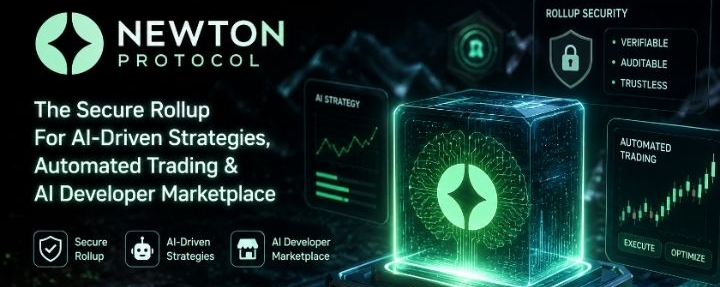

It often feels like every crypto cycle creates a new buzzword. A few years ago it was DeFi, then NFTs, then Layer 2s, and now artificial intelligence dominates almost every conversation. What I've noticed, however, is that many AI projects still rely on a fragile assumption: users are expected to trust autonomous systems without having reliable ways to verify what those systems actually do. The more I explored Newton Protocol (NEWT), the more I realized it isn't trying to build another AI assistant or chatbot. Instead, it's attempting to solve a much deeper infrastructure problem that could become increasingly important as AI begins managing digital assets, executing trades, and interacting directly with blockchain protocols.
At first glance, Newton Protocol looked like another project benefiting from the AI narrative that has attracted enormous attention throughout the current market cycle. I initially approached it with healthy skepticism because we've seen countless projects attach artificial intelligence to their branding without solving meaningful problems. After spending more time studying its architecture, though, I realized the protocol is approaching AI from a very different angle. Rather than competing to build the smartest AI model, Newton is focused on building secure execution infrastructure where AI agents can operate transparently through a dedicated rollup while enabling developers to deploy and monetize intelligent applications.
That distinction genuinely caught my attention because infrastructure usually creates longer-lasting value than short-lived consumer trends. History across crypto has repeatedly shown that the protocols supporting ecosystems often outlive the applications generating temporary excitement. Ethereum became valuable because developers built on it. Layer 2 networks gained traction because they solved scalability. Similarly, Newton Protocol appears to recognize that if autonomous AI agents eventually become major participants in decentralized finance, trading, and digital commerce, secure execution standards may become just as important as computational intelligence itself.
The deeper I researched, the more I appreciated the project's emphasis on verifiability. One challenge surrounding AI today is that decisions often resemble black boxes. An AI can recommend a trade or execute a strategy, but users still need confidence that every action follows predefined rules without unauthorized behavior. Newton attempts to bridge that trust gap by combining blockchain verification with AI execution. Instead of simply asking users to believe autonomous systems are behaving correctly, the protocol aims to create an environment where important actions become observable and auditable on-chain.
That may sound like a subtle difference, but I think it's fundamental. Financial markets don't operate efficiently because participants trust each other blindly. They function because rules, audits, transparency, and settlement mechanisms reduce uncertainty. If AI is going to manage assets worth billions in the future, similar principles will probably become indispensable.
Another aspect I found interesting is Newton's marketplace for AI developers. Many blockchain ecosystems succeed only after attracting builders rather than speculators. Developers create applications, applications attract users, and users generate sustainable economic activity. By providing infrastructure specifically designed for AI-native applications, Newton isn't simply targeting traders chasing the latest narrative. It's attempting to cultivate an ecosystem where developers have incentives to deploy intelligent agents capable of interacting safely with decentralized protocols.
Of course, building a marketplace is much easier than maintaining one. Every ecosystem depends on network effects, and network effects rarely appear overnight. Newton will need to convince developers that building within its environment provides meaningful advantages over existing blockchain ecosystems already integrating AI capabilities. Competition isn't limited to dedicated AI protocols either. Major Layer 1 networks, Ethereum scaling solutions, and modular blockchain frameworks are all expanding into AI infrastructure, making developer acquisition increasingly competitive.
From an investment perspective, tokenomics deserve careful attention because infrastructure projects often succeed or fail based on incentive alignment rather than technological innovation alone. Even excellent technology can struggle if token issuance consistently outpaces genuine demand. Investors should monitor circulating supply growth, unlock schedules, treasury management, validator incentives, and ecosystem funding programs rather than focusing exclusively on price action.
One lesson I've learned after following crypto markets through multiple cycles is that inflation isn't automatically bad. Problems emerge when newly issued tokens enter markets without corresponding increases in network usage or economic activity. Sustainable token appreciation usually requires utility growing alongside supply. If Newton successfully attracts developers, generates transaction demand, and creates meaningful protocol activity, token issuance becomes easier for markets to absorb. Without those adoption metrics, however, inflation can gradually weaken long-term investor confidence.
Liquidity is another variable that deserves more attention than it typically receives. Many promising projects experience impressive early momentum driven by limited circulating supply and narrative enthusiasm. Eventually, broader token distribution begins, early investors realize profits, and liquidity conditions become far more challenging. Watching how NEWT handles future unlock periods may provide valuable insights into market confidence beyond simple price movements.
Something else I found compelling is Newton's positioning within broader crypto narratives. Artificial intelligence remains one of the strongest investment themes globally, extending well beyond cryptocurrency. Institutions, technology companies, and venture capital continue allocating enormous resources toward AI development. Meanwhile, decentralized finance is becoming increasingly sophisticated, stablecoins continue expanding across global payment systems, Ethereum's scaling ecosystem keeps maturing, and modular blockchain architectures are improving execution efficiency.
Newton appears positioned at the intersection of several of these trends rather than relying on only one narrative. AI requires trustworthy execution. DeFi increasingly demands automation. Layer 2 infrastructure seeks scalable computation. Developers want programmable environments supporting intelligent applications. If these sectors continue converging, protocols capable of connecting them could occupy valuable positions within the broader ecosystem.
Still, I don't think investors should assume narrative alignment guarantees adoption. Crypto history contains countless examples where technically impressive infrastructure struggled because real users simply didn't arrive. Building secure rollups represents only part of the challenge. Convincing developers, attracting liquidity providers, fostering application growth, maintaining active governance, and continuously improving user experience may prove significantly harder over the coming years.
Regulation introduces another layer of uncertainty that shouldn't be ignored. Governments worldwide are still determining how artificial intelligence and blockchain technologies should coexist within financial systems. Protocols enabling autonomous financial decision-making may eventually face additional compliance expectations depending on jurisdiction. While decentralization provides resilience, evolving regulatory frameworks could still influence institutional participation, exchange listings, and enterprise adoption.
One thing I believe many traders overlook is that infrastructure projects rarely experience linear growth. Markets often reward visible consumer applications before recognizing foundational technologies supporting those applications. Investors sometimes lose patience because infrastructure develops quietly without constant headlines. Yet when adoption eventually accelerates, foundational protocols often become increasingly valuable because so many applications depend upon them.
That's why I think evaluating Newton requires looking beyond daily price fluctuations. Short-term volatility will almost certainly reflect broader market liquidity, macroeconomic conditions, and speculative sentiment. Long term success, however, depends on whether developers actually build meaningful AI driven applications that require Newton's security model instead of existing alternatives.
I also appreciate that Newton isn't attempting to replace existing blockchain ecosystems. Instead, it appears designed to complement them by specializing in secure AI execution. Crypto ecosystems increasingly reward specialization rather than trying to solve every possible problem simultaneously. Networks focusing on clearly defined strengths often establish stronger competitive identities than platforms promising universal solutions.
Another subtle strength lies in timing. AI adoption outside crypto is accelerating rapidly, but blockchain infrastructure capable of supporting autonomous agents remains relatively immature. That creates an interesting window where protocols solving execution reliability could establish credibility before demand becomes mainstream. Of course, timing cuts both ways. Building infrastructure too early risks years of limited adoption while waiting for broader technological maturity.
Investor sentiment surrounding AI-related crypto assets also deserves context. We've seen enthusiasm produce extraordinary valuations during previous narrative cycles. Eventually, markets become more selective, rewarding projects demonstrating measurable adoption rather than ambitious promises alone. Newton will eventually need tangible ecosystem metrics developer activity, transaction growth, active AI agents, protocol revenue, and sustained user engagement to justify long-term valuation.
As I continued researching Newton Protocol, my perspective gradually shifted. I stopped viewing it primarily as another AI token and started seeing it as an attempt to establish trust infrastructure for autonomous blockchain activity. Whether that vision ultimately succeeds remains uncertain, but I think the underlying problem it addresses is very real. Artificial intelligence becomes considerably more valuable when its actions are verifiable rather than simply impressive.
Crypto has always been about minimizing trust while maximizing transparency. If AI becomes an increasingly important participant within decentralized finance, automated trading, and digital economies, those principles won't become less relevantthey'll become even more important. That's why Newton Protocol continues to hold my attention. Not because it promises the smartest AI, but because it recognizes that intelligence without accountability may never achieve widespread financial trust. In a market often captivated by the loudest narratives, I find myself paying closer attention to the quieter projects building the standards that future innovation may ultimately rely upon.