
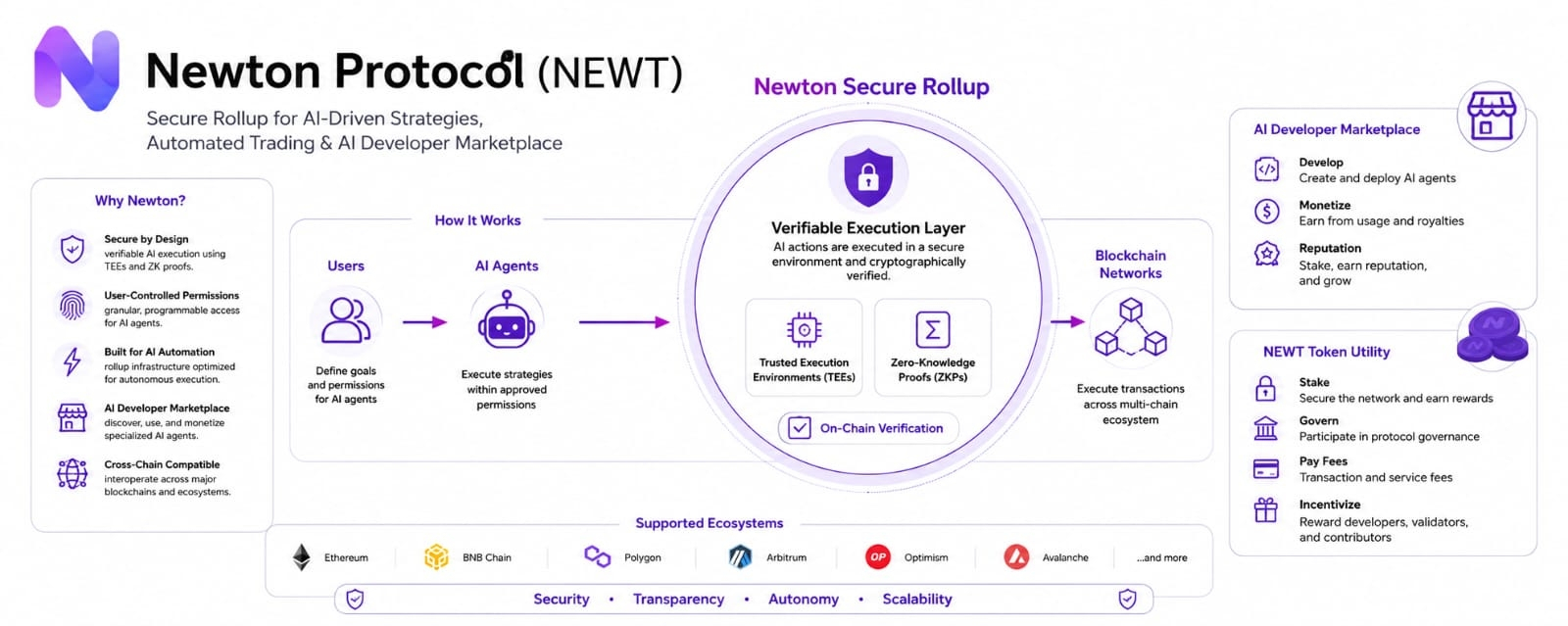
Newton Protocol (NEWT) kept pulling me back, not because it was the loudest AI project, but because it seemed to be working on the part of crypto that almost nobody gets excited about. The plumbing. The infrastructure under the hood. Everyone loves talking about AI agents making trades while they sleep. Nobody wants to talk about what happens when those agents have too much permission, or when the system they're relying on quietly becomes another point of failure. That's the mess Newton is trying to deal with.
Look, if you've been around crypto for more than one cycle, you've probably been burned by automation at least once. Maybe it was a trading bot that stopped working at the worst possible moment. Maybe a bridge got exploited. Maybe you approved a contract months ago and forgot it even had access to your wallet. Crypto has a way of reminding you that convenience usually comes with a hidden bill. You don't forget those moments. They make you suspicious of anything that promises to "do everything for you."
That's why Newton didn't feel like another AI story to me. The thing is, AI isn't the hard part anymore. Letting AI touch real assets is. Those are two completely different problems. Writing a model that can suggest trades is easy compared to building infrastructure that proves every action stayed inside the rules you originally agreed to.
Honestly, that's where the protocol started making sense. Instead of asking users for blind trust, Newton is trying to build a system where permissions actually mean something. AI agents can operate, but inside boundaries that can be verified. It leans on Trusted Execution Environments and Zero-Knowledge Proofs, which sounds technical because it is. But underneath all of that, the idea is surprisingly simple. Don't trust the agent. Verify what it did.
The rollup itself isn't trying to win some race for the highest transaction count. We've seen enough chains chase that trophy already. Newton feels more interested in making automated execution reliable than making it fast for the sake of a marketing graphic. It's not flashy. It's just necessary. If AI is going to become part of on-chain finance, someone has to build the layer that keeps it from turning into another security nightmare.
The marketplace is another piece that caught my attention. Every project talks about AI agents. Very few stop to ask where those agents actually live, how developers get rewarded, or how users figure out which ones deserve their trust. Newton is trying to build that environment instead of assuming it will magically appear later. Whether enough developers show up is another question entirely. Good infrastructure means very little if nobody builds on top of it.
I'm not looking at NEWT because I think every AI narrative deserves attention. Most of them won't survive the next market shift. The token has real jobs inside the protocol—staking, governance, fees, incentives—but crypto has taught me not to confuse utility with demand. Those are different things. Adoption has the final say, and it always does.
The thing is, this won't be easy. Building secure infrastructure is usually slow, expensive, and honestly pretty boring compared to launching another meme token or AI assistant. People rarely celebrate the projects fixing the pipes until the pipes break somewhere else. Newton still has to prove that developers actually want this framework, that users are willing to trust it, and that the security model holds up when real value starts moving through it.
Maybe that's why I keep watching it. Not because I think it's perfect. Far from it. It's because it's focused on a problem I've watched crypto ignore for years. Everyone wants smarter software. Very few people are spending their time making sure that software can't quietly become the next thing that empties someone's wallet. If Newton gets that part right, people probably won't even notice the infrastructure doing its job. And, honestly, that's usually how you know the infrastructure actually works.