
A lesson for junior traders, using LAB as a live example
Most new traders watch price, volume, and maybe RSI. Almost none watch liquidity — and it's the number that quietly decides whether you walk away with profit or get trapped. Let me explain it simply, using LAB as a real example.
What liquidity actually is
On-chain liquidity ("Chain.Lq" on your screen) is the pool of tokens sitting in the market ready to be bought or sold. Think of it as the depth of water under your boat. Deep water, you can move freely. Shallow water, you hit the bottom the moment you try to do anything.
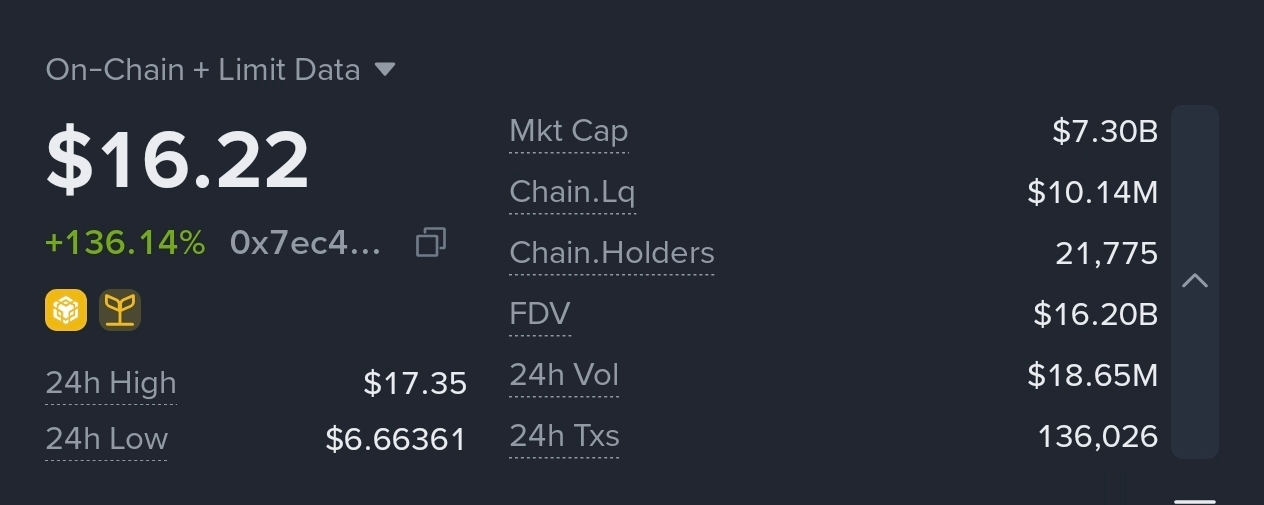
For LAB right now: liquidity is around $8-10M, sitting under a ~$7B market cap / $16B FDV. That's roughly one-tenth of one percent depth. Extremely shallow water under a very big boat.
Why this matters — it cuts both ways
Thin liquidity is why LAB can rip +136% in a day on tiny volume. But it's also why LAB has crashed 77% in two hours before. The same shallowness that makes the pumps explosive makes the dumps brutal. Thin liquidity amplifies both directions.
Why the liquidity number keeps changing (and why it drops during crashes)
Junior traders get confused when they see liquidity fall from $10M to $7M. Two reasons:
Price effect: The pool holds tokens on both sides. When price falls, the dollar value of the pool falls too — even if nobody touched it. So liquidity naturally reads lower during declines.
Providers pulling out: Liquidity providers can remove their tokens whenever they want. On insider-heavy tokens, the same wallets often control both the supply and the liquidity — and they pull it when it suits them.
Here's the trap: these two combine in the worst way. When price drops, the pool shrinks and providers flee — so liquidity is thinnest exactly when a dump is happening. Less depth to absorb selling → price falls faster → more providers flee. It feeds itself. This is how a token goes from "-20%" to "-70%" in an afternoon.
The advice — what junior traders should actually take from this
Check liquidity before you enter, not after. A huge market cap with tiny liquidity is a warning, not a bargain. LAB's $16B FDV on ~$10M liquidity should make you cautious, not excited.
Watch liquidity as a risk alarm. If Chain.Lq is falling while you hold, the exit door is narrowing. Falling liquidity often warns of trouble before price shows it.
The exit door is narrowest when everyone wants it. In a thin book, you and everyone else try to sell at the same moment. You can be "in profit" on screen and still not get that price when you hit sell.
Take profit into strength, while buyers still exist. Don't wait for the perfect top. In a thin market, selling into a pump — while there's demand to sell into — is how you actually capture gains. Selling into a crash is how you eat slippage.
Size for the crash, not the moon. Assume any thin-liquidity token can halve while you sleep. If that would hurt too much, your position is too big.
Oversold is not a buy signal here. On thin insider tokens, oversold gets more oversold. Bounces get sold. Don't catch the falling knife.
Bottom line
Price tells you what a token is worth right now. Liquidity tells you whether you can actually act on that price. On thin tokens like LAB, the second question is the one that decides if you keep your money. Learn to read liquidity, and you're already ahead of most of the people trading next to you.
DYOR. This is education, not financial advice. Stay liquid, stay alive. 🫡