
Inside Vitalik Buterin's Bold 4-Year Plan to Rebuild ETH From the Ground Up
Why This Roadmap Matters More Than Any Single Upgrade
On July 4, 2026, Vitalik Buterin dropped one of his most consequential posts of the year. Fresh off a closed-door research meeting in Berlin — a follow-up to earlier client-team discussions in Svalbard — Buterin shared an updated version of Ethereum's long-term technical blueprint, publicly known as the "strawmap." He didn't call it a minor update. He called it Ethereum's third major era, standing shoulder to shoulder with the Merge in terms of historical weight.
That's not hype for the sake of engagement. If you've been in crypto long enough to remember the run-up to the Merge in 2022, you know that Ethereum doesn't rebrand its roadmap lightly. This time, the target isn't just "more TPS." It's a wholesale redesign of consensus, data, execution, cryptography, and privacy — delivered gradually, fork by fork, over roughly four years, without breaking the apps and wallets already living on Ethereum today.
For traders, builders, and long-term ETH holders on Binance Square, this is the kind of announcement that deserves more than a headline skim. Let's break down what "Lean Ethereum" actually is, what's changing under the hood, and what it could mean for price action, Layer-2 tokens, and the broader competitive landscape heading into 2027–2029.
What Is "Lean Ethereum," Really?
Lean Ethereum isn't a single upgrade you'll wake up to one morning. It's a philosophy: strip the protocol down to its most essential, elegant components, then rebuild scalability, security, and privacy on top of that simplified foundation. Ethereum Foundation researcher Justin Drake first framed this vision in mid-2025, and it has since evolved into the "strawmap" — a living, publicly maintained visual roadmap tracking consensus-layer, data-layer, and execution-layer upgrades all the way out to 2029 and beyond.
The name "strawmap" is deliberately humble. It's a mashup of "strawman" and "roadmap," signaling that this is a draft for community debate, not a locked-in decree from Ethereum's core developers. It originated at an EF workshop in January 2026 and is maintained collaboratively by the Foundation's Architecture team. Buterin himself has compared the process to the Ship of Theseus — replacing every plank of the vessel while it's still sailing, so that by the end, the protocol is fundamentally different even though it never stopped running.
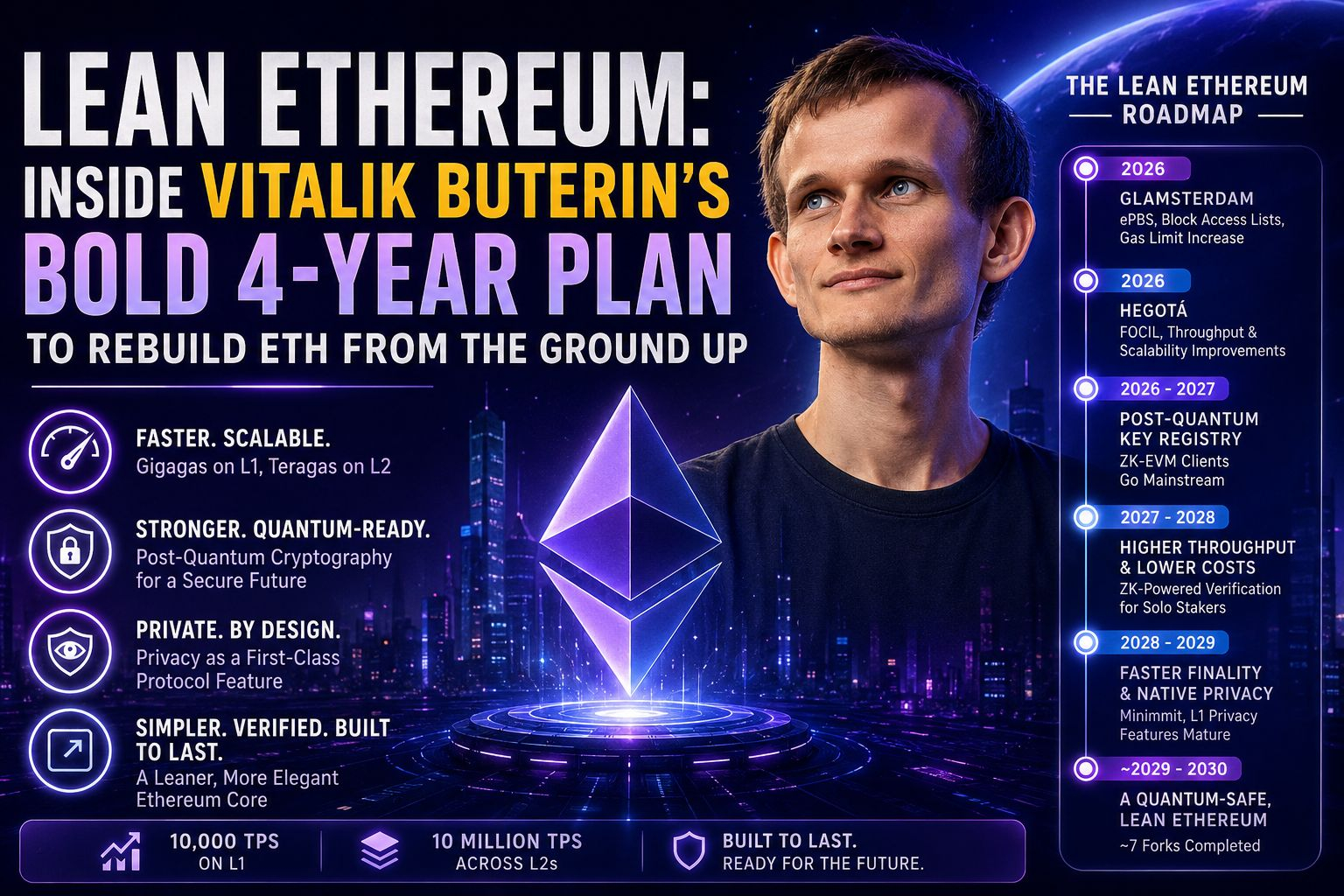
Practically speaking, the roadmap calls for around seven hard forks over four years, arriving roughly every six months. Two of them — Glamsterdam and Hegotá — are already confirmed for 2026, giving the market concrete near-term catalysts to watch rather than only distant, speculative promises.
The Core Pillars of the Roadmap
1. Scalability: Chasing Gigagas on L1, Teragas on L2
Ethereum has spent the last several years leaning almost entirely on rollups to scale. Lean Ethereum shifts some of that weight back onto the base layer itself. The stated targets are aggressive: roughly 1 gigagas per second on Layer 1 (around 10,000 transactions per second) and up to 1 teragas per second in aggregate across Layer 2s — somewhere near 10 million TPS.
To get there without turning Ethereum into a data center-only chain, the roadmap leans heavily on:
Block Access Lists (BALs)— a mechanism debuting with the Glamsterdam fork that lets nodes identify which transactions don't conflict with each other, so they can be executed in parallel across multiple CPU cores instead of one at a time.
Enshrined Proposer-Builder Separation (ePBS)— hardcoding the rules for how blocks get built and bid on directly into the consensus layer, cutting out the informal network of external relays that currently centralize a lot of block production.
PeerDAS— already live via the Fusaka upgrade, this lets validators sample small pieces of blob data instead of downloading everything, unlocking roughly an 8x increase in theoretical blob capacity.
Gradual gas limit increases— the network already moved the mainnet gas limit from 30 million to 60 million gas, and Glamsterdam is expected to push it higher still, with some researchers eyeing triple-digit millions per block over time.
2. Faster Blocks, Faster Finality
Right now, Ethereum produces a block every 12 seconds and reaches full finality in around 16 minutes. The roadmap proposes shrinking slot times using a neat mathematical progression — roughly √2 at each step: 12 seconds, then 8, then 6, then 4, then 3, and potentially all the way down to 2 seconds, though Buterin has flagged the final couple of steps as more speculative and dependent on further research.
Separately, there's a push to decouple slot time entirely from finality, moving toward a one-round Byzantine fault-tolerant algorithm called Minimmit. The long-term aim is to compress finality from minutes down into single-digit or low double-digit seconds. A related, already-discussed mechanism called the Fast Confirmation Rule aims to give users a strong practical guarantee that a block won't revert after just one slot — a meaningful UX upgrade for anyone tired of watching a spinning "pending" icon.
3. Post-Quantum Cryptography: Racing the Clock
This might be the most underappreciated part of the entire roadmap for casual observers, but it's arguably the most urgent from an engineering standpoint. Quantum computers capable of breaking today's elliptic-curve cryptography don't exist yet, but Buterin and Ethereum Foundation researchers have pointed to warnings that meaningful risk could materialize as early as 2028.
Four components of Ethereum's cryptographic stack are considered exposed:
1.ECDSA— the signature scheme securing ordinary wallets and externally owned accounts.
2. BLS signatures — used by validators to aggregate hundreds of thousands of votes into consensus.
3.KZG polynomial commitments — used for data availability in the rollup-centric scaling model.
4. Groth16 and other ZK proof systems that rely on the same vulnerable elliptic-curve math.
The fix isn't a simple swap. Post-quantum signatures are typically much larger and slower to aggregate than BLS, so replacing them naively would hurt performance. That's why the roadmap includes a project called leanVM,which uses zero-knowledge proofs to efficiently aggregate quantum-safe, hash-based signatures (an approach nicknamed leanXMSS) without the network taking a serious efficiency hit. A public registry for post-quantum keys is expected to roll out around 2026, letting validators and users begin voluntary migration well ahead of any mandatory cutover.
4. Privacy as a First-Class Citizen
For most of Ethereum's history, privacy has been something developers had to bolt on at the application layer — mixers, ZK rollups with shielded pools, and similar tools. Lean Ethereum flips that script. Buterin has explicitly said privacy is no longer an afterthought but a core protocol goal, and future components — from the mempool to new state structures — are being evaluated partly on whether they can support intermediary-free, quantum-safe privacy without excessive overhead.
The most concrete manifestation of this is the idea of native shielded ETH transfers built directly into Layer 1, rather than requiring users to route through a third-party privacy protocol. If this ships as envisioned, confidential transfers become a default option for everyone, not a niche feature for the technically sophisticated.
5. Radical Simplification and Formal Verification
Underneath all the flashy scalability and privacy talk is a less glamorous but arguably more important theme: cleaning house. Buterin has talked about wanting Ethereum's core protocol to look like "a work of art" rather than an accumulation of patches — minimal, elegant, and formally verifiable rather than sprawling and brittle. Part of this involves merging the currently separate execution and consensus clients into more unified systems, and eventually making it realistic for something as modest as a smartphone to run a full verifying node, thanks to ZK proofs collapsing the computational burden of verification toward near-zero.
Timeline: What Happens When
| Phase | Approximate Window | What's Happening |
| Glamsterdam | 2026 | ePBS, Block Access Lists, another gas limit bump |
| Hegotá | Later 2026 | FOCIL (forced transaction inclusion to fight censorship), continued gas/throughput work |
| 2026–2027 | Ongoing | Post-quantum key registry rollout, ZK-EVM clients become viable for a growing share of validators |
| 2027–2028 | Mid-term | Wider ZK-EVM adoption, cheaper verification paths for solo stakers, higher gas limits |
| 2028–2029 | Long-term | Slot-time reductions continue, Minimmit-style fast finality, native L1 privacy features mature |
| ~2029–2030 | End state | Full post-quantum protection target, roughly seven forks completed, Ethereum moves toward "maintenance mode" on core architecture |
It's worth stressing that this is explicitly described as a living document, not a locked contract. Expect quarterly-ish revisions, shifted deadlines, and features that get downgraded or dropped as engineering bandwidth and research realities collide with ambition — which is exactly what already happened with one proposed feature set around native account abstraction and quantum-resistant signatures, which got trimmed down to a smaller scope to keep the Hegotá fork on schedule.
Market Impact: ETH, Layer-2s, Developers, and Investors.
For ETH Holders
The announcement landed alongside a modestly positive price reaction, with ETH pushing to an intraday high near $1,800 before settling slightly lower, still up over 3% on the day. That's a relatively muted move for a roadmap of this scope, which tells you two things: markets have partially priced in Ethereum's long-term technical direction already, and traders tend to reward *shipped* upgrades (like Fusaka's PeerDAS rollout or the gas limit increase) more than *announced* long-term plans. The real price-relevant catalysts will likely be Glamsterdam and Hegotá actually landing on mainnet later this year, not the strawmap update itself.
For Layer-2 Tokens
This is where things get genuinely interesting — and a little uncomfortable for some L2 narratives. For the past two years, capital and attention rotated heavily toward L2s and other high-performance chains, partly because Ethereum's base layer felt slow and expensive by comparison. Lean Ethereum's push toward gigagas L1 throughput, cheaper blobs, and faster finality narrows that performance gap. If Ethereum's L1 becomes fast and cheap enough to host complex DeFi activity directly, some of the "we exist because L1 is too slow" value proposition that L2s have leaned on could soften — a genuine risk for L2 tokens whose value accrual has depended on that gap staying wide.
That said, the roadmap doesn't kill rollups; it complements them. A stronger, faster L1 combined with a teragas-scale L2 ecosystem is a bigger overall pie, not a zero-sum fight. L2s that focus on specialized execution environments, unique app ecosystems, or superior UX rather than simply "cheaper than L1" are better positioned to keep their relevance even as the base layer improves.
For Developers
The most underrated part of this roadmap for builders is the emphasis on formal verification and radical protocol simplification. A leaner, more elegant base layer generally means fewer edge cases, fewer surprise bugs, and clearer mental models to build against. Native account abstraction discussions, quantum-safe primitives baked into the protocol, and eventually native privacy tooling all reduce the amount of custom, risky infrastructure developers currently have to build and audit themselves.
For Institutional and Long-Term Investors
Institutional allocators tend to care about durability and predictability more than raw speed. A credible, multi-year post-quantum migration plan — something most competing chains have not articulated with this level of specificity — is a structural differentiator. Combined with continued spot ETH ETF inflows and a staking base north of 35 million ETH (roughly 29% of supply), the roadmap reinforces a narrative of Ethereum as infrastructure built to last decades rather than a chain chasing the current cycle's trends.
The Bull Case
A credible answer to the quantum threat years ahead of when it might matter. Few competitors have anything close to Ethereum's specificity on post-quantum migration, and getting ahead of a genuine existential risk is a real moat.
- L1 finally competitive on speed without sacrificing decentralization. If gigagas throughput and sub-4-second slots materialize while keeping solo staking accessible, Ethereum could offer a combination — strong security guarantees plus high performance — that few chains can currently claim simultaneously.
- Privacy by default could be a genuine unlock for institutional and mainstream use cases that have historically been uncomfortable with Ethereum's fully transparent ledger.
- Concrete near-term catalysts.Glamsterdam and Hegotá are confirmed for this year, giving the market tangible delivery milestones rather than only distant promises.
- A track record of executing hard transitions.The Merge is the obvious proof point that Ethereum can pull off a complex, high-stakes overhaul without significant downtime.
The Bear Case
- Execution risk across seven forks is not trivial.Ethereum's history includes plenty of delayed timelines, and a four-year plan with this many moving parts leaves a lot of room for slippage — and Ethereum's community governance model, by design, invites debate and revision rather than top-down enforcement.
-The roadmap is explicitly a draft. "Strawmap" isn't marketing modesty; features are already being trimmed (as happened with the account abstraction/quantum signature bundle heading into Hegotá) when engineering bandwidth runs short.
- Layer-2 tokens face genuine repricing risk if L1 closes the performance gap faster than L2 ecosystems can differentiate on something other than cost and speed.
- Quantum migration involves real friction.** Multiple hard forks, temporary gas cost increases during cryptographic transitions, and mandatory key migrations for validators all introduce operational and psychological friction that could slow adoption or create short-term uncertainty.
- Muted immediate price reaction suggests limited near-term speculative fuel. Long-dated infrastructure roadmaps are a tougher sell to short-term traders than concrete, imminent catalysts.
Final Take
Lean Ethereum isn't a marketing rebrand — it's arguably the most technically ambitious version of Ethereum's roadmap since the transition to Proof-of-Stake. Over the next four years, if the strawmap holds together even loosely, Ethereum aims to be simultaneously faster, cheaper, quantum-resistant, and more private, all while preserving the decentralization and backward compatibility that got it here in the first place.
None of this guarantees a specific price target, and nobody should treat a multi-year engineering roadmap as a short-term trading signal. But for anyone building a long-term thesis around ETH, the direction of travel matters: Ethereum is explicitly choosing to compete on both security and speed rather than picking one, betting that a leaner, formally verified base layer is the foundation that lets it do both. Whether that bet pays off will be decided fork by fork — starting with Glamsterdam later this year.
This article is for informational and educational purpose
s only and does not constitute financial or investment advice. Always do your own research before making investment decisions.
#VitalikOutlinesLeanEthereumRoadmap #EthicalHackersFindAptosFlawRisking$70B #BrazilCentralBankSaysStablecoinsElectronicMoney $BTC $ETH $BNB

