
@NewtonProtocol #Newt #newt $NEWT
It was a regular morning scrolling through crypto feeds when a bold claim caught my eye: “Newton Protocol is building a secure rollup for AI-driven strategies, automated trading, and a marketplace for AI developers.” Posts on Binance Square and Twitter touted Newton (NEWT) as an “authorization layer” and praised its TEEs and ZKPs for trust. Intrigued by the AI buzz and seeing “secure rollup” repeatedly mentioned, I dove in — ready to separate the noise from the nucleus of what this project really is. Over the past months I’ve gone from excited believer in the hype to a skeptic seeking substance in Newton’s design, token, and real usage.
I began by asking: What is Newton, truly? The official docs and whitepaper call it a “decentralized policy engine for onchain transaction authorization”. In plain terms, Newton sits between when you click “send” and when the blockchain settles, enforcing rules—compliance checks, risk limits, identity screens—before money moves. It’s not just about AI anymore; it’s about making smart contracts aware of off-chain context (sanctions lists, corporate policies, liquidity conditions, etc.) using a network of operators and oracles. In effect, Newton aims to “embed[] compliance, risk, and business rules directly into transaction execution”. Think of it as adding a Visa-like authorization step to every transaction on chain, secured by EigenLayer staking and zero-knowledge proofs.
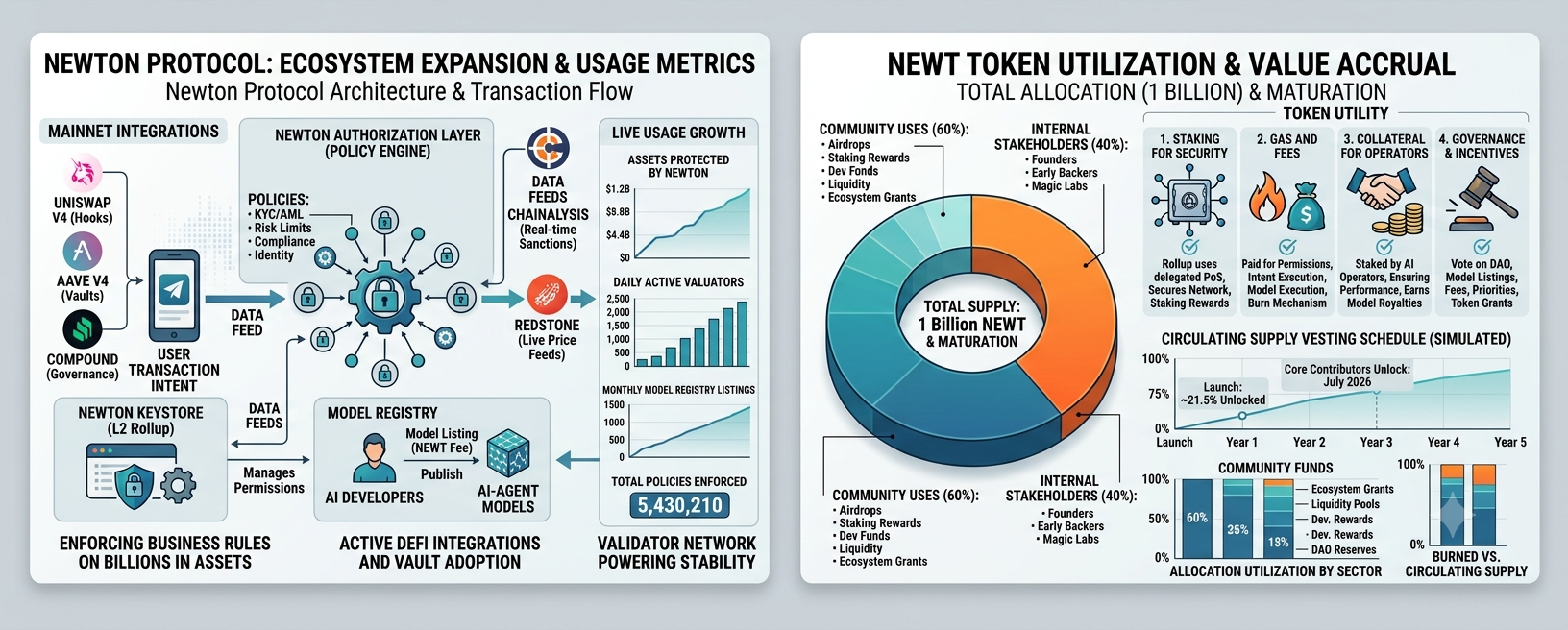
Behind the PR taglines, Newton’s architecture has a few moving parts. There’s a Newton Keystore (an L2 rollup) for managing user permissions without handing over private keys. There’s a Model Registry, where developers can publish AI-agent “models” or strategies; listing a model requires a NEWT fee, and operators who run those models pay NEWT collateral while paying royalties back to model creators. Finally, there are “automation intents” – user-submitted instructions that link their wallet, permissions, and chosen AI agent together. Validators and operators then ensure each intent obeys the pre-set policies. In short, a user might grant a trading-bot permission to act, but Newton verifies that every bot action conforms to agreed rules, with a signed proof onchain. As one analyst put it, Newton lets “decentralized [developers] publish strategies, users choose how they deploy capital, and the network creates clear rules around execution, verification, and incentives”.
Behind the scenes, the NEWT token tries to align all these participants. There are 1 billion NEWT fixed supply. At launch only ~21.5% (215 million) were circulating, the rest locked into long vesting. Tokenomics split 60% to community uses (airdrops, staking rewards, dev funds, liquidity, ecosystem grants) and 40% to internal stakeholders (founders, early backers, Magic Labs). The Newton blog even promises new transparency standards: foundation funds live in tagged wallets with on-chain policies for how proceeds are handled.
What does NEWT actually do? Its four main roles are: (1) Staking for security – Newton’s rollup uses delegated PoS, so staking NEWT secures the network; (2) Gas and fees – all actions on the Newton network (granting permissions, executing intents) cost NEWT; (3) Collateral for operators – to run an agent model, operators must stake NEWT, aligning incentives with proper execution; and (4) Governance – over time stakers should vote on the DAO, model listings, fees and development priorities. (For example, listing an AI trading model in the registry costs NEWT and yields royalties back to its creator.) Essentially, NEWT is both the fuel and skin in the game for this ecosystem.
Next I looked at participation and activity. Onchain, there are about 13,000 NEWT holders now, many of them likely tiny positions from the IEO and airdrop. According to tokenomics trackers, about 215M NEWT (~21.5%) are currently unlocked, and the rest vest gradually (with core team tokens locked for 1 year, then 3-year cliffs). So far only early investors and networks are set to receive significant new supply – for example, a large “core contributors” unlock is scheduled July 24, 2026. In practice this means price and circulation could shift on those cliff dates, so one must watch for token unlocks more than daily market noise.
In terms of real usage, Newton just launched Mainnet Beta in June 2026. It’s live on Base and Ethereum, and integrated with DeFi partners like Euler and Morpho via “VaultKit”. Vaults (onchain managed funds) can now optionally enforce Newton’s policies: for example, a vault might block red-flagged addresses or risky allocations in real-time through Newton. Data oracles like Chainalysis (sanctions), Vaults.fyi (vault health), RedStone (price feeds) and others feed policies with up-to-date info. These are first signs of an ecosystem — but as of writing there’s no headline dApp using it heavily. Transaction counts on the Newton network and actual value protected remain modest. The project is still looking for traction beyond its launch fanfare.
So, what builds conviction, and what demands caution? On the positive side, Newton tackles a real gap: blockchains lack native ways to enforce business rules or compliance. The Newton approach is theoretically powerful: turning “curator promises” into onchain-enforced policies. It has solid backing (about $90M in funding from PayPal Ventures, Polygon, etc.) and clear token incentives for staking and development. Its core tech (ZKPs, policy oracles) is sound, and its token distribution skews heavily toward community incentives (60% of supply). If institutions ever pour capital onchain at scale, a layer like Newton could indeed become critical infrastructure.
But there are red flags too. The AI-trading marketing turned out to be somewhat disingenuous: in reality Newton is about general automation and compliance, not exclusively high-frequency AI bots. The “secure rollup for AI strategies” pitch glosses over that the flagship product (VaultKit) is about DeFi vault rules, KYC and risk limits, not algorithmic trading per se. Moreover, adoption is unproven — vast moat or development effort aside, the project must actually gain users and validators. Right now it’s a fresh beta with heavy reliance on promise. The staking security layer is only as strong as the NEWT that people put up; if token price stays low, validators may not earn much, potentially slowing decentralization. And the long vesting schedules mean insiders have locked power for years. The market’s excitement (40% pump on Upbit/Bithumb listing news) could fizzle quickly if onchain usage doesn’t follow.
In this light, I focus less on the price chart or the buzz (the fact that Binance’s launchpad underperformed was even cited as a challenge) and more on substance. The signals that matter will be meaningful activity: number of policies enforced, value of assets under Newton’s guard, active validator nodes on EigenLayer, real-world compliance use cases. Early Ethereum or Base developer interest (via hackathons or grants) is another positive sign, as is steadily growing staking and liquidity. Conversely, silence from partners, stagnant staking numbers, or broken promises of transparency would be warnings.
In the end, Newton’s identity will be forged by participation, not press releases. It promises trust in an automated future, but that trust is only earned by proving useful when the initial hype dies down. As one analyst summarized, Newton “needs execution, adoption, and real liquidity”. My takeaway is sober: the project could underlie “the next generation of automated markets” if it delivers on its vision and people actually build on it. Until then, I remain cautiously optimistic. Real value will only be proven when policies enforced by Newton are protecting billions in assets after the early excitement fades – and that remains an open question.
Key Takeaways: Newton’s novel approach to onchain authorization and AI-based automation is intriguing, but its success hinges on actual usage and community commitment. Watch for growth in staking, policy deployment, and integration (strong signals), and be skeptical of marketing noise and unlocked token dumps (caution signals). In crypto as in life, hype attracts attention, but enduring value comes from the hard work of building something people truly use.
Sources: Newton’s whitepaper and docs; official announcements and tokenomics; community analysis and news, which provide factual context for this critical look at the project.