
I noticed something interesting this morning while trying to understand how Newton’s policy evaluation actually works behind the scenes.
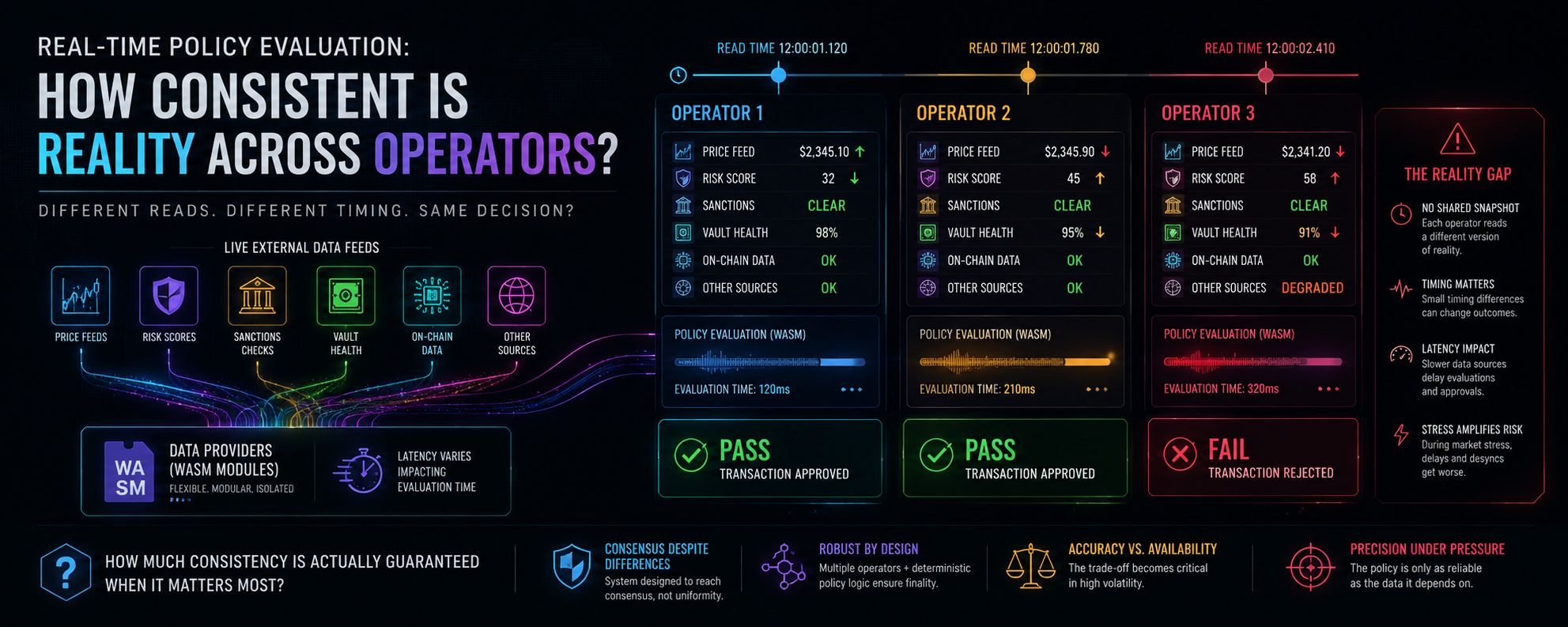
When an operator receives a transaction, it doesn’t just check pre-set rules. Instead, it pulls in live data right at that moment from different sources—price feeds, risk scores, sanctions checks, vault health, all of it. Everything gets combined into a simple pass or fail decision before the transaction goes through.
At first, that design feels solid. It’s modular, flexible, and easy to extend. Naturally, I assumed the outcome would be consistent across operators, as long as they were using the same inputs.
But that’s where things get a bit messy.
Each operator pulls this external data on its own, in real time. There’s no shared snapshot. So if a price feed updates between two reads, or a risk score changes mid-evaluation, different operators could technically be working with slightly different versions of reality.
In theory, the system should still reach consensus. That’s the whole point of having multiple operators. But the process getting there isn’t as clean as it looks. A transaction might pass, but you don’t really know how close it was to failing—or if slightly different timing would’ve changed the result.
Another layer to this is how the data gets processed. These external sources run as WASM modules inside each operator. That’s great for flexibility, but it also introduces latency. If a data provider is slow—not down, just slow—that delay carries into the evaluation time. And that delay affects how fast a transaction gets approved.
What I’m unsure about is how the system handles that delay. If a data source lags, does the system wait? Does it fail safely? Or does it move forward anyway?
I ran into a similar issue recently with a trade. I assumed a risk check was instant, but it turned out to be delayed. That small misunderstanding cost me a good exit. It’s a reminder that “real-time” doesn’t always mean “perfectly synchronized.”
The bigger concern shows up during market stress—exactly when timing and accuracy matter the most.
If data providers are under heavy load, or updates are happening rapidly, does the system keep up? Or does it start lagging right when precision is critical?
At the end of the day, the policy is only as reliable as the data it depends on. And if that data isn’t synchronized closely enough across operators, it raises a simple but important question:
how much consistency is actually guaranteed when it matters most?
