
Most blockchain discussions still orbit around narratives: faster chains, cheaper fees, louder ecosystems. But AI-driven systems don’t care about narratives. They care about infrastructure reliability, continuity, and economic execution. As artificial intelligence shifts from experimentation to deployment, blockchains that fail to meet real operational requirements will quietly fall out of relevance.
This is where @Vanar enters the conversation — not as a trend, but as infrastructure aligned with how AI systems actually operate in production environments.
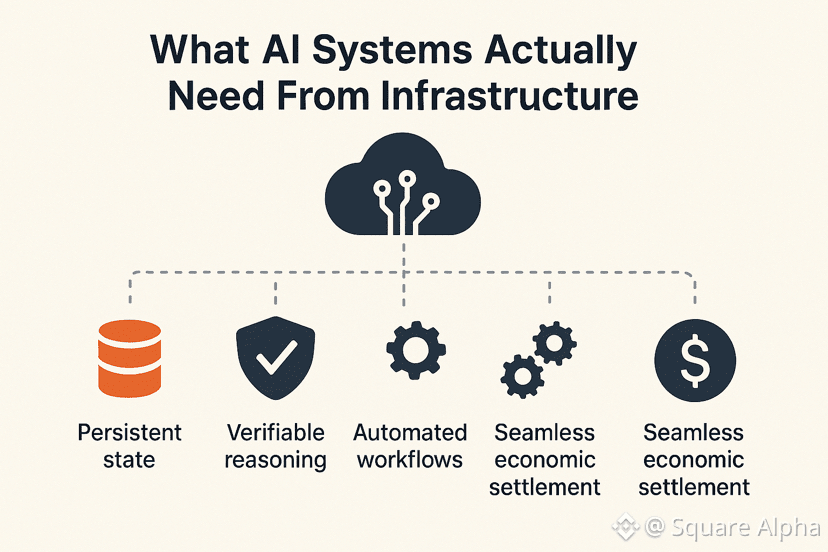
What AI Systems Actually Need From Infrastructure
AI workloads behave differently from human-driven applications. They don’t “log in.” They don’t wait for approvals. They continuously process information, retain context, and act based on probabilistic reasoning.
For infrastructure to support this, it must offer:
Persistent state instead of session-based interaction
Verifiable reasoning instead of black-box execution
Automated workflows instead of manual triggers
Seamless economic settlement without human UX
Vanar’s architecture reflects these realities. It focuses on functionality before optics, which is why its development roadmap emphasizes systems that work under autonomous conditions.
AI-Ready Infrastructure
AI-ready infrastructure means more than integrating AI tools. It refers to base-layer systems capable of supporting continuous intelligence. AI-ready infrastructure must support persistent memory, native reasoning, automated execution, and programmable settlement. AI-ready infrastructure cannot depend on off-chain coordination or human intervention. AI-ready infrastructure must scale across environments while remaining economically deterministic. Vanar is designed around AI-ready infrastructure principles, with $VANRY enabling value flow across this intelligent stack.
Why Proof Matters More Than Claims
Many platforms promise AI compatibility. Few demonstrate it. Vanar distinguishes itself by shipping live components that show readiness in practice:
myNeutron proves that contextual memory can exist at the infrastructure level
Kayon demonstrates native reasoning and explainability
Flows connects intelligence to controlled, automated execution
These are not abstract ideas. They are operational systems, already validating Vanar’s approach.
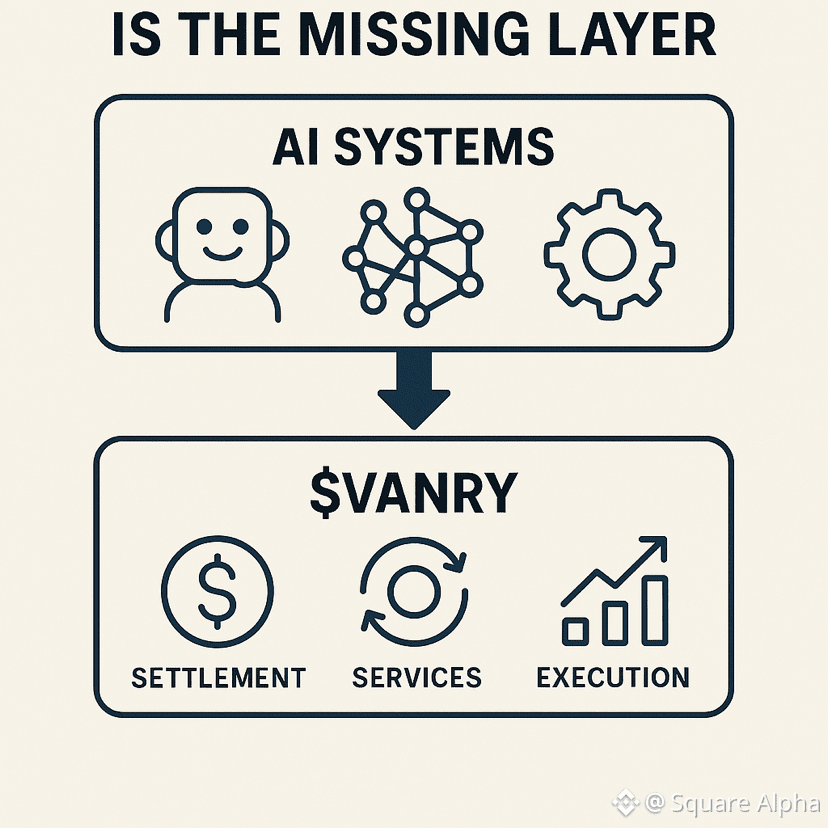
Economic Activity Is the Missing Layer
AI systems are useless if they cannot participate in real economies. They need to pay, receive, settle, and account for value autonomously. This is where VANRY plays a central role.
Rather than acting as a speculative placeholder, VANRY functions as an economic primitive — enabling settlement between intelligent processes, services, and execution layers. This shifts the conversation from demos to deployment.
Cross-Chain Expansion as a Necessity, Not a Feature
Intelligence does not remain isolated. Vanar’s cross-chain availability, beginning with Base, allows its infrastructure to interact with broader ecosystems. This increases surface area for usage, coordination, and settlement without fragmenting the core architecture.
For AI-driven systems, interoperability is not optional — it’s foundational.
Why This Approach Scales Over Time
New L1 launches often struggle because they solve problems that no longer matter. Vanar focuses on problems that are becoming unavoidable: automation, intelligence, and economic execution without humans in the loop.
As AI adoption accelerates, infrastructure that supports continuous operation and real settlement gains relevance automatically. That is how long-term value accrues — quietly, through usage rather than hype.
Conclusion
The next phase of blockchain relevance will not be driven by marketing cycles. It will be driven by infrastructure that works under autonomous conditions. Vanar is positioning itself in that layer, with $VANRY anchoring real economic activity across intelligent systems.
This is not about chasing trends.
It’s about building infrastructure that remains useful when trends disappear.