

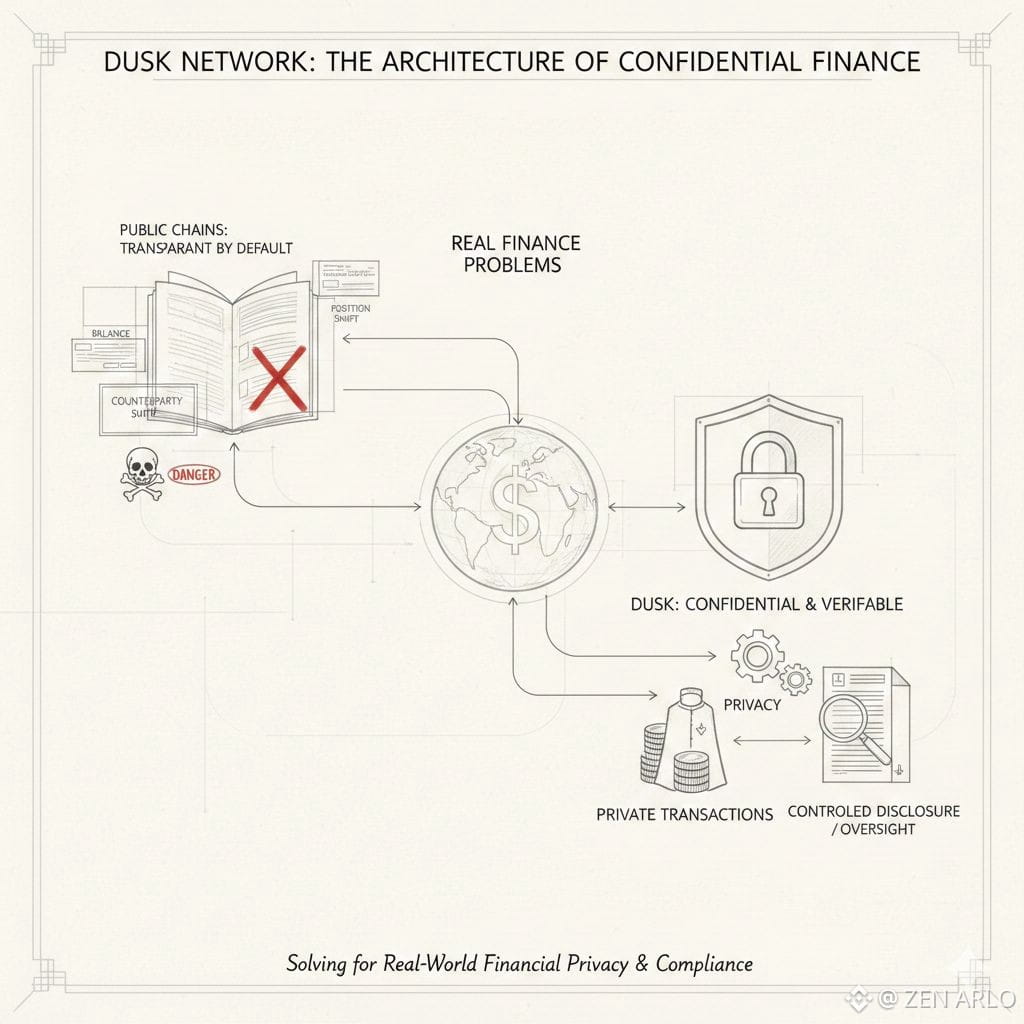
Dusk, I see a project that starts from a real finance problem instead of a trend. Most public chains are transparent by default, and that sounds fair until you imagine regulated markets living on that surface. Every balance, every counterparty relationship, every position shift becomes public data. In real financial systems, that is not just inconvenient, it can be dangerous. Dusk is built around the idea that confidentiality is not optional for finance, but neither is verification. So the chain is designed to keep transactions private when they should be private, while still allowing controlled disclosure when oversight is required.
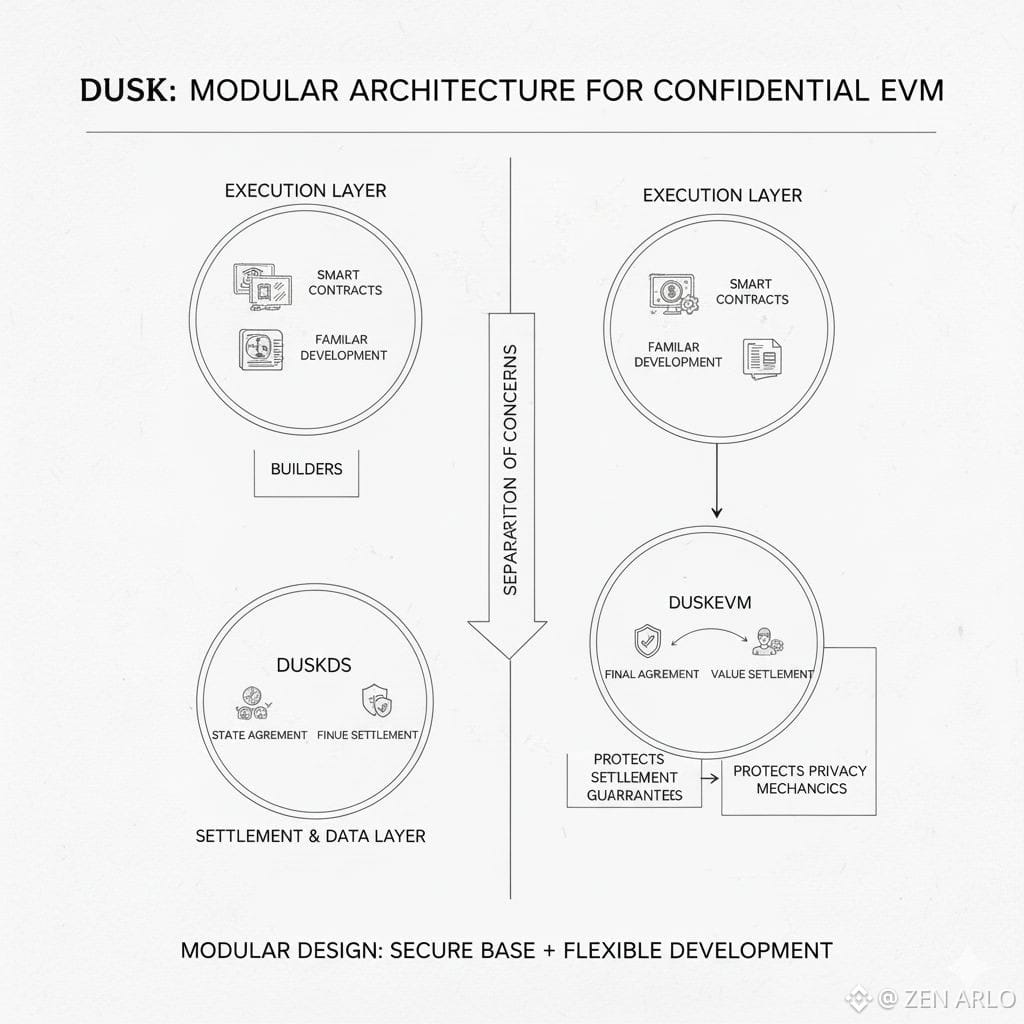
Dusk matters. It is not trying to be everything for everyone. It is aiming at the kind of activity that only moves on chain if privacy, settlement finality, and compliance logic are baked in from day one. If Dusk succeeds, it becomes a settlement layer for tokenized assets and institutional grade applications where participants can transact without broadcasting sensitive information to the world, and yet still meet the reality of regulated workflows.
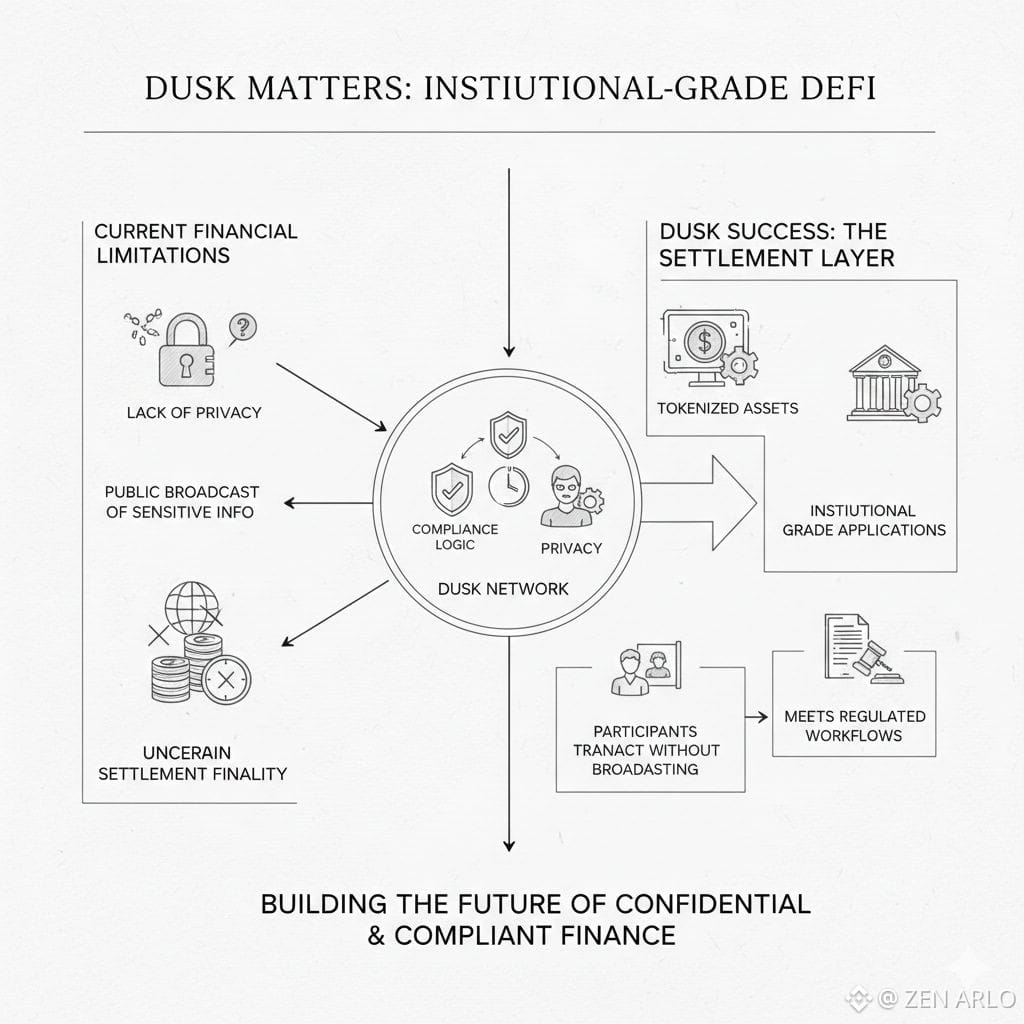
Dusk Behind the scenes, the project is not built as a single monolith. Dusk is modular by design. It separates the settlement and data layer from the execution layer. In plain terms, DuskDS is where the chain agrees on state, reaches final settlement, and validates how value moves. DuskEVM is where smart contracts run in an EVM equivalent environment. That split is important because it lets Dusk protect its settlement guarantees and privacy mechanics at the base, while still offering a familiar development environment for builders who want EVM style tooling.
Dusk feel different is how it treats transactions at the settlement layer. It is not only one transaction model. It supports two native ways value moves, each built for different realities. Moonlight is the public account based route, closer to what most chains do. Phoenix is the shielded note based route, designed for confidential transfers using zero knowledge proofs. The big point is that privacy is not just an app feature sitting on top. It is a first class transaction model that the base layer knows how to verify. That is a harder approach, but it is also the approach that matches the promise of finance grade confidentiality.
Dusk Phoenix is also where the narrative becomes more than a marketing line. Dusk has published work around Phoenix security proofs, which matters because privacy systems cannot rely on vibes. They need formal guarantees and careful engineering. On top of that, Dusk supports the idea of selective disclosure through viewing keys, which is how you can keep day to day flows confidential while still enabling authorized verification when it is legitimately needed.
Dusk Now connect that to the pieces you mentioned, because this is where the project becomes a complete story instead of a collection of terms. XSC is the Confidential Security Contract standard, designed for issuing and managing confidential securities on chain. Phoenix is the privacy engine that makes confidential value transfer possible. Zedger is the hybrid approach aimed at security tokens, where you need privacy but you also need the mechanics that securities demand, things like regulated ownership constraints, lifecycle logic, and the ability for appointed parties to reconstruct cap tables at specific moments under defined rules. When you place those together, you get the direction Dusk is taking: tokenized securities and regulated assets that can actually live on chain without turning the market into a glass box.
Dusk Compliance is not only about token rules though. It is also about identity and eligibility. Dusk introduced Citadel as a zero knowledge KYC framework, which is basically an attempt to let participants prove claims without exposing everything. That matters because the identity layer is often where privacy dies in regulated systems. Dusk is trying to make identity verification compatible with confidentiality rather than a forced tradeoff.
Dusk So what exists today, as a real project you can evaluate, is not just a thesis. There is a full documentation stack, an operator path that describes different node roles, and an execution layer that targets EVM compatibility for developer adoption. On the protocol side, the node software continues to ship releases, which is a good signal that the chain is being treated like infrastructure, not just an idea. On the product side, Dusk also presents a dedicated surface for tokenized asset markets through Dusk Trade, which gives a clear hint about how they want users to interact with the ecosystem over time.
Dusk The token story fits the infrastructure logic. The ERC20 contract you shared, 0x940a2db1b7008b6c776d4faaca729d6d4a4aa551, represents DUSK on Ethereum. That is the liquid representation many people first encounter. But the project tokenomics describes a longer lifecycle: an initial 500 million supply represented across ERC20 and BEP20, plus emissions distributed over decades to reward staking and secure the network, reaching a maximum supply of 1 billion over time. DUSK is positioned as the utility token that powers staking, network fees, and participation in consensus. The migration path into native DUSK is also part of the story, because a finance focused Layer 1 ultimately wants its native asset to live and operate on its own settlement layer, not only as a wrapped representation elsewhere.
Dusk What makes the project useful is how the benefits trace directly back to the design choices. Confidentiality at the transaction model level means Dusk can support private transfers without forcing every application team to reinvent privacy from scratch. A modular architecture means the chain can protect settlement integrity and still offer EVM style execution. Identity primitives like Citadel create a path where regulated verification does not automatically mean full exposure. And the emphasis on final settlement is aligned with financial markets where probabilistic confirmation is not good enough.
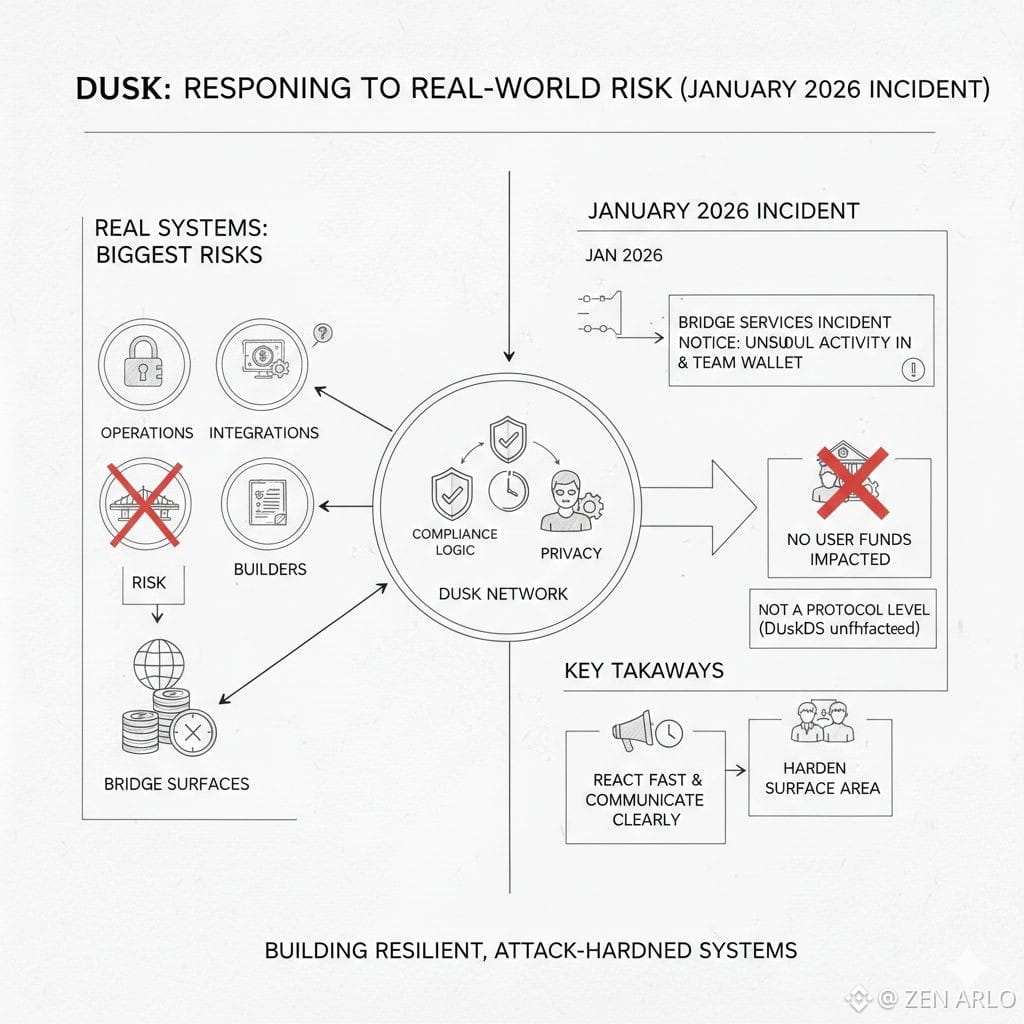
Dusk In real systems, the biggest risks are not always in the cryptography. They show up in operations, integrations, and bridge surfaces. In January 2026, Dusk published a bridge services incident notice describing unusual activity involving a team managed wallet used in bridge operations and pausing bridge services as a precaution, while stating that based on available information no user funds were impacted and it was not a protocol level issue on DuskDS. That kind of update matters because it tells you where the risk sits in practice and how the team responds when something looks off. The best chains are not the ones that never face issues, they are the ones that react fast, communicate clearly, and harden the surface area that actually gets attacked.
From here, the next phase looks like an execution phase, not a narrative phase. The obvious near term focus is bridge hardening and safe resumption after the incident response work. In parallel, DuskEVM maturity and ecosystem tooling will matter because a finance focused chain still needs builders and applications that can use its privacy and compliance primitives without friction. And the bigger long term win remains the same: real issuance and real markets for confidential security tokens and tokenized assets, powered by XSC and the hybrid compliance realities Zedger is designed to support.
Dusk is building for the world where on chain finance is real finance, not only a public experiment. Privacy is treated as a structural requirement, auditability is treated as a controlled capability, and settlement is treated as final, not probabilistic. That is a disciplined lane. It is harder than chasing general purpose attention, but if the project keeps executing, it is also the kind of lane where long term relevance can compound.
Dusk In the last 24 hours, what is new is mostly visible through activity and market signals rather than a fresh official announcement. The ERC20 contract continues to show ongoing transfer activity on chain, and market trackers show the usual 24 hour price and volume changes. The most meaningful official project update in January 2026 remains the bridge incident notice, and until a newer official post lands, the best way to read the short term is to watch for bridge status communications, infrastructure releases, and signs of deeper DuskEVM application activity.
