


For a long time people thought blockchains were only about money
Trading
Payments
Tokens
But blockchains were never just financial
They are coordination systems
They decide ownership
Rules
Who can act and who cannot
The real problem Web3 never solved was data
Real apps need large data
Photos
Videos
Game files
AI datasets
User records
Long history
Putting this directly onchain is too slow and too expensive
So the industry took shortcuts
Data is stored somewhere else
Cloud servers
Centralized storage
Then a small reference is placed onchain
This works technically
But it breaks the promise of Web3
If the real data can disappear
Be censored
Or priced out
Then the app is only half onchain
That missing piece is what Walrus is trying to fix
Storage Should Not Be a Hack
Walrus treats storage as a real Web3 service not a workaround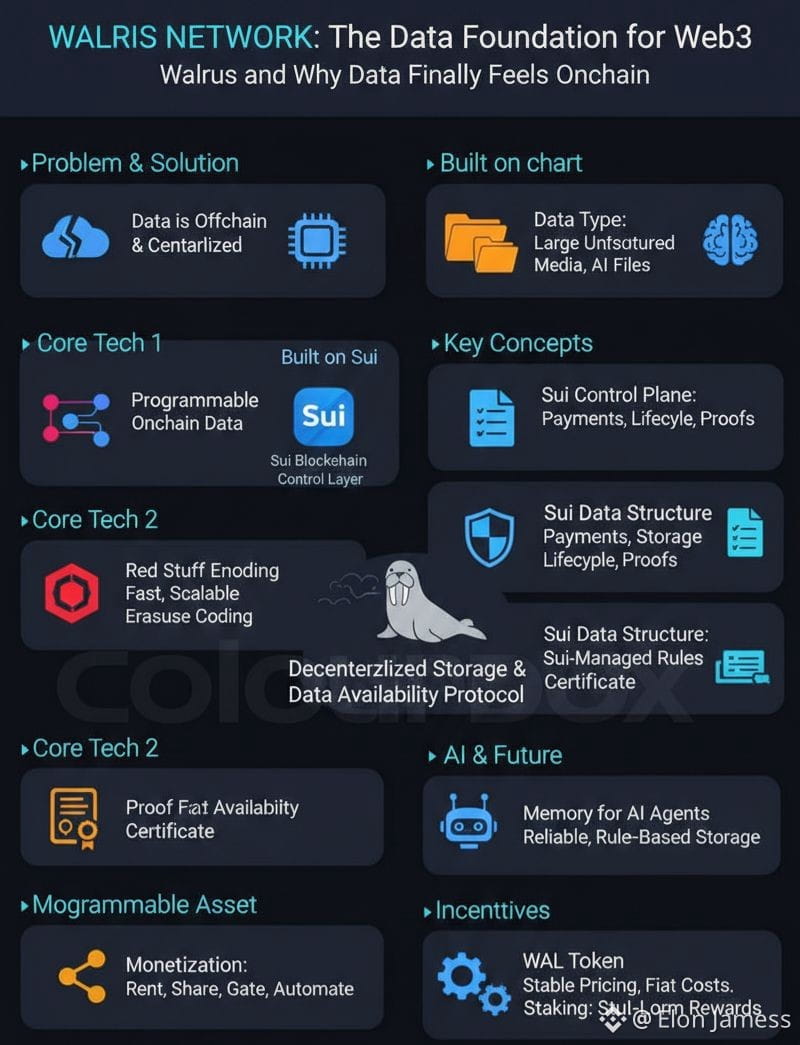
The idea is simple
If data is reliable decentralized and verifiable
Then it becomes a foundation for new business models
You no longer trust one company
You trust code and incentives
Walrus is not just a place to put files
It turns data into something programmable
Something contracts and apps can depend on
That is a big shift
What Walrus Actually Is
Walrus is a decentralized storage and data availability protocol
It is built for large unstructured data
Media files
AI data
Archives
Game assets
It stores data as blobs
Not small pieces of metadata
The important part
Walrus uses Sui as its control layer
This means storage is coordinated onchain
Payments
Rules
Lifecycle
Responsibilities
Mysten Labs described Walrus as a secure blob store
It launched first as a developer preview for Sui builders
With plans to expand to other ecosystems
This is storage with coordination not just storage with nodes
Making Data Behave Like an Onchain Asset
Once storage is programmable
It can be rented
Shared
Gated
Monetized
Just like tokens
This is why Walrus matters
It makes data a dependable building block
Not an external dependency
It is not only about keeping files safe
It is about making data usable inside smart contracts
Why Decentralized Storage Always Felt Hard
Decentralized storage is not new
But developers avoid it
Replication costs too much
Recovery is slow
Proof systems are heavy
Coordination between nodes is painful
One major issue mentioned in the Walrus design
Replacing offline nodes often requires huge data transfers
This removes the benefit of reduced replication
At scale this becomes unworkable
Walrus keeps decentralization
But reduces the pain
The Core Tech Red Stuff Encoding
Walrus uses a special erasure coding system called Red Stuff
In simple terms
Files are split into parts
Smart redundancy is added
Parts are spread across many nodes
No single node holds the full file
If some nodes fail
The file can still be recovered
Red Stuff uses fast decoding
Low overhead
And scales to hundreds of nodes
Recovery does not require massive network transfers
This makes storage stable under real world conditions
Nodes going offline
New nodes joining
Hardware failures
Why Sui Handles the Coordination
Walrus did not create its own blockchain
Instead it uses Sui to manage
Payments
Rules
Lifecycle
Proofs
This keeps the system simpler
And makes storage logic readable onchain
Anyone can verify
Who paid
What was stored
For how long
Who is responsible
Storage becomes transparent and programmable
Proof That Data Is Really Stored
Storage only matters if people trust it
Walrus introduces Proof of Availability
This is an onchain certificate on Sui
It proves that storage service has started
Think of it as a public receipt
Apps can reference it
Contracts can depend on it
Incentives are tied to it
Storage becomes a public service
Not a private agreement
WAL Token and Practical Pricing
Most Web3 projects fail because users hate unstable costs
Storage should feel boring and predictable
Walrus uses the WAL token for payments
But prices are designed to stay stable in fiat terms
Users pay a clear amount
For a clear duration
Storage nodes and stakers are paid fairly
This makes Walrus usable as real infrastructure
Not just a token experiment
Staking and Long Term Incentives
Walrus uses proof of stake
WAL holders can stake
Support the network
And earn rewards
Rewards are higher early
And stabilize as the network grows
This shows long term thinking
Not hype chasing
Storage networks win by becoming boring and reliable
The Data Economy Angle
When data becomes programmable
It stops being just a cost
Apps can store data
Control access
Charge for usage
Automate payments
No middlemen
This creates new data based business models
Fully onchain
Walrus becomes more than storage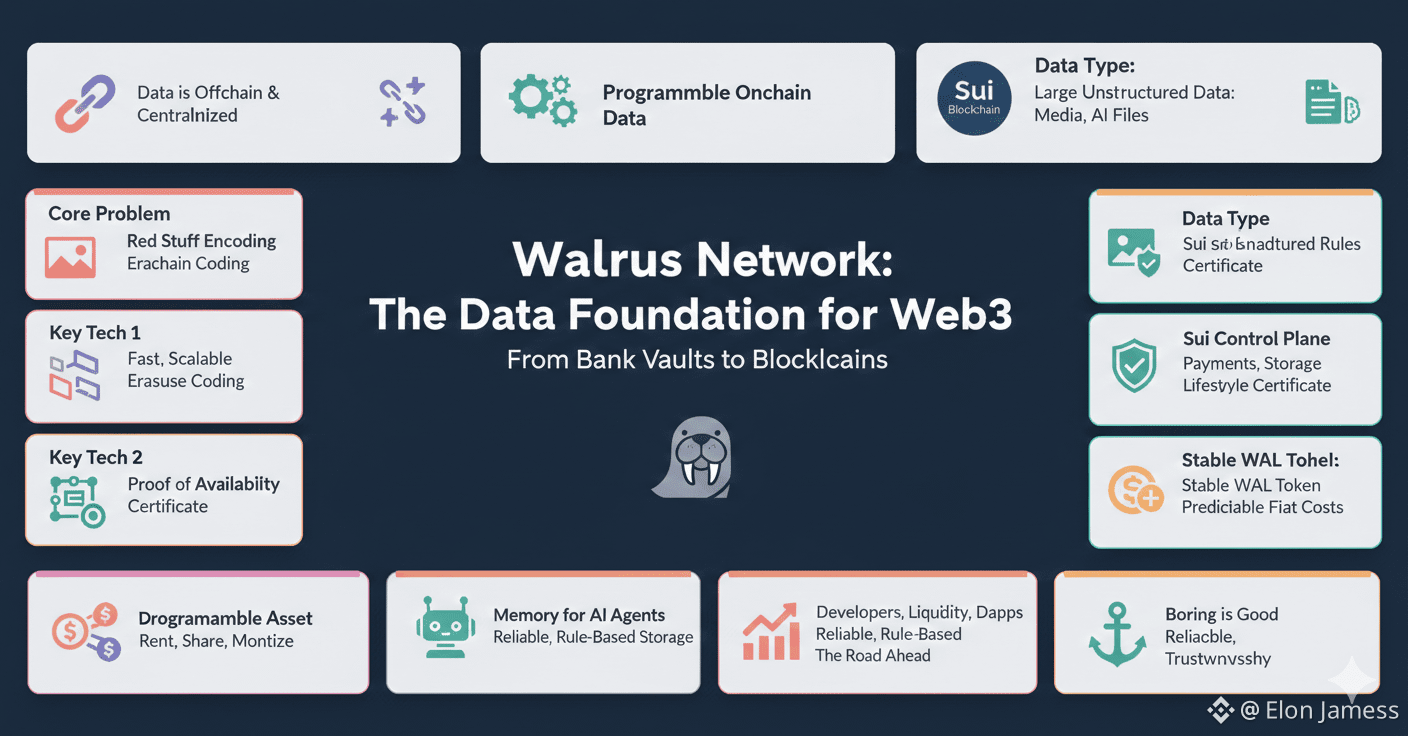
It becomes a composable layer for apps and autonomous agents
Why AI Fits Perfectly
AI agents need memory
Logs
Data access
Onchain AI needs predictable storage
With clear rules and costs
Walrus is built exactly for this
Reality Check and What Success Looks Like
Walrus still needs real usage
The network must prove
It can handle stress
Costs remain stable
Incentives stay aligned
Success is simple
Developers use Walrus by default
Because it works
Because it is predictable
Because it is boring in a good way
Final Thoughts
Web3 will not be limited by smart contracts
It will be limited by data
Serious apps still rely on Web2 storage
Because nothing else works reliably
Walrus challenges that idea
If it succeeds
Data becomes as programmable as value
And storage finally becomes a real onchain service layer