

When I sit with Dusk Network, I don’t think about it as something that wants to redefine how people behave. I think about it as a system that assumes people already know how they want to behave and quietly adapts to that reality. That framing shapes everything else for me. It shifts the conversation away from novelty and toward durability. I start asking whether this is something that could be left running in the background of real financial activity without constantly demanding attention, education, or belief from the people using it.
What becomes clear after spending time with the design is that Dusk seems to expect users who are not curious about infrastructure at all. Most people interacting with financial systems care about outcomes, not mechanics. They want transactions to complete, records to exist when needed, and sensitive information to remain appropriately private. They don’t want to decide how much cryptography is enough for each interaction, and they don’t want to manage compliance as a manual process. The architecture here reflects that assumption. Privacy and auditability are not treated as philosophical opposites but as practical requirements that must coexist if the system is going to be used in regulated environments.
I find the modular approach especially revealing, not because modularity is fashionable, but because it signals a willingness to accept change. Financial infrastructure rarely stands still. Rules evolve, products evolve, and expectations evolve. Systems that hard-code too many assumptions tend to fracture under that pressure. By separating responsibilities and allowing components to evolve independently, Dusk feels designed for maintenance rather than perfection. From a user’s perspective, this matters in subtle ways. A system that can adapt without forcing users to relearn or reconfigure their behavior reduces friction over time, even if that adaptability is never explicitly noticed.
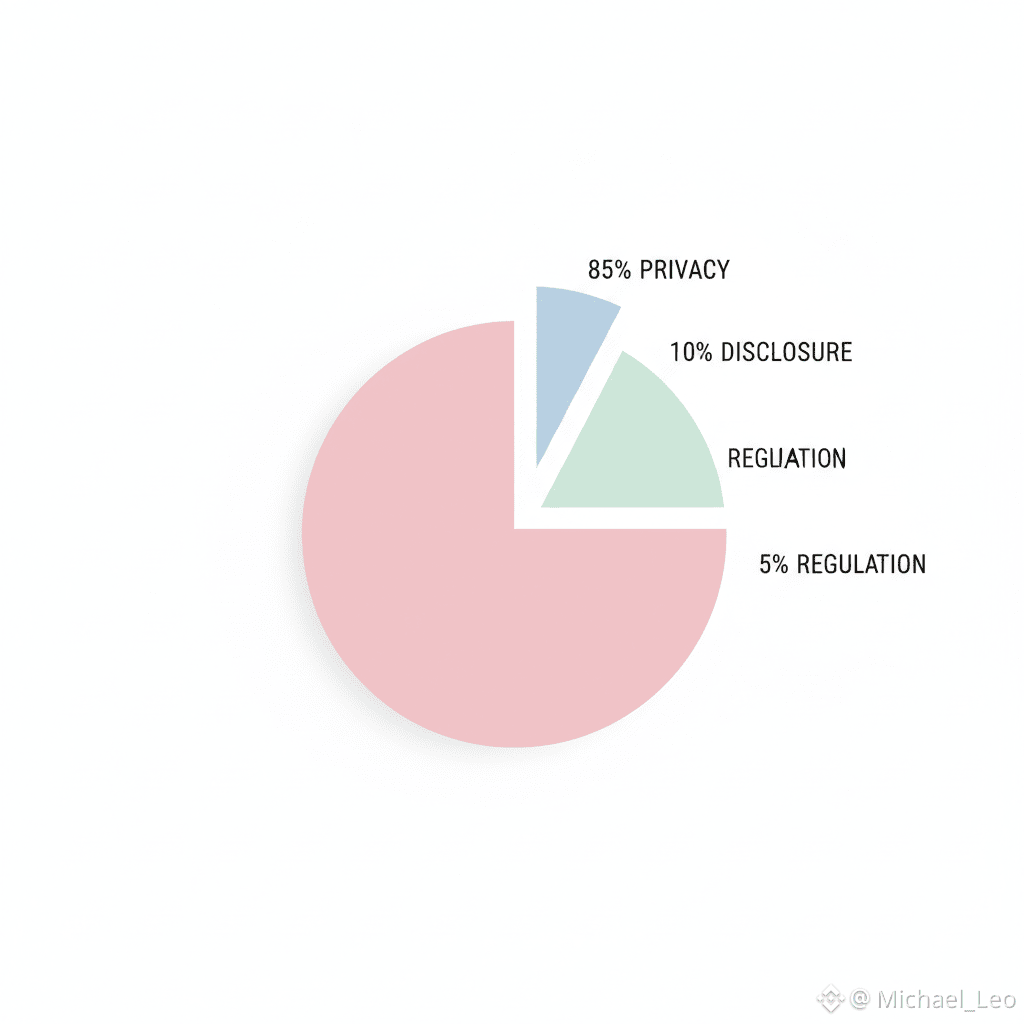
One area where theory often collapses in practice is disclosure. In real financial life, privacy is selective and contextual. You don’t reveal everything to everyone, but you also don’t operate in total secrecy. You disclose when required, to the right parties, under defined conditions. Dusk’s approach reflects that reality. Instead of forcing a binary choice between transparency and privacy, it supports controlled disclosure. That tells me the system is designed for environments where accountability exists and must be provable, not merely asserted. It’s a pragmatic view that aligns closely with how institutions already operate.What I appreciate most is how complexity is handled. The system does not appear to celebrate its own sophistication. The difficult parts are kept where they belong, at the protocol level, rather than pushed onto the user as a learning requirement. Everyday users should not need to understand transaction modes, cryptographic proofs, or compliance logic to complete ordinary actions. When systems insist on that understanding, they turn participation into work. Here, the intent seems to be the opposite. Complexity exists to protect users, not to test them.
I’m cautiously interested in how Dusk supports regulated financial applications and tokenized assets, not because the idea is ambitious, but because the execution environment is unforgiving. These use cases are stress tests by nature. They expose how a system behaves under audits, disputes, and long-term obligations. Marketing examples don’t matter much in this context. What matters is whether the system can remain predictable and legible when something goes wrong. The design choices suggest an awareness that trust in finance is built through consistency and verifiability over time, not through surface-level innovation.
When I think about real applications on this infrastructure, I imagine quiet workflows rather than showcase products. Settlement processes that must run reliably every day. Issuance mechanisms that need to remain compliant years after deployment. Financial agreements that require discretion without ambiguity. These scenarios don’t reward spectacle. They reward systems that behave the same way under pressure as they do in ideal conditions. That’s where infrastructure proves its value, and it’s where many systems quietly fail.
The role of the token in this environment feels intentionally restrained. It functions as part of the system’s operation and alignment rather than as something users are meant to constantly engage with. That restraint matters. In practical financial infrastructure, tokens work best when they fade into the background and support coordination without becoming a focal point. Users should feel the system working, not the token demanding attention.
Stepping back, what this approach suggests to me is a maturing understanding of what consumer-facing blockchain infrastructure actually needs to be. Not louder, not more expressive, but calmer and more reliable. Systems that fit into existing financial behavior instead of trying to replace it stand a better chance of being used consistently. Dusk appears to be built with that assumption at its core. It doesn’t ask users to admire it. It asks to be trusted quietly, and over time, that may be the most meaningful ambition an infrastructure project can have.
