
Web3 today often feels less like a unified ecosystem and more like a collection of isolated islands. Ethereum dominates DeFi, Solana powers consumer apps and games, and Sui experiments with new execution models. Each chain excels in its own way, but getting them to share data reliably is still expensive, fragile, and complex. Walrus enters this landscape with a deceptively simple idea: what if data itself didn’t belong to any single blockchain?
Rather than positioning itself as “just another decentralized storage network,” Walrus is aiming to become a neutral data layer that any chain can use. The core vision is to treat data as a shared, programmable resource—one that applications across ecosystems can store, verify, and retrieve without friction. In that sense, Walrus is less like a hard drive and more like a universal data commons for Web3.
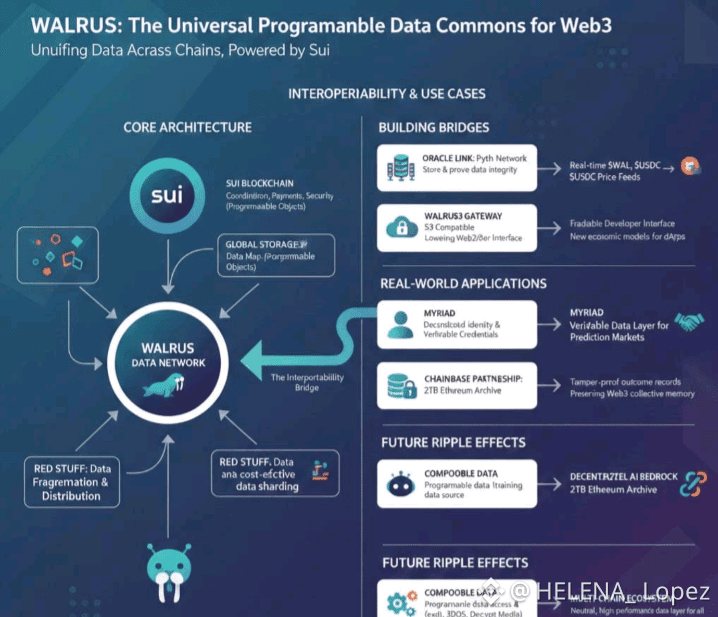
At the technical level, Walrus makes two architectural choices that set it apart. The first is its use of an erasure-coding system called RedStuff. Instead of storing full files or simple replicas, data is broken into small fragments and distributed across a global network of storage nodes. Only a subset of those fragments is required to reconstruct the original data, which improves fault tolerance while keeping costs low. This approach makes data both resilient and efficient at scale.
The second design choice is arguably more important for interoperability. Walrus does not run its own standalone blockchain. Instead, it uses the Sui blockchain as its coordination and verification layer. Payments, metadata, access rules, and proofs of storage all live on Sui as programmable objects. Storage nodes simply prove that they are holding the correct data. This separation allows Walrus to act as a verified warehouse, while Sui functions as a transparent notary that other chains can trust.
For cross-chain usage, Walrus relies on familiar infrastructure rather than reinventing everything from scratch. Price discovery is handled through integration with Pyth Network, allowing storage payments to be priced accurately using assets like USDC or WAL. This secures the economic layer and enables predictable costs for applications coming from different ecosystems.
Developer adoption is addressed through WalruS3, an open-source, S3-compatible gateway built with Chainbase. Any team already using AWS S3 can interact with Walrus using tools they already understand, significantly lowering the barrier for Web2 and multichain developers. Storage itself is also tokenized on Sui, meaning capacity can be owned, leased, or traded by smart contracts—turning storage into a composable onchain asset.
Since launching mainnet in March 2025, real use cases have begun to emerge. Humanity Protocol uses Walrus to store verifiable identity proofs, allowing credentials to be portable across dApps without exposing personal data. Myriad, a prediction market platform, anchors market outcomes and evidence on Walrus, creating tamper-resistant records that other chains and AI systems can reference. Meanwhile, Chainbase is experimenting with migrating terabytes of Ethereum archive data to Walrus, with the goal of building a decentralized data lake for analytics and AI training.
Looking ahead, the implications go beyond storage. Data on Walrus can be governed by smart-contract rules—who can access it, under what conditions, and at what cost. This creates a foundation for decentralized AI, composable analytics, and truly multichain applications. In a future where Web3 remains inherently multichain, a neutral, programmable data layer may be just as important as the chains themselves.
Walrus is ultimately a bet on connection over isolation. By addressing fragmentation at the data layer, it aims to make cross-chain applications less fragile and more practical. Whether that vision succeeds at scale remains to be seen, but the building blocks for a connected Web3 are clearly taking shape.