
I still remember the first time I watched a short demo of Walrus and felt a real flutter of hope because it looked like someone had decided to treat data with care and respect and not just as a line item on a balance sheet, and that feeling stuck with me as I read more about how they are building things.
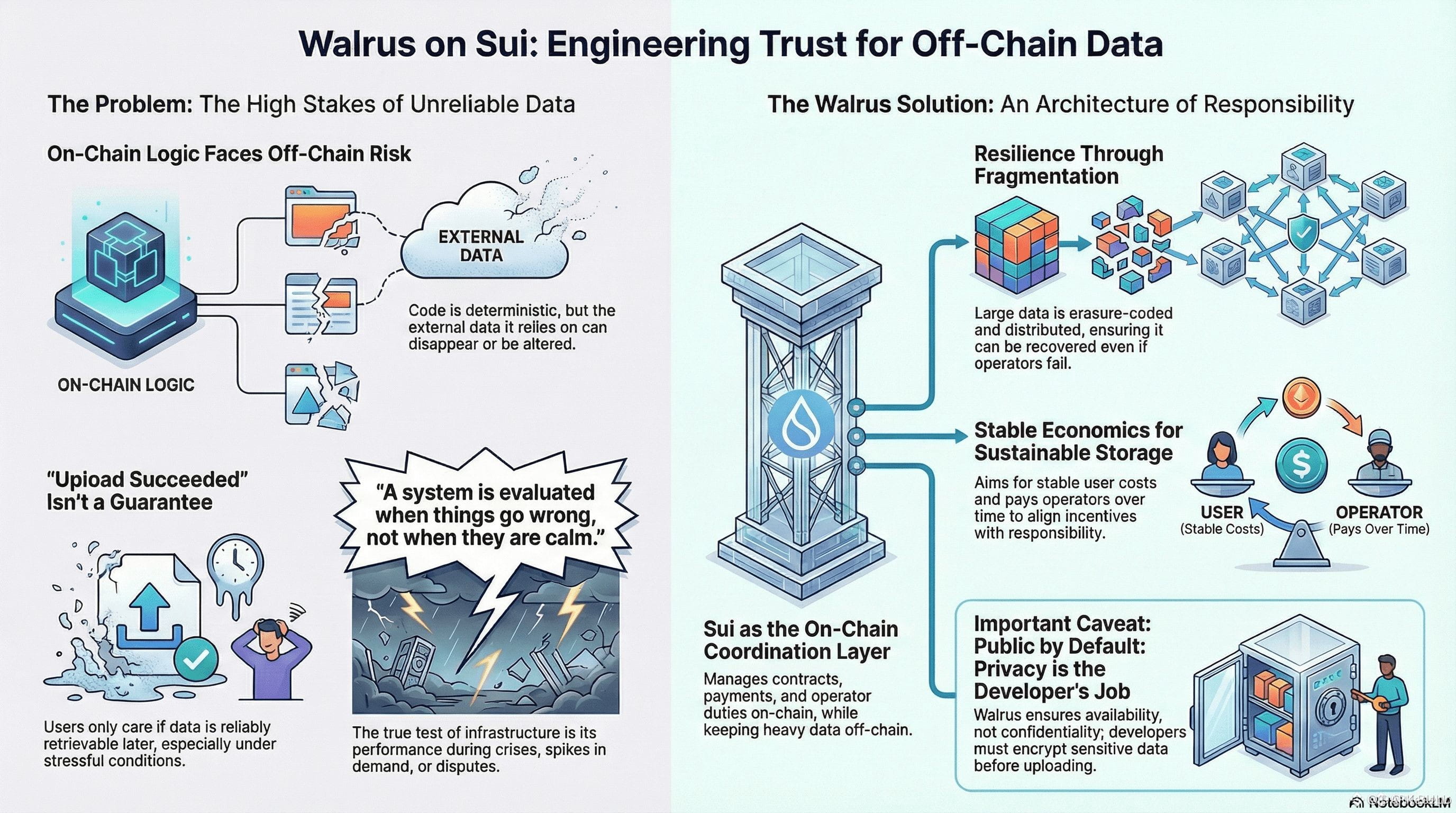
Theyre building a storage system that breaks big files into many pieces then spreads those pieces across many independent nodes so if some of those nodes go offline the file still comes back together like it always should, and they call the encoding Red Stuff which is a two dimensional approach that aims to keep costs down while keeping reliability high.
What I find beautiful about the design is how simple it feels in human terms because there is a clear control layer on the Sui blockchain that tracks who paid for storage who is responsible for keeping it and how availability is proven so nothing important is hidden behind mystery and trust becomes verifiable.
If you are a developer you will notice the team put effort into making tooling approachable so you can register a blob pay for storage and retrieve it with proofs using command line tools and examples from their repositories which lowers the friction to actually try things in the real world.
Theyre also thinking about the money side in a practical way because the WAL token is used to pay storage and reward nodes and the protocol has mechanisms intended to smooth payments so cost becomes something you can plan for rather than a guessing game.
I get emotional when I think about creators and researchers who have felt trapped by a single cloud vendor or terrified that a hard drive failure will erase years of work because Walrus promises an alternative that feels like protection and freedom at the same time.
We are seeing uses already from demo sites to data sets for machine learning where teams want verifiable availability and predictable cost instead of brittle one off setups and the community projects and examples show that people are beginning to build not just to test but to produce.
Security and privacy matter to me and to many people I know and Walrus takes a layered approach so nodes never hold whole files plain and the system issues proofs onchain so you can check that data is still there without having to trust a single operator.
There are real risks that I would not sugarcoat because distributed storage is complex and token economics can behave unpredictably so they need to keep improving reputation systems repair strategies and incentive alignment while staying transparent about trade offs.
When I imagine the next few years I see engineers and creators choosing storage that treats their work like something that matters and I see projects building on top of an infrastructure that is designed to be resilient and fair which makes me feel hopeful in a way that is practical not naive.
If youre curious I would suggest looking at the whitepaper the docs and the GitHub to feel the same grounded confidence I did because the technical writing is clear and the code is public which is important if youre going to trust something with your data.
In the end this is a human technology and what matters is how it serves people so if youre building storing or protecting something precious I want you to feel the relief I felt when I first read about Walrus because there are teams trying to build infrastructure that respects our work our stories and our right to keep control and that hope is worth watching closely.