

In most DeFi projects tokens arrive late.
First comes the application. Then come liquidity programs, yield incentives and growth campaigns. Only after the system is already live does a token appear. Often it is bolted on as governance or worse, as a financial asset still searching for a meaningful role.
Walrus took a very different path.
The WAL token was not created to ride a market narrative or to retroactively justify a protocol’s existence. It was designed from the beginning as an economic coordination tool. One meant to solve a specific structural problem that DeFi had largely ignored. How to build decentralized, privacy-preserving data storage that is verifiable, sustainable and economically fair.
To understand Walrus you have to start with that motivation. Not price action. Not speculation. Not hype. But the problem it was built to solve.
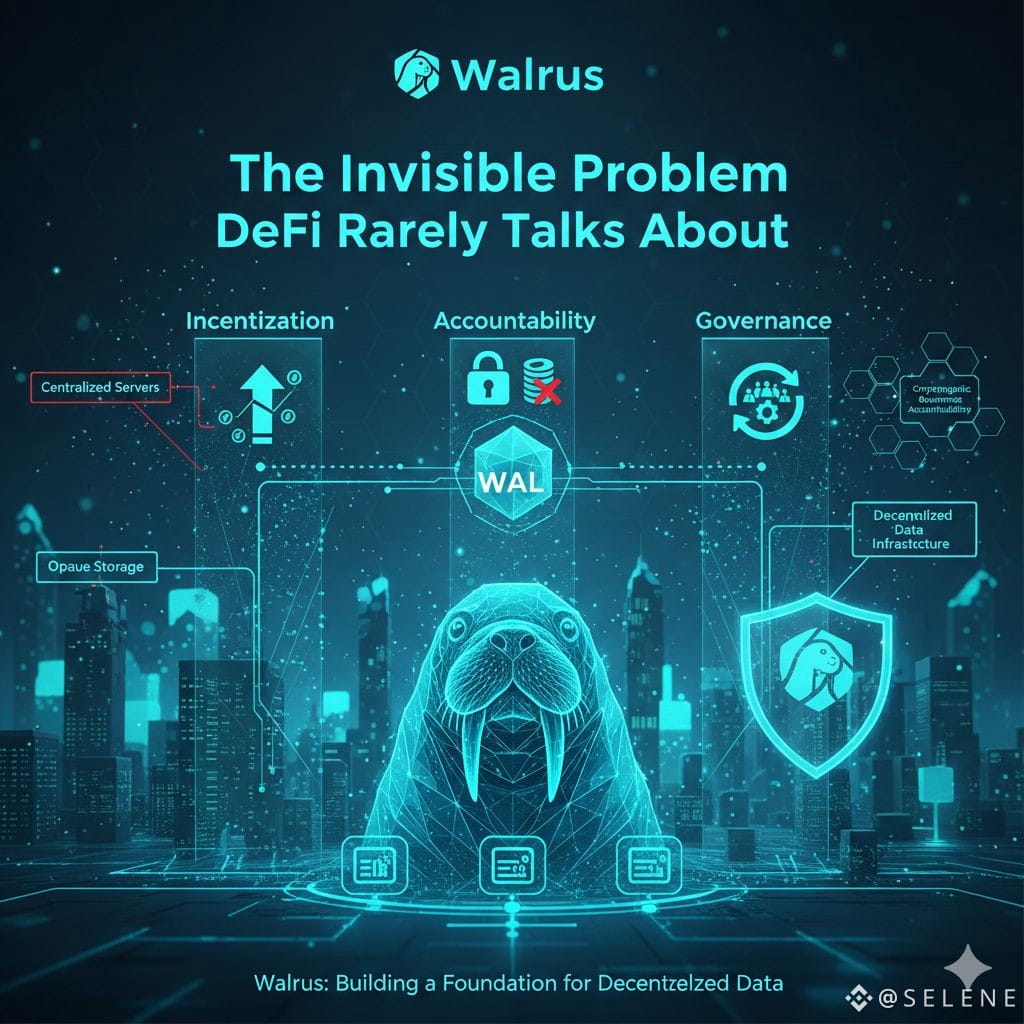
The Invisible Problem DeFi Rarely Talks About
DeFi loves to talk about decentralization. But usually only at the execution layer.
Smart contracts are decentralized. Consensus is decentralized. Validators are decentralized. Yet the data these systems rely on often is not.
Modern DeFi applications depend heavily on data. Historical state snapshots. Transaction logs. Off-chain inputs. Proofs. Checkpoints. User-generated content. Increasingly, entire applications rely on large datasets that simply do not fit neatly on chain.
And where does most of this data live today?
On centralized servers. On cloud providers. On semi-centralized storage networks with opaque guarantees and unclear economics.
This creates a quiet but serious contradiction. Financial logic may be decentralized, but the data it depends on often is not. That introduces censorship risk. Single points of failure. Unpredictable pricing. And weak assurances around long-term availability. For privacy-sensitive applications, the problem deepens further. Metadata leaks, custodial control and hidden surveillance become real concerns.
DeFi has been building higher and faster, but it has been standing on a shaky foundation.
Walrus emerged to fix that foundation.
Why Storage Is Not Just Infrastructure
Storage is often treated as a solved problem. Something external. Something you plug in and forget.
But in decentralized systems storage is not neutral. It shapes what applications can do. How long they can exist. And who ultimately controls access to information.
If storage providers can disappear without consequence, data permanence is an illusion. If pricing is arbitrary, long-term applications become fragile. If availability cannot be verified, trust quietly creeps back into a system that claims to be trustless.
Walrus was designed with a simple but radical idea. Decentralized finance needs decentralized data infrastructure that is built with the same rigor as blockchains themselves.
Not as an afterthought. Not as a wrapper around Web2 systems. But as a core layer with cryptographic guarantees and economic accountability.
Why a Native Token Became Inevitable
Once Walrus’ design goals were clear, the need for a native token became unavoidable.
Decentralized storage is not just about disks and bandwidth. It is about coordination among independent actors who do not trust each other. Storage providers must commit resources over time. They must serve data reliably. They must not censor or selectively withhold information. And they must do all of this without centralized oversight.
That level of coordination cannot be enforced socially. It requires economic structure.
WAL was created to fulfill three tightly connected roles.
First, incentivization.
Storage providers contribute disk space, bandwidth and uptime. WAL compensates them based on verifiable performance. Proofs of storage, availability checks and protocol-level measurements. Rewards are tied to actual service, not promises or reputation.
Second, accountability.
Through staking and slashing, WAL introduces real economic consequences for misbehavior. Failing to store assigned data, going offline repeatedly or participating in censorship is no longer a cost-free choice. The protocol enforces reliability economically.
Third, governance.
Long-term infrastructure needs adaptability. WAL holders collectively shape parameters such as reward curves, slashing thresholds and economic balances. Governance is not cosmetic. It directly affects network sustainability.
Without a native token, these functions would require off-chain contracts, trusted operators or centralized enforcement. Each of those options undermines decentralization at its core.
WAL is not optional to Walrus. It is structural.
The Architectural Gap Walrus Fills
What truly distinguishes Walrus in the DeFi landscape is not simply that it exists, but where it operates.
Walrus sits at the intersection of infrastructure and economics.
Technically, Walrus uses erasure coding and blob storage on the Sui blockchain to distribute large datasets efficiently. Instead of full replication, where every node stores every byte, data is split into fragments and distributed across the network. This dramatically reduces storage costs while increasing resilience.
But this architecture only works if participants behave correctly. Nodes must store their fragments, serve them when requested and remain online. Any weak incentive breaks the system.
This is where WAL becomes the coordination layer.
Rather than incentivizing trading, speculation or abstract yield strategies, WAL aligns economic incentives around data availability itself. Tokens are earned by storing data, serving fragments and submitting cryptographic proofs. Value flows directly from real network activity.
This fills a gap most DeFi tokens never touch.
Beyond Financial Abstractions
Many DeFi tokens derive value from circular mechanics. Liquidity begets rewards. Rewards attract liquidity. And the system feeds itself until incentives fade.
WAL is different.
Its utility is not abstract. It is operational.
If data is stored, WAL is used.
If data is retrieved, WAL is used.
If the network grows, WAL demand grows with it.
There is no version of Walrus that works without WAL. And no version of WAL that derives value without Walrus being used.
That tight coupling is intentional.
Designing for the Long Term
Another core motivation behind WAL’s creation was longevity.
Data infrastructure does not operate in short cycles. Files are not stored for weeks or months. They are stored for years. Sometimes decades. Applications built on Walrus must trust that data will still be accessible long after market conditions change.
This demands an economic model that survives beyond hype cycles.
WAL is structured to support this long horizon. Its role in payments, rewards and governance creates ongoing demand rooted in protocol usage, not temporary incentives. As storage demand increases, WAL’s relevance increases naturally. Without needing constant token emissions or promotional campaigns.
This stands in contrast to many DeFi tokens whose utility fades once incentives end or attention shifts elsewhere.
Privacy as a First Class Constraint
Walrus was also motivated by privacy. Not as a feature, but as a constraint.
Data systems leak information even when content is encrypted. Metadata, access patterns and control points can reveal more than users realize. Centralized storage magnifies these risks.
By distributing data fragments and minimizing trust assumptions, Walrus reduces metadata exposure and custodial control. WAL plays a role here too, ensuring that operators have no financial incentive to collude, censor or surveil.
Privacy is enforced economically, not just technically.
The Broader Implication for DeFi
By introducing WAL, Walrus challenges an unspoken assumption in DeFi. That decentralization ends at execution.
In reality, decentralized finance also needs decentralized data infrastructure. Especially as applications become more complex, data-heavy and long-lived.
Without credible storage guarantees, DeFi risks rebuilding centralized dependencies under a decentralized facade.
WAL provides the economic glue that allows decentralized storage to function at scale. With verifiability, privacy and sustainability built in from the start.
Conclusion
The Walrus WAL token was motivated by a clear and practical need. Coordinating decentralized, privacy-preserving storage in a way DeFi systems can actually rely on.
It fills a structural gap by aligning incentives around data availability, integrity and governance. Areas most DeFi tokens overlook entirely.
Rather than existing as a financial abstraction, WAL is embedded in the daily operation of the Walrus protocol. Its value comes from use, not narrative. From infrastructure, not speculation.
In a space where data is often assumed rather than designed, WAL represents a deliberate attempt to make decentralized storage as credible and resilient as decentralized finance itself.