Can an AI-native Layer 1 redefine the future of this token?
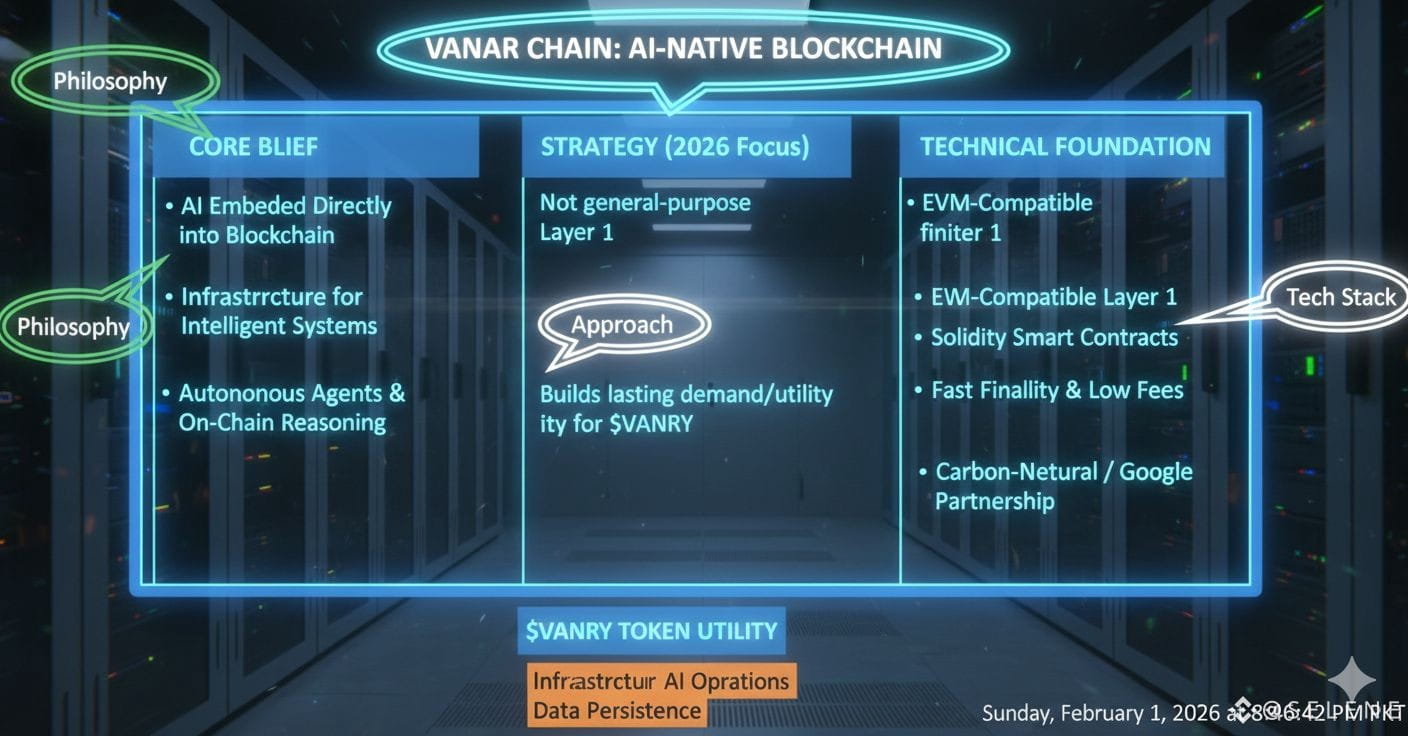
The crypto industry has always been full of confidence. Each new cycle introduces faster networks, cheaper transactions, and bold claims about transforming global finance. By 2026, one theme stands out more than any other: artificial intelligence. While many blockchains are racing to add AI features on top of existing systems, Vanar Chain is taking a more fundamental approach. Its core belief is that AI should be embedded directly into the blockchain itself.
This idea sits at the center of VANRY’s long-term direction.
Instead of positioning itself as just another general-purpose Layer 1 competing for attention through short-term metrics like total value locked or NFT volume, Vanar is focused on building infrastructure for intelligent systems. The project aims to become an AI-native blockchain where autonomous agents, persistent data, and on-chain reasoning are native features rather than external tools.
As 2026 progresses, an important question emerges. Can this technical strategy generate lasting demand and real-world utility for the VANRY token?
Built with intention rather than noise
Vanar’s development path has been relatively quiet compared to many other projects. It did not rely on viral marketing or aggressive incentives to attract attention. Instead, the focus remained on steady and deliberate building.
At its foundation, Vanar is an EVM-compatible Layer 1, which makes it accessible to developers already familiar with Ethereum tools. Smart contracts written in Solidity work seamlessly, and integration with existing wallets and infrastructure is straightforward. This reduces friction and allows builders to deploy applications without reinventing their workflows.
Beyond compatibility, Vanar emphasizes performance and efficiency. The network is designed for fast transaction finality, low fees, and environmentally responsible operations. Its carbon-neutral approach is supported in part by renewable energy initiatives and infrastructure partnerships connected to Google’s sustainability programs. As environmental concerns continue to influence enterprise adoption, this positioning becomes increasingly relevant.
However, speed and affordability alone are no longer enough to stand out.
The shift toward AI at the protocol level
What truly separates Vanar from many other blockchains is its decision to treat AI as core infrastructure rather than an external service.
Most AI-enabled applications today depend on off-chain servers for computation, which introduces centralization risks and trust assumptions. Vanar challenges this approach by integrating AI capabilities directly into the blockchain.
One key component is the Kayon AI engine. It allows decentralized applications to perform reasoning on-chain, enabling logic that adapts to context instead of following fixed rules. This changes smart contracts from static code into systems that can respond dynamically to changing conditions.
Another core element is Neutron, Vanar’s decentralized data and semantic memory layer. Neutron allows applications and AI agents to store structured data, retrieve historical context, and maintain long-term memory without relying on centralized databases. For intelligent agents, persistence is essential, and Neutron provides that capability natively.
Together, these systems form the backbone of Vanar’s AI-native design, where blockchain applications can operate with a higher level of intelligence and autonomy.
From concept to execution in 2026
A major milestone arrived in January 2026, when Vanar launched live AI infrastructure on its mainnet. This was not a conceptual demonstration or a test environment. It was fully functional technology available for developers to use.
This distinction matters because AI narratives are common, but working infrastructure is far less so.
With these tools live, developers can now build agent-driven applications that operate independently. These agents can initiate transactions, manage digital assets, interact with smart contracts, and respond to real-time conditions without constant human input.
This capability enables a new class of financial systems often described as intelligent PayFi. Payments can adjust automatically, financial agreements can evolve based on context, and treasury systems can rebalance themselves dynamically. These use cases become practical only when intelligence exists directly on-chain.
The role of VANRY in the ecosystem
A strong technical vision must ultimately translate into token utility. VANRY’s role within the Vanar ecosystem is closely tied to its AI-native architecture.
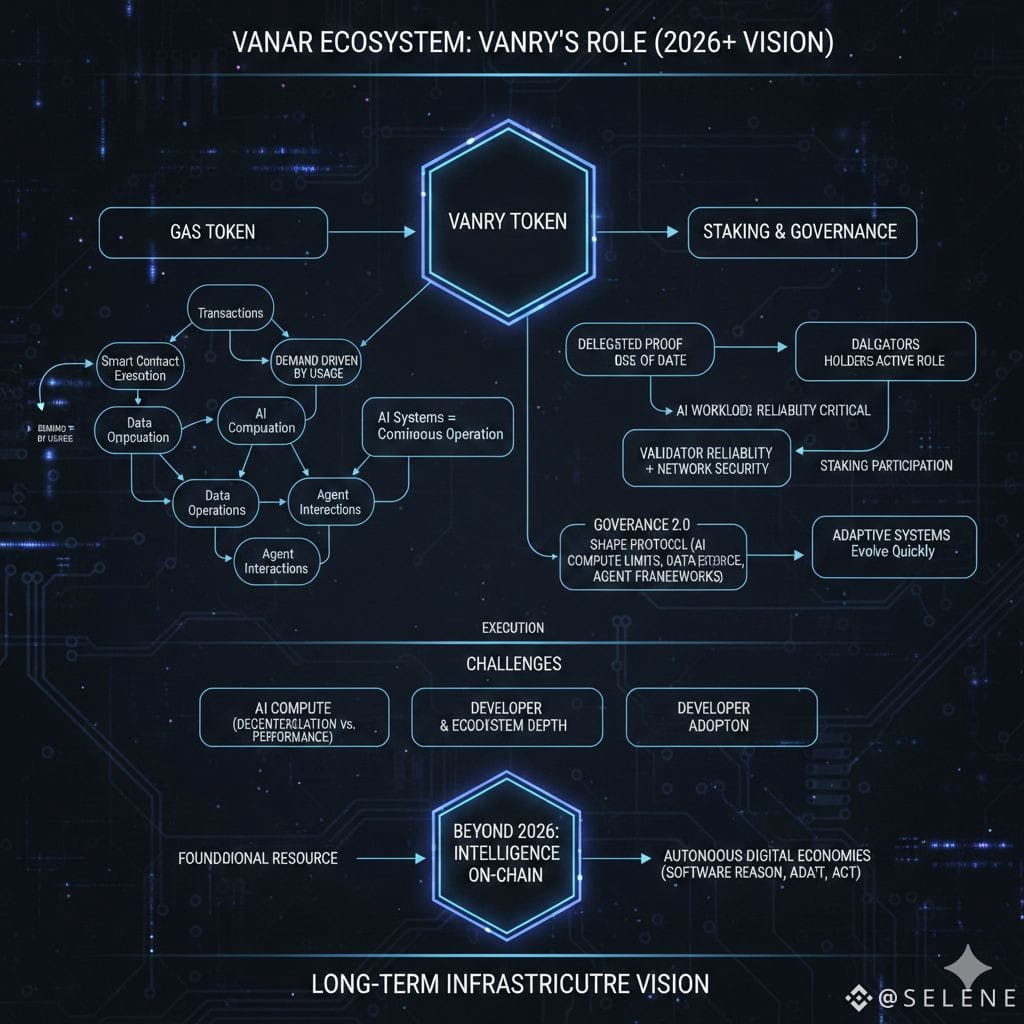
VANRY serves as the gas token for the network. Every transaction, smart contract execution, AI computation, data operation, and agent interaction consumes VANRY. As intelligent systems operate continuously, token demand becomes driven by usage rather than speculation.
This represents an important shift. Traditional blockchain activity often rises and falls with market sentiment. AI-powered systems, however, are designed to run continuously. Autonomous agents do not pause during slow markets, and intelligent infrastructure does not depend on hype cycles.
Staking further reinforces VANRY’s utility. Vanar operates under a delegated proof of stake model, allowing holders to delegate their tokens to validators. In return, they earn rewards while contributing to network security and performance.
As AI workloads increase, validator reliability becomes even more critical, strengthening the relationship between staking participation and network demand.
Governance built for adaptive systems
Governance is often treated as an afterthought in blockchain design, but Vanar approaches it differently.
With the introduction of Governance 2.0, VANRY holders gain a more active role in shaping the protocol. Stakers can influence decisions beyond basic network parameters, including AI-related settings such as compute limits, data persistence rules, and agent interaction frameworks.
This governance structure reflects the reality that AI systems evolve quickly. Locking decisions permanently would limit adaptability. Allowing the community to guide these changes ensures that the network can respond to new requirements over time.
Challenges that remain
Despite its progress, Vanar still faces challenges.
AI computation requires significant resources, and balancing decentralization with performance will remain an ongoing effort. Developer adoption will also be essential. Infrastructure alone does not guarantee success, and builders must see clear advantages in choosing Vanar over competing platforms.
Visibility and ecosystem depth are additional factors. VANRY is still establishing its presence, and growth in applications and users will need to keep pace with technical development.
However, these challenges are rooted in execution rather than empty promises.
Looking beyond 2026
By 2026, the industry conversation has shifted. The question is no longer whether AI and blockchain will intersect, but where intelligence should reside.
Vanar’s position is clear. Intelligence belongs on-chain.
If this approach succeeds, VANRY could evolve from a speculative asset into a foundational resource for autonomous digital economies. Not just decentralized finance, but systems where software can reason, adapt, and act independently.
This is not a short-term narrative. It is a long-term infrastructure vision.
And in crypto, infrastructure is what tends to last.