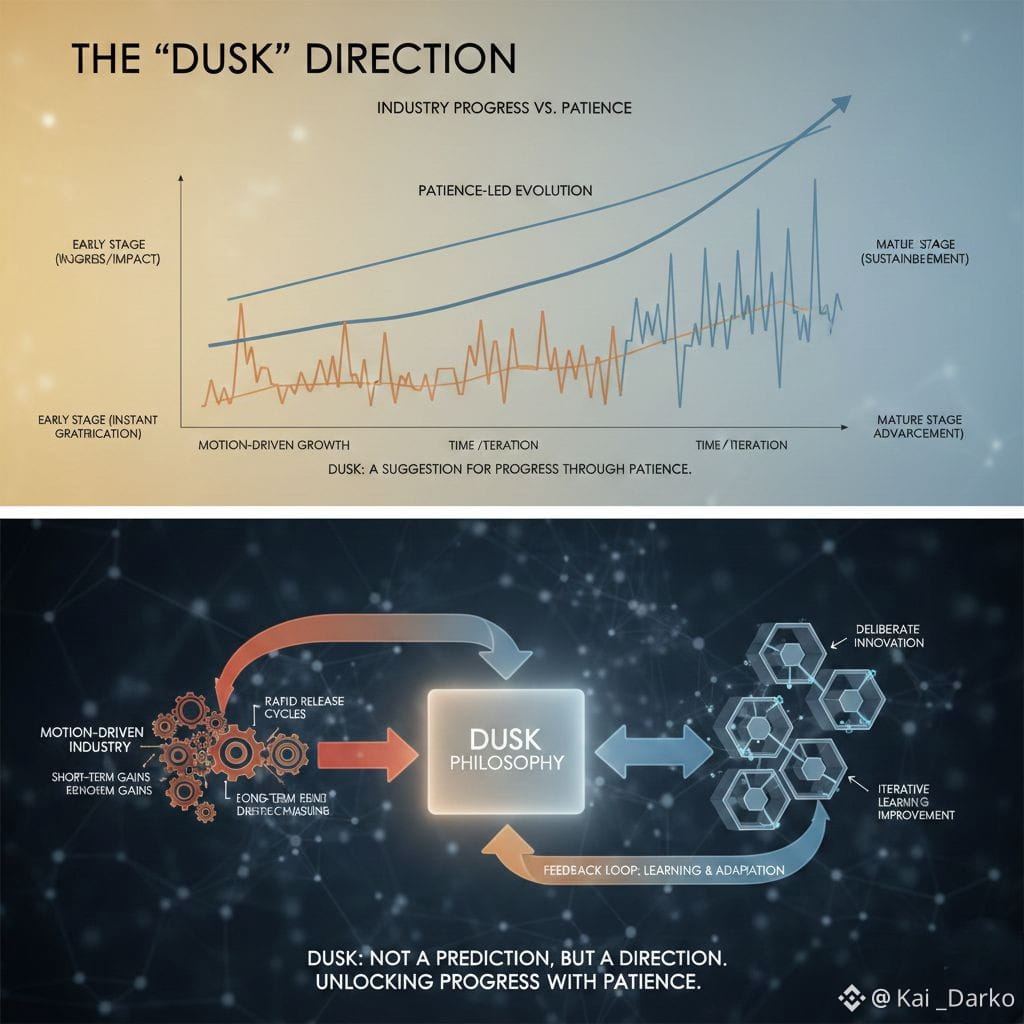
@Dusk When I first came across Dusk, it didn’t announce itself in a way that demanded attention. There was no dramatic framing, no insistence that it was about to redefine everything we thought we knew. It appeared more like a quiet system note in the margins of a noisy industry, the kind you only notice if you’ve spent enough time watching patterns repeat. After multiple cycles of big promises and fast fades, that kind of restraint tends to slow me down. It suggests a project that is less interested in being admired and more interested in being usable.
To understand why Dusk exists, it helps to remember the moment it entered the space. By 2018, blockchains had already proven that decentralized systems could work, at least in principle. But the gap between experimentation and real-world finance was still wide. Most platforms were built with openness as a virtue and regulation as an afterthought. That approach made sense early on, when the goal was exploration rather than integration. But as institutions began circling the edges of the industry, the limitations of that mindset became hard to ignore. Financial systems don’t operate in a vacuum. They live inside rules, audits, and accountability, whether we like it or not.
Dusk seems to have noticed a problem that many others preferred to avoid. Privacy and compliance are often treated as opposites in this space, as if one must be sacrificed for the other. Existing solutions leaned awkwardly in one direction. Some offered full transparency that made institutional use uncomfortable. Others added layers of privacy that regulators could never realistically accept. The result was a kind of stalemate, where technology advanced but adoption stayed tentative. Dusk’s starting point appears to be the assumption that this tension isn’t going away, and that ignoring it doesn’t make it simpler.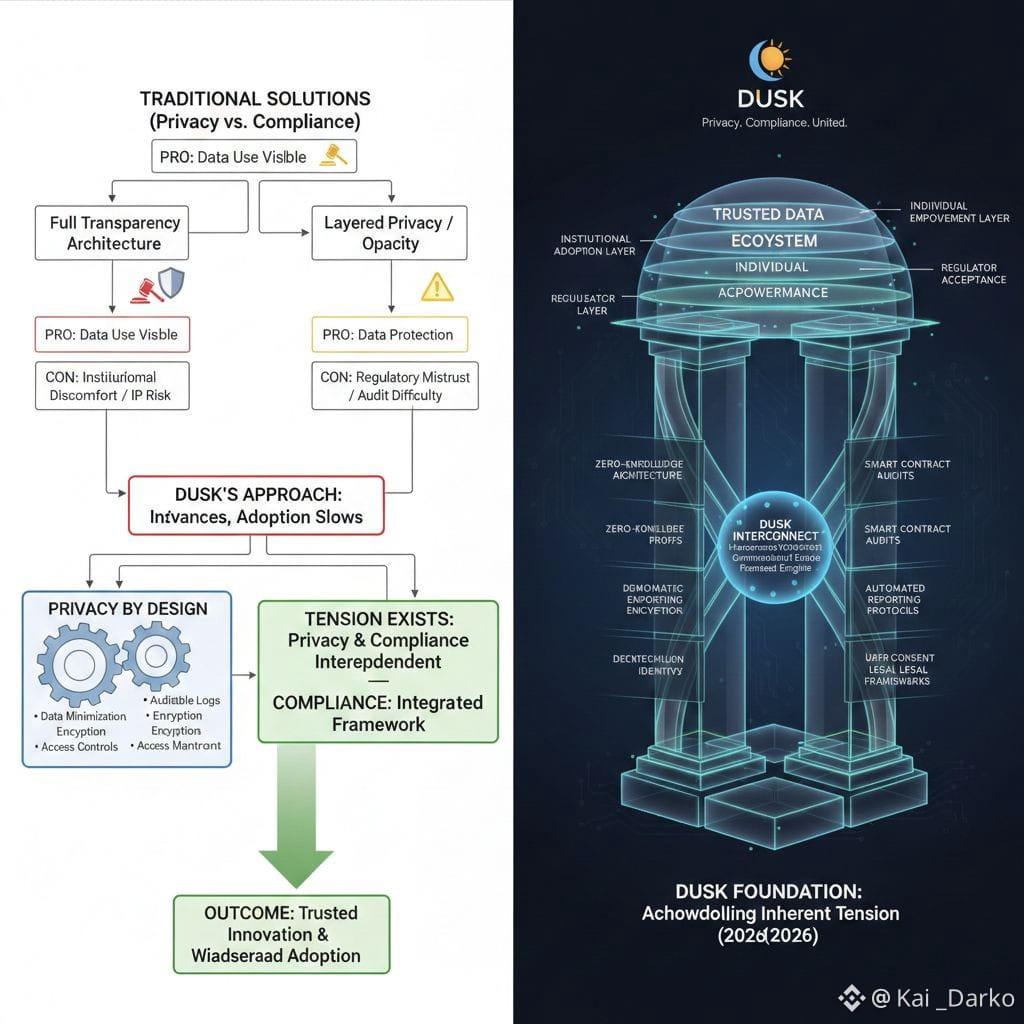
What’s interesting is not that Dusk tries to balance privacy and oversight, but how calmly it approaches that balance. There’s a sense that the design was shaped less by ideology and more by observation. Instead of chasing maximal openness or absolute secrecy, it accepts that financial systems require selective visibility. Some information needs to be hidden to protect participants. Other information needs to remain accessible to maintain trust. This is not a glamorous insight, but it’s a practical one, and practicality has a way of aging better than ambition.
In many blockchain projects, complexity is worn almost like a badge of honor. More features, more mechanisms, more cleverness. Dusk seems more deliberate about where it allows complexity to exist. The core ideas are kept restrained, while flexibility is pushed to the edges. That choice suggests an understanding that institutional systems don’t want to constantly reinvent themselves. They want foundations that feel stable, even boring, because stability is what allows experimentation to happen safely on top.
Of course, that restraint comes with trade-offs. By choosing to operate in regulated contexts, Dusk limits the kinds of narratives it can participate in. It’s not designed for permissionless chaos or rapid, viral experimentation. That may make it less appealing to certain segments of the crypto community that thrive on speed and spectacle. But it also avoids a common trap: building something that is theoretically powerful but practically unusable by the very actors it claims to serve.
Another thing that stands out is the pace at which Dusk appears to move. Growth here doesn’t feel rushed, and that can be unsettling in an industry addicted to timelines and roadmaps. Adoption, when it comes from institutions, rarely arrives in dramatic spikes. It comes through pilots, approvals, revisions, and long periods of silence. Dusk seems structured to survive those quiet stretches, rather than relying on constant attention to justify its existence.
That said, it would be dishonest to present Dusk as a finished answer. Questions remain, and they should. Balancing privacy with auditability is not a problem you solve once and move on from. Regulations change, expectations shift, and what feels acceptable today may feel insufficient tomorrow. There’s also the broader uncertainty of whether institutions will fully embrace decentralized infrastructure at all, or continue to rely on hybrid systems that dilute some of the original promise.
There’s also the challenge of relevance in a fast-moving space. By choosing not to be loud, Dusk risks being overlooked. Attention, even when superficial, can attract developers and partnerships. Quiet competence doesn’t always win mindshare, especially in markets driven by narratives. Whether Dusk can remain visible enough without compromising its philosophy is an open question.
Still, there’s something reassuring about a project that doesn’t seem to mind being underestimated. After watching multiple cycles, I’ve learned that the loudest systems are often the most fragile. They depend on constant belief. Dusk, by contrast, feels like it’s built to persist even when belief wavers. It doesn’t ask you to imagine a distant future. It asks you to consider how financial systems actually work today, and how they might be nudged, carefully, toward something more flexible.
In the end, Dusk doesn’t feel like a statement. It feels like a direction. Not a prediction of where everything will go, but a suggestion of how progress might happen if patience is allowed back into the conversation. For an industry that often mistakes motion for meaning, that alone makes it worth paying attention to.