
Where Most People Start From the Wrong Assumption
Vanar is usually introduced as a gaming chain or a brand-focused blockchain. That description is not false, but it is incomplete in a way that matters. Labels like these flatten the conversation too early and push analysis toward surface-level features. The harder question is never asked. What does it actually take for a blockchain to support millions of ordinary users who do not think of themselves as “using crypto” at all?
This is the question Vanar is built around. Not how to impress early adopters, but how to survive contact with the mainstream.
Here is the part most people skip.
The Trap in the Usual Approach
Most Layer 1 blockchains fall into one of two camps. The first group optimizes for developers and power users. They offer maximum flexibility, complex tooling, and rapid experimentation. These systems are impressive, but they assume users are willing to tolerate friction, manage keys carefully, and accept occasional breakage as the price of innovation.
The second group optimizes for control and predictability. They are often tightly curated, permissioned, or narrowly scoped. They work well for specific use cases but struggle to grow beyond them. Innovation is slower, and integration outside the original design intent becomes difficult.
Mass adoption does not live comfortably in either extreme. Real users want things to work without learning new mental models. Brands want reliability without sacrificing creativity. Builders want distribution without chaos.
Vanar positions itself in the narrow third space most projects talk about but rarely engineer for.
The Real Thesis in One Sentence
Vanar is not trying to onboard users to crypto; it is trying to make crypto invisible to users while keeping the system open to builders and brands.If you only remember one thing, remember this.
How the System Actually Works
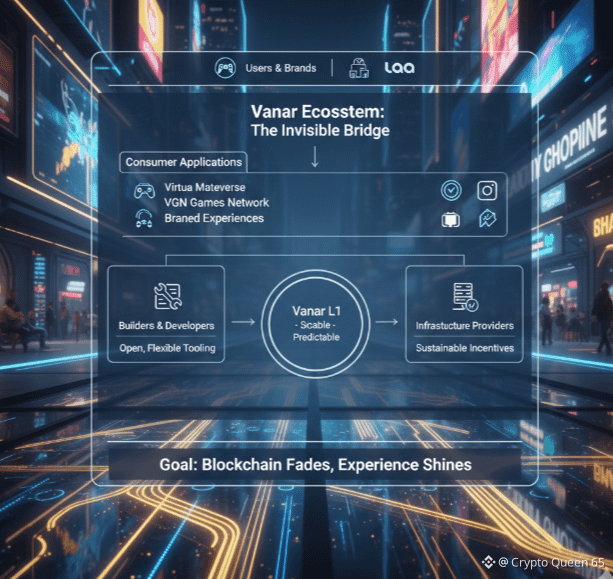
Vanar is designed from the ground up with consumer-facing applications in mind. That design choice shows up not in slogans, but in priorities.
At the base layer, Vanar operates as a general-purpose Layer 1, capable of supporting a wide range of applications. On top of that base, the ecosystem emphasizes products that users already understand: games, digital collectibles, branded experiences, and interactive environments. These are not abstract financial instruments. They are familiar entry points.
The project describes an approach where infrastructure is shaped around use cases rather than the other way around. Applications like Virtua Metaverse and the VGN games network are not experiments bolted on later; they are examples of how the chain is intended to be used.
The VANRY token powers the network, but the emphasis is not on constant token interaction by end users. In many consumer scenarios, the best outcome is that users never have to think about the token at all. Transactions, ownership changes, and interactions should feel native to the application, not like a blockchain ceremony.
Suppose a global entertainment brand wants to launch a digital experience tied to a live event. They need scalability, predictable performance, and user flows that do not require technical explanations. Vanar is designed so that the blockchain fades into the background, while still providing verifiable ownership and interoperability underneath.
The uncomfortable truth is this: most chains are optimized for builders first and hope users will adapt later.
Where the Design Gets Serious
One overlooked design challenge in consumer blockchains is operational risk at scale. When millions of users interact simultaneously, small inefficiencies become visible failures. Latency, fee spikes, and confusing UX are not minor issues; they are adoption killers.
Vanar’s focus on entertainment and brand use cases forces the system to confront this early. Games and live experiences are unforgiving environments. Users do not wait. They do not read documentation. They leave.
This pressure shapes validator incentives, infrastructure priorities, and product decisions. Systems built under these constraints tend to be more disciplined. Not because of ideology, but because the market demands it.
This is a second-order effect many technical analyses miss.
Why This Matters in the Real World
Real-world adoption is not driven by ideology. It is driven by habit.
Users return to systems that feel intuitive. Brands return to platforms that protect their reputation. Developers return to ecosystems where their work reaches real audiences.
Issues like front-running or data leakage may seem abstract in gaming or entertainment contexts, but they surface quickly when digital assets carry real value. Fairness in execution, predictability in performance, and clarity in ownership rules all shape trust.
Vanar’s positioning recognizes that consumer-facing markets amplify both strengths and weaknesses. There is nowhere to hide behind technical complexity.
Fair markets require information hygiene, even when the market looks like a game.
The Adoption Wall
Adoption is difficult because it requires alignment across very different actors.
Users want simplicity. Developers want flexibility. Brands want control and compliance. Infrastructure providers want sustainable incentives. Few systems satisfy all of these at once.
Vanar must continue to balance these pressures as the ecosystem grows. Tooling must remain accessible without becoming restrictive. Governance must evolve without fragmenting the network. Performance must scale without centralizing control.
This is not a one-time problem. It is an ongoing negotiation.
What must be solved is not just technology, but coordination.
What Success Would Look Like
Success for Vanar would look like consumer applications where blockchain ownership feels natural, not novel. It would look like brands launching experiences without fear of technical failure. It would look like developers choosing the ecosystem because distribution and reliability matter more than experimental features.
Most importantly, success would look boring from a distance. Usage would grow steadily, not explosively. Problems would be operational, not existential.
That is how real platforms mature.
The Honest Risks
There are real risks specific to this approach. Consumer-focused ecosystems are sensitive to reputation shocks. A single high-profile failure can slow adoption dramatically. Balancing openness with brand requirements can also create tension within the community.
There is also execution risk. Building for mainstream users raises the bar across design, infrastructure, and support. It is easier to build for a niche that tolerates friction.
These risks do not invalidate the thesis, but they raise the cost of getting it wrong.
Closing: A Calm, Convincing Future
Think of Vanar less like a financial marketplace and more like a public venue. When it works well, people enjoy the experience and forget about the systems underneath. When it fails, everyone notices immediately.
Vanar is not promising to reinvent finance or replace existing systems overnight. It is attempting something more grounded: to make blockchain infrastructure sturdy enough, and simple enough, that millions of people can use it without thinking about it.
That is a harder goal than it sounds. And if achieved, far more meaningful.
