

There are some stories in the crypto world that feel loud from the start, and then there are others that grow quietly in the shadows, gathering power until suddenly everyone realizes something big has been building right under their noses. Dusk is exactly that kind of story. It began back in 2018 with a bold idea that most people in blockchain thought was either impossible or too complicated to ever work. But Dusk kept building, kept refining, kept pushing toward a world where blockchain could finally meet real financial regulations without losing the heart of decentralization or the soul of privacy. And now, standing in 2026, Dusk is no longer a theory or a dream. It’s a living, functioning Layer-1 chain built for the world of regulated finance, privacy-preserving markets, and on-chain assets that behave exactly like the financial system demands, but without the heavy friction that slows today’s markets to a crawl.
The story starts with a problem that every blockchain has struggled with. Traditional chains are transparent by default, which is great for openness but terrible for financial confidentiality. No bank wants its trades on a public explorer. No company wants its internal moves tracked by competitors. No regulator wants an asset system where rules are optional. Dusk looked at this mess and decided to do something different. Instead of trying to apply regulation on top of a public chain like a bandage, they embedded compliance inside the chain itself. Instead of treating privacy as suspicious or optional, they made it a core function. And instead of separating blockchain from the real financial world, they designed the protocol specifically for things like security issuance, bond trading, structured products, and markets regulated under European frameworks like MiCA and MiFID.
The result is a chain where privacy and compliance finally walk together rather than pulling in opposite directions. Transactions can be transparent or fully shielded. Identity can be proven without exposing personal details. Regulators can access exactly what they need, nothing more. Institutions can trade, issue, and settle assets without worrying about leaks or legal conflicts. The founders in Amsterdam weren’t trying to build another hype-fueled DeFi playground. They were trying to rebuild the core machinery of the financial system on top of cryptography strong enough for real-world markets.
As the years passed, the technology behind Dusk became more and more impressive. Zero-knowledge proofs allow users to validate actions without revealing the details. A dual model of public and private transactions lets institutions operate with flexibility and safety. A powerful Proof-of-Stake system called Succinct Attestation delivers fast finality, a must-have for settlement markets where delays can cost millions. And then came the real turning point: the shift to a modular blockchain architecture that feels like something from the next era of Web3.
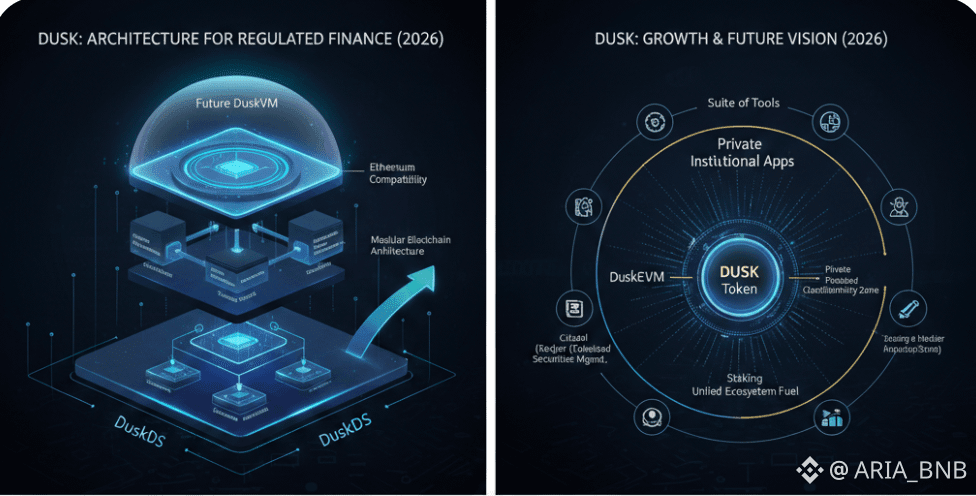
Instead of one monolithic chain doing everything, Dusk split the network into layers with their own responsibilities. The DuskDS layer handles settlement, data availability, and consensus. It’s the truth engine of the chain. Above it sits DuskEVM, a fully Ethereum-compatible environment that launched its testnet in 2025, letting developers finally build on Dusk with the tools they already know. And the future DuskVM layer will power fully private, institution-grade applications that operate deep inside the confidentiality zone. This modular design means Dusk can stay fast, remain compliant, and scale with the demands of real enterprises.
Around this architecture lives a suite of tools built specifically for regulated finance. Citadel enables private identity checks without exposing unnecessary details. Zedger and Hedger help manage the full lifecycle of tokenized securities. Everything is designed to make the blockchain behave like the financial markets expect, but without the paperwork, delays, intermediaries, or opaque systems that slow traditional finance.
The DUSK token is the engine that keeps all of this moving. It secures the network through staking, pays for fees and computation, and acts as the unified token across every layer of the ecosystem. Whether a user is interacting with DuskDS, DuskEVM, or one day DuskVM, they rely on DUSK as the central fuel.
The ecosystem around Dusk has begun attracting serious attention. A major partnership with Chainlink brings high-quality market data and secure cross-chain communication. A collaboration with NPEX, a regulated Dutch stock exchange, puts Dusk directly in the path of real asset issuance and trading. And Dusk’s involvement in the Leading Privacy Alliance shows its commitment to shaping the regulatory and educational landscape around privacy in Web3.
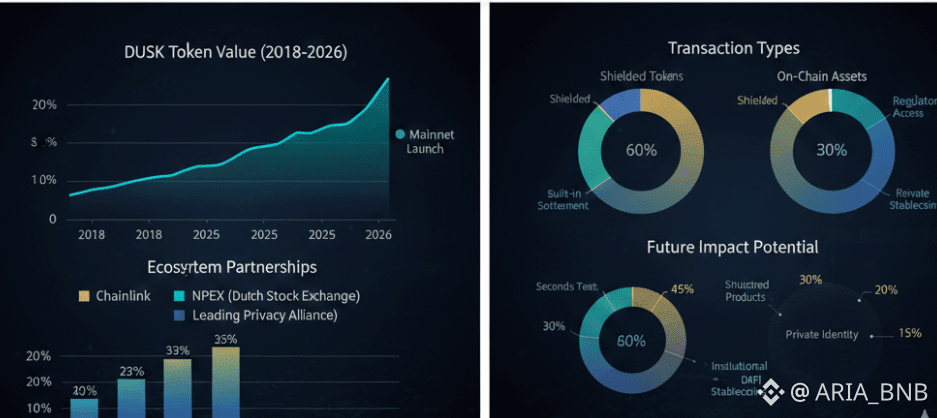
By early 2026, after years of development and increasingly sophisticated testnets, Dusk’s mainnet quietly but powerfully went live. This moment marked a turning point: Dusk was no longer a promise but a functioning, production-grade blockchain ready to handle regulated financial operations. The earlier phases, Daybreak and Daylight, laid the technical foundation, while the future phases, Alba and Aurora, promise the full privacy application layer and the complete ecosystem for regulated DeFi.
The real-world potential of Dusk is enormous. Imagine securities that settle in seconds with zero counterparty risk. Imagine global markets where compliance is built in, not bolted on. Imagine DeFi where institutions can participate without fear of breaking laws. Imagine on-chain identity that protects privacy instead of destroying it. Imagine regulated stablecoins like digital euros powering real payments and financial rails directly on the network. This is the world Dusk is building.
But as with any great vision, challenges remain. Regulations vary globally, adoption takes time, and markets move quickly. Dusk must continue proving itself, attracting developers, onboarding institutions, and expanding its toolset. Yet what it has built so far is already far ahead of most competitors, and its focus on privacy and compliance gives it a unique spot in the blockchain landscape.
Dusk’s journey is the story of a silent giant coming out of the shadows. It is the story of blockchain finally maturing into something serious enough for the world’s financial markets. And it is the story of a protocol daring to dream that privacy, regulation, and decentralization do not have to fight each other they can be woven into one powerful engine that may redefine the future of global finance.
