I keep running into the same problem whenever I study privacy-focused blockchain projects: the stronger the privacy model is, the harder it is for people to actually feel what’s happening. That’s the trap. If a system hides sensitive information well, then to most people it can look like nothing is happening at all. It becomes technical, distant, almost invisible in the wrong way. And that’s exactly why Midnight City Simulation stands out to me. It doesn’t just talk about privacy. It lets me observe how privacy behaves inside a living system. That difference matters more than most people realize.
What grabbed me right away is that Midnight City Simulation is doing something a lot of blockchain projects fail to do. It’s translating an invisible rule set into something people can watch, compare, and understand. I’m not looking at privacy here as a static security feature or some abstract technical layer hidden deep inside protocol design. I’m looking at it as an active environment. A city. A place where actions happen, access changes, and information appears differently depending on who is looking. That’s the real breakthrough. Midnight isn’t trying to make privacy louder. It’s making privacy legible.
And honestly, that’s a much bigger achievement than it first sounds.
When I look closely at Midnight’s broader mission, the core idea is pretty clear. Privacy isn’t supposed to mean total darkness. It’s not supposed to mean that nobody can verify anything and everyone just “trusts the system” blindly. Midnight is building around the idea of rational privacy, which is way more useful and realistic. In simple terms, not everyone should see everything, but the system should still be able to prove what matters. That’s the part I find compelling. It’s not privacy for the sake of secrecy. It’s privacy designed for control, relevance, and accountability.
Midnight City Simulation gives that idea shape.
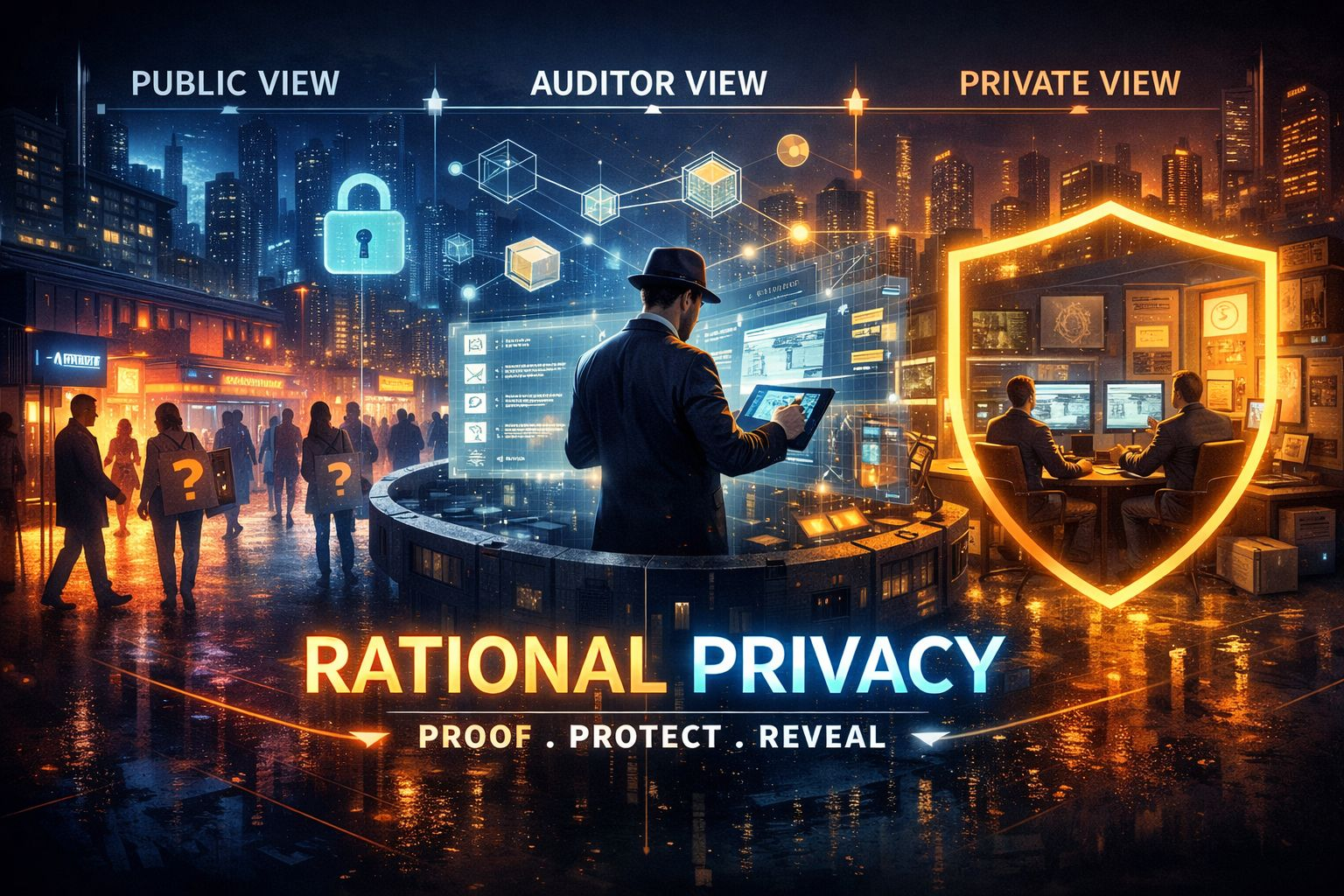
I think that’s why the project feels more important than a normal demo. It’s not just a visual layer placed on top of protocol claims. It functions like a model of selective disclosure in motion. When I observe the simulation, I’m not being told that privacy exists somewhere under the hood. I’m being shown how different perspectives reveal different truths. Public observers can see one layer. Auditors can see more. A full internal view reveals even more. That separation is everything. It’s the architecture of privacy, made visible without breaking privacy itself.
That’s incredibly hard to do well.
Most blockchain systems lean too hard in one of two directions. Either they show nearly everything and call that trust, or they hide nearly everything and leave users struggling to understand what is being protected, how it is being validated, and why the system should be trusted at all. Midnight City Simulation doesn’t sit comfortably in either camp. It creates a third space. A more mature one. It shows that privacy isn’t the opposite of transparency. It’s the discipline of controlled visibility.
The more I think about it, the more I see how smart that framing is.
A city is the perfect setting for this concept because cities already run on layered access. Streets are public. Homes are private. Businesses reveal some information and protect the rest. Institutions inspect certain things under certain rules, while ordinary people move through the same space with very different permissions. So when Midnight uses a city simulation to express privacy, it’s not just being creative. It’s choosing a structure that naturally explains how information should behave in a complex society. That’s what makes the simulation feel grounded rather than gimmicky.
I notice this especially when I think about what blockchain privacy usually looks like in people’s minds. Too often, privacy gets framed like a locked box. Something sealed off. Something removed. But that’s incomplete. Real privacy isn’t just about hiding. It’s about deciding what gets revealed, to whom, at what moment, and for what purpose. Midnight City Simulation turns that idea into something I can observe almost intuitively. I don’t need to sit with a dense protocol document for hours just to grasp the basics. I can understand the principle by seeing how the environment behaves.
That kind of comprehension matters because blockchain adoption won’t come from technical elegance alone. It comes when people can actually make sense of the design.
And that’s where I think Midnight is being unusually strategic.
The project isn’t only building privacy infrastructure. It’s also building privacy understanding. Those are not the same thing. Plenty of projects obsess over mechanism and ignore interpretation. But if people can’t interpret the mechanism, then the value of the mechanism stays trapped inside expert circles. @MidnightNetwork Midnight City Simulation helps close that gap. It teaches people how to think about private computation, selective disclosure, and visibility rules without forcing them to start at the deepest technical layer.
I find that especially useful because privacy is one of those fields where language often gets in the way. Terms like zero-knowledge, shielded data, confidential state, or programmable disclosure sound impressive, but they can also create distance. For many users, developers, or institutions exploring blockchain, the question is much simpler: what can be seen, what stays hidden, and how do I know the system is still telling the truth? Midnight City Simulation answers that through observation. It doesn’t flatten the complexity, but it organizes it in a way that feels human.
That’s rare. And honestly, it’s overdue.
Another thing I keep coming back to is the role of movement in the simulation. Privacy here is not frozen. It’s not treated like a single yes-or-no switch. The city is active. Agents move, interact, transact, respond, and generate ongoing activity. That motion changes everything because privacy in real digital environments is never static. It’s tied to behavior. It’s shaped by roles. It has to survive repetition, scale, and interaction. By showing a city in motion, Midnight is showing privacy where it actually matters most: inside living systems, not isolated examples.
To me, that makes the simulation feel closer to research than branding.
It tests whether privacy still makes sense when there’s complexity. It asks whether a network can preserve proof without forcing exposure, and whether a system can support active economic life without turning every participant into open data. Those are serious questions. And I think Midnight City Simulation is effective because it doesn’t answer them with slogans. It answers them with structure.
I also think the simulation helps correct a common misunderstanding in blockchain design. Public visibility is often treated as the main path to trust. The idea goes like this: if everyone can see everything, then the system is honest. But I’ve never found that logic fully convincing, especially when applied to real-world use cases. Total public visibility can expose behavior, strategy, financial relationships, identity signals, and organizational patterns far beyond what should be necessary for verification. It creates a world where trust is purchased through overexposure. That might work for simple on-chain speculation, but it starts to break down when blockchain touches payments, identity, enterprise workflows, regulated interactions, and sensitive data.
Midnight is pushing against that old assumption.
What I see in Midnight City Simulation is a different model of trust. One based on proof without unnecessary leakage. One where the system can validate actions while still respecting boundaries. One where visibility is purposeful, not automatic. That’s a much stronger foundation for real digital coordination. It means privacy is not being treated as an exception or an add-on. It’s part of the system’s logic from the start.
And that changes the entire tone of the project.
Instead of asking the world to choose between secrecy and transparency, Midnight is introducing a more intelligent spectrum. That spectrum matters because most real environments don’t function at extremes. Businesses don’t publish every internal process. Governments don’t open every confidential file to the public. Individuals don’t live by exposing every transaction, preference, relationship, or decision to whoever wants to inspect it. Yet all of those systems still require accountability. They still require proof. So the real challenge isn’t deciding whether information should be visible or hidden in absolute terms. The real challenge is designing the conditions of visibility well.
That’s what Midnight City Simulation makes visible better than anything else: the conditions.
I keep noticing that the project’s real strength is not that it shows hidden data. It doesn’t need to. In fact, showing hidden data would weaken the point. Its strength is that it shows the boundaries around data. It shows the logic of access. It lets me compare perspectives and understand that truth inside a private system can be layered without becoming vague or arbitrary. That is a sophisticated message, and the simulation delivers it in a surprisingly accessible way.
There’s also something powerful about the fact that the city feels alive rather than mechanical. A static demonstration can show features. A dynamic city shows consequences. Once autonomous agents are interacting in a shared system, privacy stops feeling like a checkbox and starts feeling like governance. It becomes part of how the environment is organized. Who can observe what? What is publicly meaningful? What remains protected? What becomes inspectable under legitimate conditions? Those are governance questions as much as technical ones, and Midnight City Simulation handles them in a way that feels immediate.
I’d go even further: I think the simulation gives privacy a public language.
That may sound dramatic, but I mean it. Privacy has always had a visibility problem. When it works, it disappears. When it fails, everyone notices. That imbalance makes it hard to communicate the value of private systems. Midnight City Simulation flips that dynamic by making the form of privacy visible even when the protected content stays concealed. I can see the system’s design choices. I can see how one observer’s world differs from another’s. I can see that privacy isn’t emptiness. It’s arrangement. It’s structure. It’s discipline.
And once I see that, the project becomes much easier to take seriously.
From a researcher’s perspective, that’s what makes this simulation more than a clever presentation tool. It acts like a conceptual bridge between protocol mechanics and human understanding. It brings the abstract closer to the observable. It helps people see that selective disclosure is not weak transparency and not diluted privacy either. It’s a stronger model for environments that need trust, compliance, protection, and usability at the same time.
That balance is where Midnight feels most relevant.
Because let’s be honest, the future of blockchain can’t be built only for people who are comfortable living in public by default. That model is too narrow. It excludes too many serious applications and too many real human needs. A mature digital network has to support verification without demanding surrender. It has to allow participation without forcing permanent exposure. It has to create systems where truth can be demonstrated without every detail becoming public property. Midnight City Simulation makes that future feel less theoretical and more tangible.
That’s why I find the project so persuasive on this topic. It isn’t trying to impress me with privacy as an abstract ideal. It’s showing me privacy as a functioning civic principle. In this simulated city, invisibility doesn’t mean absence. It means protected depth. It means information has layers, and those layers are revealed with intention. That’s a much richer idea than the old blockchain habit of equating openness with trust and concealment with risk.$NIGHT
By the time I finish examining Midnight City Simulation through that lens, one thing feels obvious to me: the project is not simply making privacy more attractive. It’s making privacy understandable. And that may be the bigger win. Because once people understand that privacy can be verifiable, structured, and useful in motion, they stop seeing it as a barrier to adoption. They start seeing it as a requirement for better systems.
That’s where Midnight’s vision sharpens. Not in claiming that everything should be hidden, and not in pretending that exposure equals integrity. Its real message is much stronger than that. A serious network should know how to prove, how to protect, and how to reveal with precision. Midnight City Simulation captures that idea with unusual clarity. It takes the hardest part of privacy—the part that usually stays unseen—and gives it form without betraying its purpose.
And in my view, that’s exactly why this project matters. It doesn’t just say privacy belongs in the future of blockchain. It shows what that future actually looks like when privacy is designed to live in public without being consumed by it.