
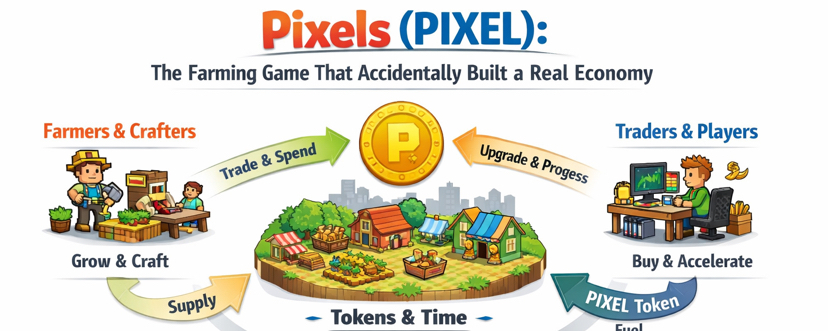
At first glance, Pixels feels simple. You plant seeds, harvest crops, gather materials, and slowly expand your land. It’s calm, colorful, and easy to understand. But after spending time inside the world, something else becomes clear: the real game isn’t farming — it’s how players organize an economy together.
PIXEL, the token at the center of the game, isn’t just handed out as a reward. It quietly influences decisions. Spend it to upgrade faster, or save it to trade later. Use it to craft, or hold it for bigger investments. Over time, players stop doing everything themselves and begin specializing. One farms, another crafts, another trades. Without explicitly telling players what to do, the game nudges them into roles.
That’s what makes Pixels interesting right now. It’s slowly shifting from a solo farming loop into something closer to a shared digital marketplace.
What Changed Recently — And Why It Matters
One of the biggest shifts came after Pixels settled into the Ronin ecosystem. Actions became faster, cheaper, and smoother. That sounds technical, but the effect is very human: players stopped hesitating. They craft more often, trade more frequently, and reinvest faster. The entire economy started moving at a quicker pace.
Another important change is how land works. Land used to feel like a cosmetic upgrade. Now it’s productive. Some plots boost crafting efficiency, others improve farming output. Suddenly, owning land isn’t just about space — it’s about running infrastructure. This encourages players to specialize. Instead of doing everything, they focus on what their land does best.
Guild mechanics also pushed players toward cooperation. Groups now coordinate production, share resources, and divide tasks. Instead of ten players farming everything individually, you might see one player producing raw materials while another handles crafting. It’s more efficient — and more social.
Energy adjustments played a quieter role but mattered just as much. By limiting endless farming loops, the game made resources feel scarce again. When everything isn’t unlimited, trading becomes necessary. And when trading becomes necessary, the token suddenly has real purpose.
What the Activity Patterns Suggest
Watching how players behave reveals more than surface-level numbers.
After performance improvements, daily activity increased — but more importantly, players started doing more actions per session. That means people aren’t just logging in; they’re participating in the economy.
Crafting activity grew faster than raw farming. That usually signals a maturing system where players move beyond gathering and into production.
Guild participation also increased, which suggests coordination is becoming the optimal strategy. Instead of grinding alone, players are finding it more effective to collaborate.
Marketplace activity rose as well. Items change hands more frequently, and that typically happens when players specialize instead of producing everything themselves.
Put together, these patterns suggest Pixels is slowly turning into a living economy, not just a farming loop.
How the PIXEL Token Actually Fits In
PIXEL sits quietly behind most decisions. Players use it to upgrade land, unlock recipes, speed up crafting, and progress faster. It’s not forced, but it’s always relevant. If you want to move quickly, you spend. If you want leverage, you save.
The game also removes PIXEL through upgrades, crafting costs, and progression gates. This matters because it prevents the token from simply accumulating. Instead, it cycles back into gameplay.
This creates an interesting tension. Spend now and grow faster, or hold and trade later. Players make different choices, and those choices shape the economy.
A Contrarian Insight Most People Miss
Pixels looks like a farming game, but farming is only the entry point. The real gameplay appears when players stop trying to do everything.
The most efficient players don’t grow every crop. They focus on one. They don’t craft every item. They specialize. Eventually, you get chains like:
One player farms cotton
Another spins thread
Another crafts clothing
Another sells finished goods
At that point, Pixels starts to feel less like a farming sim and more like a cooperative production network.
Two Ways to Think About Pixels
One way to understand the token is to imagine traffic lights. Without them, everyone would rush into the same profitable activity. PIXEL costs act like signals, slowing some actions and encouraging others. The flow spreads out naturally.
Another analogy is a weekend farmer’s market. At first, everyone brings vegetables. Then someone shows up with bread. Another brings tools. Soon, you have a functioning marketplace where people rely on each other. Pixels recreates this process, but digitally.
Risks and Open Questions
The system isn’t perfect. If too many players produce the same resource, prices could fall and reduce incentives. The economy depends on balance.
There’s also reliance on the token itself. If its value weakens significantly, progression could slow and motivation might drop. That’s a common challenge in token-driven systems.
Land concentration is another open question. Players with highly optimized land may gain efficiency advantages, which could create inequality inside the game economy.
Finally, activity tends to spike around updates. The long-term question is whether the economy stays active between those moments.
What I’d Watch Next
Three signals would help show where Pixels is heading:
Crafting activity growing faster than farming
More players participating in guild-based production
Increasing PIXEL spending per active player
If those trends continue, the coordination economy thesis becomes stronger.
Conclusion
Pixels isn’t just about planting crops. It’s about how players organize themselves when incentives subtly push them toward cooperation and specialization. The token acts as a quiet coordinator, guiding behavior without forcing it.
The farming brings people in.
The economy keeps them engaged.
The token connects everything.
Key Takeaways
PIXEL works as a coordination tool shaping player roles
Recent updates encouraged specialization and cooperation
The long-term success depends on sustained token-driven gameplay demand
