
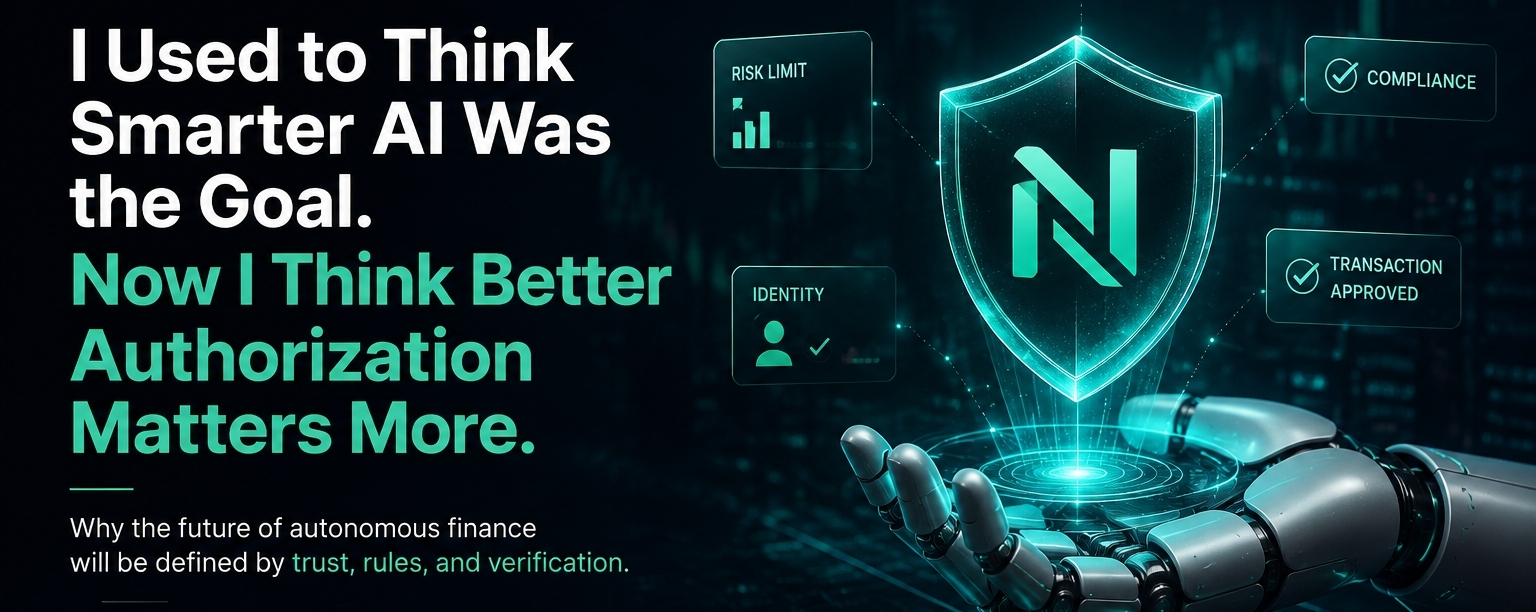

Over the past year, I've spent a lot of time reading about AI in crypto. Most conversations revolve around one question: How capable can AI become?
The more I followed the space, the more I realized I was asking the wrong question.
Capability isn't the hardest problem anymore.
Control is.
We're moving toward a future where AI won't just answer questions or analyze charts. It will manage wallets, rebalance portfolios, execute trades, interact with DeFi protocols, and coordinate across multiple chains without waiting for human approval every step of the way.
That future sounds exciting.
It also raises a simple question that I don't think gets enough attention:
Who decides what an AI agent is allowed to do?
For years, crypto focused on proving ownership. If you hold the private key, you control the assets. That idea helped build decentralized finance.
But autonomous finance changes the conversation.
When software starts making decisions on our behalf, ownership alone isn't enough. The real challenge becomes defining the rules under which those decisions are allowed to happen.
Imagine an AI agent managing your capital.
You might want it to provide liquidity, but never borrow funds.
You might allow it to trade only within a specific risk limit.
You might want every transaction to satisfy certain policies before execution.
Those aren't questions of intelligence.
They're questions of authorization.
This is the perspective that made Newton Protocol stand out to me.
Instead of asking, "Can AI execute transactions?" Newton asks something more fundamental:
"Under what conditions should those transactions be allowed?"
That subtle difference changes the entire conversation.
As AI becomes more autonomous, trust can't rely on assumptions or good intentions. It has to be built into the infrastructure itself. Permissions, policies, and verifiable execution become just as important as the intelligence driving the decisions.
I think this is where the next phase of on-chain innovation begins.
For a long time, we've competed to make blockchains faster, cheaper, and more scalable. @NewtonProtocol
The next competition may be about making autonomous systems safer, more accountable, and easier to trust.
Infrastructure that quietly enforces rules will probably never generate as many headlines as the newest AI model.
But history has shown that invisible infrastructure often creates the strongest foundations.
The internet didn't succeed because of flashy protocols. It succeeded because people eventually trusted the systems running underneath.
Crypto may be entering a similar phase.
As autonomous agents become part of everyday finance, the projects defining authorization, permissions, and verifiable execution could become just as important as the agents themselves.
The more I think about it, the less I see this as an AI story.
I see it as the next chapter of trust.
What do you think will matter more in the long run: building smarter AI agents, or building stronger rules for how they operate on-chain? #Newt $NEWT