
Last year, while traveling in Thailand, my Visa credit card was stolen.
By the time I realized it, several unauthorized transactions had already gone through.
It wasn’t just the money that bothered me. It was the feeling that once the payment had been approved, everything else came too late.
That experience stayed with me.
Months later, when I started exploring crypto, I realized blockchain had a similar characteristic.
02:14 a.m.
ETH: 1800
Gas: 47.3 Gwei
Slippage: 1.5%
Network: Ethereum Mainnet
I tapped Confirm without reading the transaction one more time
12 seconds later, it was finalized.
5 minutes later, I realized I had approved the wrong contract
When I first entered crypto, that experience came back to me more than once. Blockchains are incredibly efficient at moving value. Once you sign a transaction with your private key, the network verifies the signature and settles it exactly as instructed. That’s one of crypto’s greatest strengths, but it also raises a question I’ve been thinking about for a long time: who decides whether a transaction should happen before it is executed?
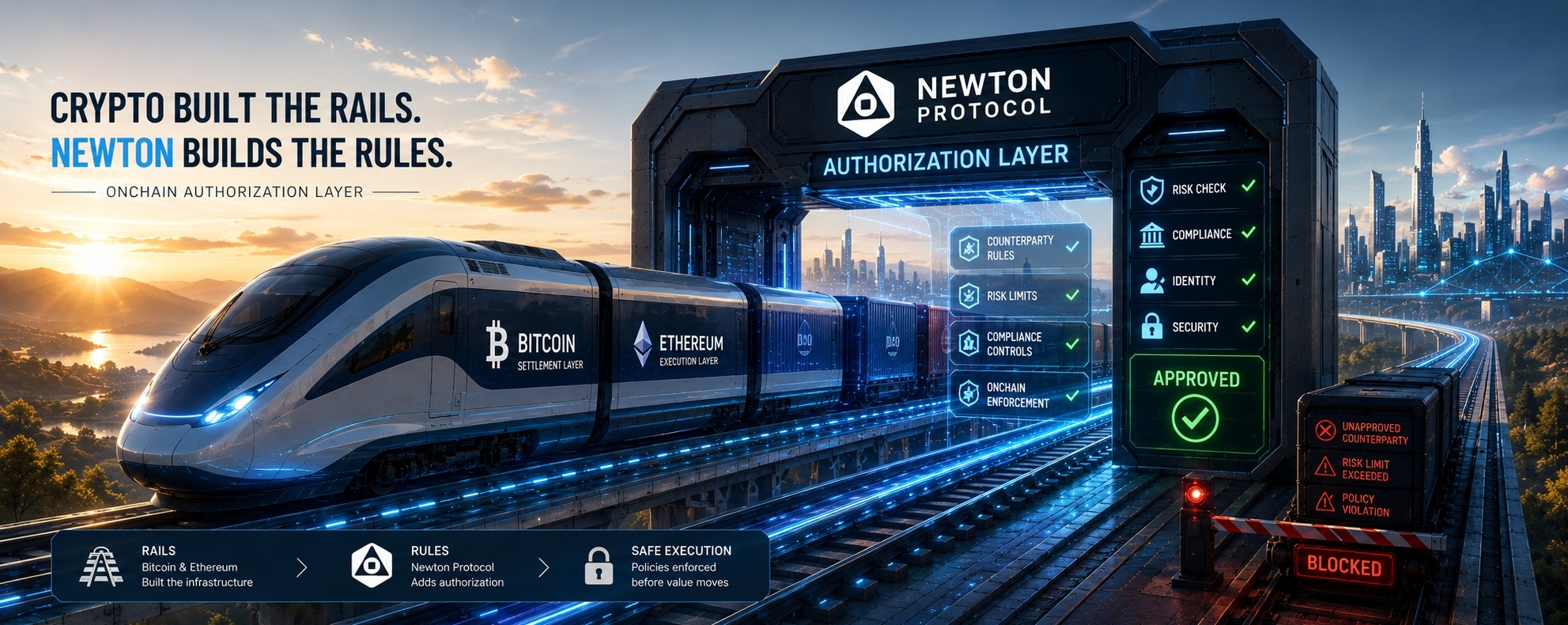
For most of crypto’s history, that question wasn’t particularly important. Bitcoin had to prove that money could exist without banks, and Ethereum had to prove that finance could be programmable without intermediaries. Building fast, censorship-resistant settlement infrastructure was the priority, and it worked. As Newton Protocol puts it, “Crypto built the rails. Nobody built the rules.” Looking back, that sequencing actually makes sense because you don’t build enforcement infrastructure before there’s something valuable enough to protect.
Today, however, the environment is very different. Institutional capital is moving onchain, tokenized assets are gaining traction, and professional asset managers are deploying billions of dollars into DeFi. At that scale, every institution eventually asks the same question before moving capital: where are the controls?
That’s the reason Newton Protocol caught my attention.
Newton isn’t trying to replace Ethereum or compete with existing blockchains. Instead, it’s building an onchain authorization layer that sits before execution. Rather than relying solely on signature verification, institutions can define policies in advance, including approved counterparties, risk limits, compliance requirements, identity checks, and security rules. Every transaction is evaluated against those policies before it reaches settlement, making authorization part of the protocol itself instead of something handled by an application or an internal operations team.
That distinction is more important than it might seem. Front-end restrictions can be bypassed, internal processes depend on people, and manual reviews become increasingly difficult as transaction volume grows. If authorization lives at the protocol level, every transaction follows the same predefined rules regardless of whether it is initiated by a human, a trading bot, or an AI agent. Institutions don’t have to trust someone remembered to check the rules—they know the rules are enforced before any assets move.
The easiest way I think about it is through Visa. When you tap your credit card, the payment network doesn’t immediately transfer money. It first decides whether the transaction should be approved based on spending limits, security checks, fraud detection, and other predefined policies. Blockchain has always been excellent at settlement, but it has largely lacked that authorization layer. Newton is attempting to bring that missing decision-making process onchain so policies become verifiable infrastructure instead of operational procedures.
To me, this isn’t about adding more restrictions to crypto. It’s about giving institutions the confidence to participate without sacrificing the transparency and trustlessness that make blockchains valuable in the first place. Bitcoin gave us decentralized money. Ethereum gave us programmable finance. As institutional adoption accelerates, authorization may become the next foundational layer of onchain infrastructure—and that’s exactly the problem Newton is trying to solve.