

Key Highlights
Kaspa (KAS) is trading near $0.031, up nearly 11% in 24 hours, with trading volume surging to $22 million.
The network has now processed over 2.35 billion transactions, highlighting its growing adoption.
Kaspa's major Toccata Hard Fork is set to go live today, June 30.
The upgrade will transform Kaspa into a programmable Layer-1 blockchain with support for smart contracts and ZK applications.
Kaspa is rallying today on the back of what the network itself describes as its most significant technical milestone since launch. With the Toccata Hard Fork set to activate on mainnet later today, KAS is seeing a meaningful surge in both price and trading volume — reflecting genuine market anticipation for an upgrade that fundamentally expands what the blockchain is capable of.
KAS Price at a Glance — June 30, 2026
Kaspa (KAS) is showing strong momentum, trading at $0.03126, up 10.94% over the past 24 hours and 2.71% over the last 30 days. The cryptocurrency currently boasts a market capitalization of approximately $861.13 million, while its 24-hour trading volume has nearly doubled, surging close to 100% to $22 million, signaling heightened market activity and investor interest.

Strong On-Chain Activity — The Network’s Foundation
Before examining the upgrade itself, it’s worth grounding the story in Kaspa’s existing on-chain performance — because the Toccata upgrade is being built on top of a network that is already demonstrating substantial, real-world usage.
The blockchain has processed over 2.35 billion transactions all-time — a figure that reflects years of consistent, high-throughput operation rather than a network still searching for genuine adoption. More immediately, over 30,700 transactions were recorded in just the last hour alone — a snapshot that confirms Kaspa’s signature high-speed block production continues operating at significant scale right now, independent of today’s upgrade news.
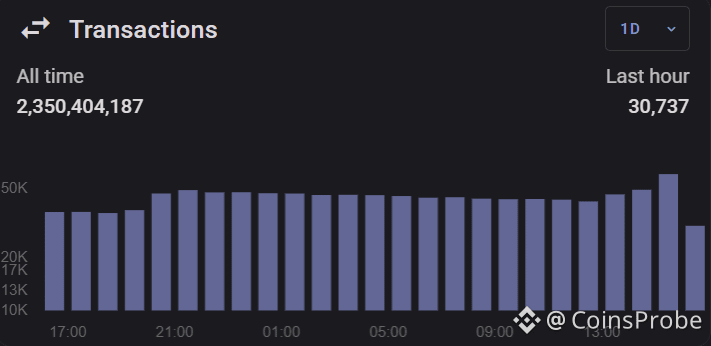
This level of sustained activity is the practical foundation that makes Kaspa’s blockDAG architecture — its core technical differentiator from traditional single-chain blockchains — a genuinely proven system, rather than a theoretical promise. The Toccata upgrade is being layered onto infrastructure that has already demonstrated it can handle substantial transaction volume reliably.
The Toccata Hard Fork — Kaspa’s Biggest Upgrade Yet
Kaspa is preparing for what is being described as its most significant upgrade since the network’s original launch — and the timing is immediate: the Toccata Hard Fork is scheduled to activate on mainnet today, June 30, 2026, at approximately 16:15 UTC, corresponding to DAA score 474,165,565.

Toccata Hardfork Countdown/Source: kaspa.stream
What this upgrade fundamentally changes:
The Toccata hard fork marks a genuine architectural shift for Kaspa — transitioning the network from its established identity as a high-speed, payment-focused blockchain into a natively programmable Layer 1 platform. This is not a minor feature addition; it represents an expansion of Kaspa’s fundamental capabilities.
Key components of the upgrade:
Native covenant programming on Layer 1 — Covenants are a mechanism that allows transactions to enforce specific rules on how the resulting funds can be spent in the future — a foundational building block for more sophisticated smart-contract-like functionality, now implemented directly at the base layer rather than requiring a separate execution environment.
Infrastructure support for zero-knowledge (ZK) applications — Laying the groundwork for privacy-preserving and cryptographically verifiable applications to be built on Kaspa going forward.
A new transaction version — Introducing covenant, computeBudget, and storage_mass fields — each adding new dimensions to how transactions can be constructed and what they can enforce.
UTXOs now carrying covenant_id — Embedding covenant logic directly into Kaspa’s UTXO (Unspent Transaction Output) model, which is the core accounting structure underlying the network.
Updated fee policy and new RPC endpoints — Practical infrastructure changes that accompany the broader architectural shift, ensuring the network’s economic and developer-facing systems align with the new capabilities being introduced.
The technical foundation: The Toccata upgrade is built on several Kaspa Improvement Proposals (KIPs 16, 17, 20, and 21) — the formal technical specifications that define exactly how these new capabilities are implemented at the protocol level.
Why This Upgrade Matters
The Toccata hard fork is widely regarded within the Kaspa community and broader Layer 1 ecosystem as a foundational step toward enabling smart contract-like functionality and advanced decentralised applications directly on the Kaspa blockchain — capabilities that have, until now, been largely associated with other Layer 1 platforms rather than Kaspa’s payment-focused architecture.
Critically, the upgrade is designed to open the door to these more complex use cases while maintaining the network’s core strengths in speed and scalability — the blockDAG architecture and high-throughput transaction processing that have defined Kaspa’s identity and that the on-chain data above continues to demonstrate in real time.
This positions Kaspa to compete more directly for developer attention and application deployment against established programmable Layer 1 platforms, while retaining the specific performance characteristics that have differentiated it within the broader blockchain landscape.
What Node Operators and Infrastructure Providers Need to Know
Given the scale of today’s upgrade, Kaspa has issued clear guidance for the various participants who maintain the network’s infrastructure:
Node operators, miners, pools, wallets, and exchanges are advised to upgrade to the latest version (v2.0.1 or newer) before activation — ensuring smooth participation in the hard fork and avoiding potential network issues or disruptions around the transition.
This kind of coordinated infrastructure upgrade requirement is standard practice for hard forks of this scale across the blockchain industry — and the clarity of Kaspa’s guidance reflects the network’s awareness that a smooth transition depends on broad participation from the ecosystem’s various infrastructure providers ahead of the specific activation time.
Market Context — Anticipation Driving Volume
The upcoming upgrade has clearly contributed to increased market interest in $KAS, with trading volume rising significantly in recent sessions — culminating in today’s nearly +100% spike to approximately $22 million in 24-hour volume, alongside the +10.94% price gain.
This pattern — volume and price both accelerating in the lead-up to a major, scheduled technical milestone — is a recognisable dynamic across crypto markets, where anticipation of a confirmed upgrade with a specific activation time tends to draw concentrated attention and trading activity in the immediate window before the event itself.
Kaspa’s distinctive blockDAG architecture, combined with the new programmability capabilities the Toccata upgrade introduces, positions the project as one of the more technically ambitious efforts currently underway in the broader Layer 1 space — attempting to deliver both the high-throughput performance Kaspa has already proven, and the smart-contract-adjacent functionality typically associated with more traditional programmable blockchains.
Bottom Line
Kaspa’s surge today reflects genuine market anticipation for the Toccata Hard Fork — a technical milestone the network itself describes as its most significant upgrade since launch. With activation scheduled for approximately 16:15 UTC today, the upgrade introduces native covenant programming, ZK application infrastructure, and a meaningfully expanded transaction model — all built on the foundation of KIPs 16, 17, 20, and 21.
The combination of Kaspa’s already-demonstrated on-chain performance — 2.35 billion all-time transactions and over 30,700 in the last hour alone — with the Toccata upgrade’s new programmability capabilities represents a genuine attempt to combine proven high-throughput infrastructure with the more complex application capabilities typically associated with other Layer 1 platforms.
Watch for confirmation of successful activation around the 16:15 UTC target time, and monitor whether node operators, exchanges, and wallets complete the required upgrade to v2.0.1 or newer smoothly across the broader ecosystem.
Disclaimer: The views and analysis presented in this article are for informational purposes only and reflect the author’s perspective, not financial advice. Technical patterns and indicators discussed are subject to market volatility and may or may not yield the anticipated results. Investors are advised to exercise caution, conduct independent research, and make decisions aligned with their individual risk tolerance.