
Crypto has always felt like an experiment in automation. In the early days, the conversation was mostly about money sending value without banks or intermediaries. Then smart contracts changed the discussion completely. Suddenly, code could manage agreements, move assets, and execute financial logic without waiting for human approval. Over time, decentralized finance pushed that even further. Markets began running continuously, powered by code instead of institutions.
But while looking into Newton Protocol, I found myself thinking about something bigger. We may be entering another shift entirely—one where the participants inside these systems are no longer only humans.
That idea stayed with me.
We are already seeing AI become deeply involved in decision-making across industries. It can process large amounts of information, detect patterns, and react faster than people ever could. In finance, that advantage becomes even more obvious. Markets reward speed, efficiency, and precision. So naturally, AI-driven strategies and automated trading feel like an inevitable direction.
But that also creates a problem.
When humans make decisions, we can question them, audit them, or at least understand the reasoning afterward. Machines operate differently. They can make thousands of decisions in moments, often based on internal logic that most people never see. I noticed this is where Newton Protocol becomes interesting, because it is not really trying to solve an AI problem alone, and it is not just solving a blockchain scalability problem either. It seems to sit in the uncomfortable space between intelligence and trust.
That space matters more than people realize.
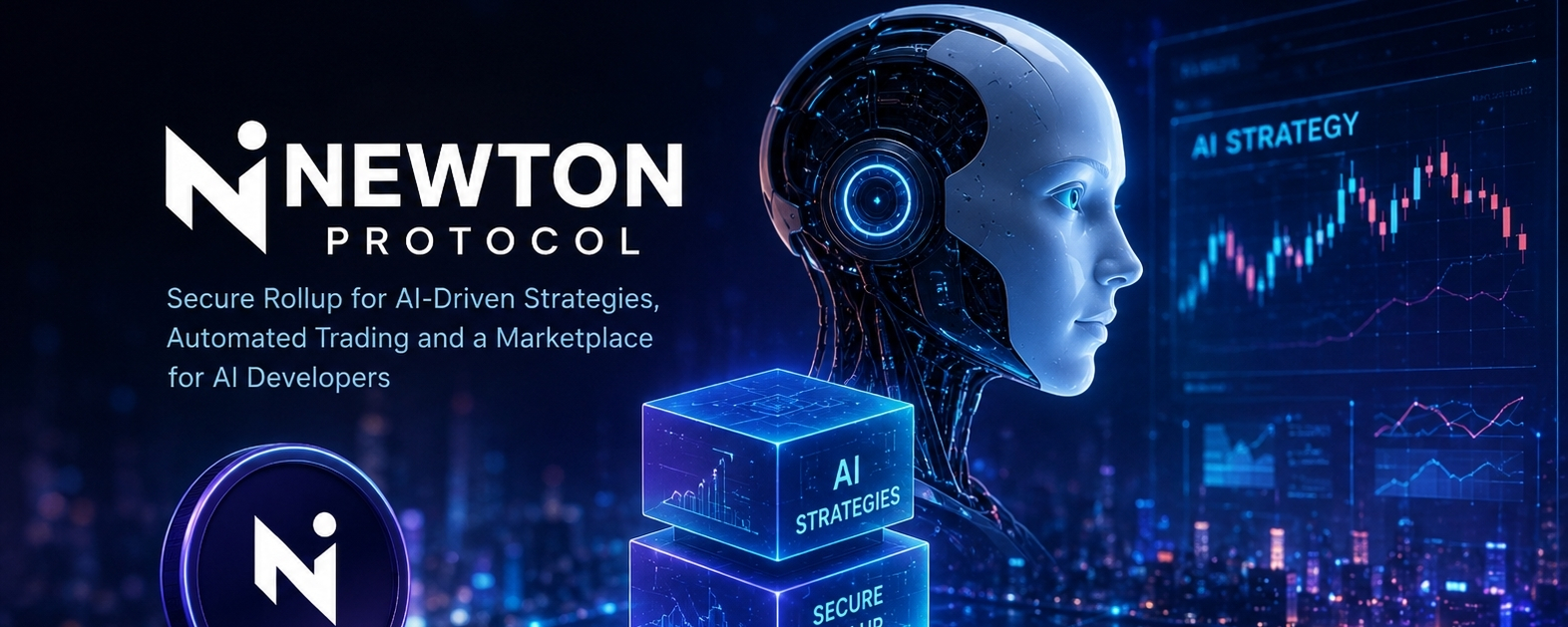
Newton Protocol is built around the idea of creating secure infrastructure for AI-driven strategies, automated trading, and an ecosystem where developers can build and deploy intelligent systems. At first glance, that sounds technical, almost abstract. But the more I thought about it, the simpler it became. If AI agents are going to participate in financial systems, they need an environment where their actions can be coordinated, verified, and trusted.
Without that, intelligence alone is not enough.
I started thinking about how blockchains were originally designed. They are excellent for settlement and transparency, but they are not naturally suited for heavy computation. AI models constantly process huge volumes of data. Running that directly on-chain would be slow, expensive, and impractical. That is why Newton’s use of a secure rollup makes sense.
A rollup, in simple terms, allows large amounts of activity to happen away from the main blockchain while still preserving security guarantees when results are finalized on-chain. That design choice feels practical. Instead of forcing AI computation into an environment that was never built for it, Newton creates a bridge between off-chain intelligence and on-chain trust.
The more I looked at that architecture, the more intentional it felt.
Speed matters enormously in automated trading. Sometimes a delay of even a second changes outcomes. AI systems need fast execution to remain useful. But speed without verification creates risk. I wondered what happens when an AI strategy behaves unpredictably, or when bad data leads to harmful decisions, or when malicious actors manipulate the system.
That is where Newton’s architecture starts to feel meaningful.
They are trying to build a system where intelligent agents can operate efficiently without removing accountability from the equation. That balance between speed and verification feels like the real foundation of the protocol.
I also found the marketplace aspect especially interesting. Most AI ecosystems today remain highly centralized. Access to powerful models is often controlled by large corporations with vast computing resources. Newton appears to be exploring a more open approach, where AI developers can build strategies or services and offer them within a shared decentralized environment.
That changes the economic model.
Instead of intelligence remaining locked inside private systems, it becomes something developers can contribute to an ecosystem and monetize through shared infrastructure. I noticed that this creates a different kind of network effect. More developers can attract more users. More users create demand for better models. Better models strengthen the overall ecosystem.
That is where the NEWT token becomes important.
Whenever I look at a token, I try to ignore market excitement and ask a simpler question: what role does this asset actually play? Many crypto tokens struggle because their utility remains vague once the narrative fades.
With NEWT, the token appears to function as an economic coordination mechanism. It can help align incentives between validators, developers, and users participating in the network. Validators may secure protocol activity. Developers may use the token to access infrastructure or deploy services. Users may pay fees when interacting with strategies or intelligent applications.
That creates a circular economy inside the protocol.
But token design is rarely simple. Good tokenomics is not about making a token scarce or popular. It is about creating incentive structures that encourage useful behavior over long periods. If speculation becomes stronger than actual utility, the economic foundation weakens. That challenge is not unique to Newton. It is one of crypto’s most persistent problems.
Looking at the broader market, Newton clearly sits within several major narratives at once.
The most obvious is AI infrastructure. Everyone talks about increasingly powerful AI models, but intelligence by itself does not create functioning systems. Intelligent agents still need secure environments for execution, coordination, and payment. That infrastructure layer often gets less attention than it deserves.
Then there is the idea of machine economies.
I started thinking about how strange that phrase sounds, yet how realistic it may become. We are moving toward a world where machines will increasingly make economic decisions. They may allocate capital, purchase resources, optimize logistics, or negotiate with other systems. That sounds futuristic, but early forms already exist.
If machines become active participants in economic networks, they will need trustless infrastructure.
That is where blockchain becomes powerful.
Newton seems to be positioning itself around that future. They are trying to build infrastructure for systems where autonomous agents are not just tools used by humans, but active participants within decentralized economies.
That vision is ambitious, but ambition alone changes nothing.
Adoption remains the hardest test for any infrastructure project. Strong architecture does not guarantee usage. Developers care about real advantages—cost efficiency, tooling, usability, integration, and liquidity. Newton will ultimately need to prove that its infrastructure solves practical problems better than alternatives.
Regulation also remains an open question.
AI-driven financial systems introduce difficult issues around accountability. If an autonomous agent causes major losses, responsibility becomes complicated. Does liability fall on developers, operators, validators, or users? I do not think the industry has clear answers yet.
Market cycles create another layer of uncertainty. Crypto has a habit of rewarding narratives quickly and punishing them just as fast. Bull markets amplify excitement. Bear markets expose weakness. Infrastructure projects survive only when utility remains meaningful after attention fades.
That is why I do not think token price alone says much about success.
Real success for a protocol like Newton should be measured differently. Are developers actively building on it? Are AI strategies being deployed and used? Is meaningful economic activity flowing through the network? Are machine agents actually participating in sustained ways?
Those questions matter far more.
After spending time thinking about Newton Protocol, the most interesting part for me was not the token or even the technical design. It was the deeper question hiding underneath everything.
How do we build trust in systems where machines increasingly make decisions with economic consequences?
That question feels much bigger than crypto.
It touches finance, infrastructure, governance, and responsibility. Whether Newton becomes a dominant protocol or not, the problem it is trying to address feels real and increasingly urgent.
And maybe that is what makes projects like this worth paying attention to.
The future may not simply belong to faster blockchains or smarter AI models. It may belong to the systems capable of making both work together safely.
That possibility feels exciting, but it also forces us to think carefully about what kind of digital economy we are building and who, or what, will participate in it.