
There was a time when using the internet mostly meant clicking through one page after another. Every action depended on someone being present. You opened the app, approved the request, refreshed the screen, and repeated the process the next day. Looking back, it feels surprisingly manual. Most people never noticed because that was simply how digital systems worked.
Lately I've been thinking about whether crypto is quietly sitting at a similar point.
For years we've focused on decentralizing ownership. Wallets gave people control over their assets, smart contracts removed some dependence on centralized intermediaries, and blockchains created shared systems where rules could be verified instead of trusted. Those were meaningful shifts. But they still left one important part of the experience unchanged.
People remained the operators.
Even today, countless onchain actions begin with someone opening a wallet, checking conditions, signing transactions, and repeating the same routine over and over. The assets may belong to users, yet the workflow often depends on constant human attention. It works, but it doesn't feel like the final version of decentralized coordination.
That kept standing out to me.
As blockchain ecosystems become more connected, the number of decisions happening every hour keeps increasing. Different applications interact with one another, liquidity moves across networks, governance proposals evolve, and market conditions change while most people are away from their screens. The difficult part is no longer writing code that executes. It's creating systems that can continue operating without forcing users to remain online every moment.
That's where the conversation around @NewtonProtocol started making more sense to me.
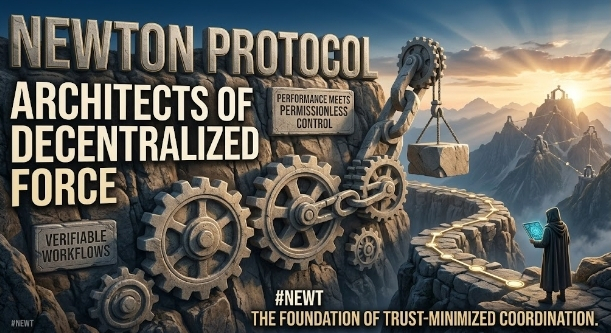
Rather than treating automation as a convenience feature, the project approaches it as infrastructure. The idea isn't simply allowing actions to happen automatically. It's making those actions verifiable, permissionless, and ultimately controlled by the user instead of an unseen intermediary.
That distinction matters more than it first appears.
Traditional automation usually asks for trust. You connect an account, grant permissions, and hope the service behaves as expected. The automation works because someone else is responsible for keeping the system running.
Crypto has always tried to reduce those kinds of assumptions.
So if automation is going to become part of decentralized finance and onchain coordination, it has to inherit those same principles. Execution should be transparent. Ownership should remain with the user. Every automated action should be accountable to rules that anyone can verify rather than promises made behind closed doors.
The interesting part is that this changes how we think about digital agents.
Most conversations around AI agents focus on intelligence. Can they reason? Can they make decisions? Can they complete increasingly complicated tasks?
Those are important questions, but they aren't the only ones.The deeper layer may actually be execution.
An intelligent agent without trustworthy execution still leaves room for uncertainty. Someone has to ask whether the action happened correctly, whether permissions were respected, or whether hidden dependencies influenced the outcome. Once value starts moving across decentralized systems, those questions become impossible to ignore.
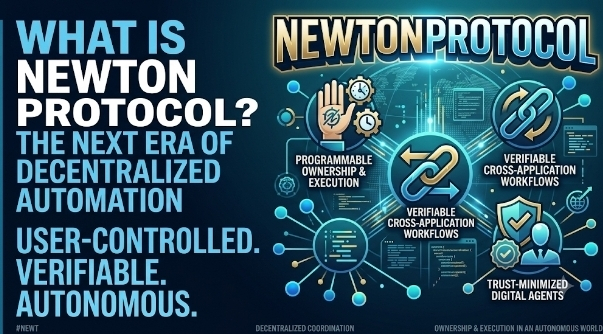
Newton Protocol seems to approach this challenge from the opposite direction. Instead of beginning with intelligence alone, it focuses on creating an environment where autonomous execution itself becomes verifiable. User-owned agents, programmable ownership, cross-application workflows, and trust-minimized coordination all fit into that larger picture. They aren't isolated features. They're pieces of an operational framework designed for systems that continue functioning even when the user steps away.
I don't think this is only about saving time.
Over time, infrastructure shapes behavior. When coordination becomes easier, people attempt more ambitious workflows. When execution becomes reliable, entirely new applications begin to appear. We rarely notice these transitions while they're happening because the underlying systems improve quietly before the visible products change.
History tends to reward infrastructure that disappears into the background. Electricity isn't valuable because we constantly think about it. The internet isn't successful because we admire its cables. They matter because they become dependable enough that everything else can be built on top of them.
Maybe decentralized automation is moving toward that same point.
If that happens, projects like @NewtonProtocol and assets such as $NEWT may eventually be remembered less for introducing another protocol and more for helping redefine how ownership and execution coexist in an increasingly autonomous onchain world.
Most people still ask what automation can do.
I'm starting to think the better question is who truly controls it once it begins acting on our behalf.
