
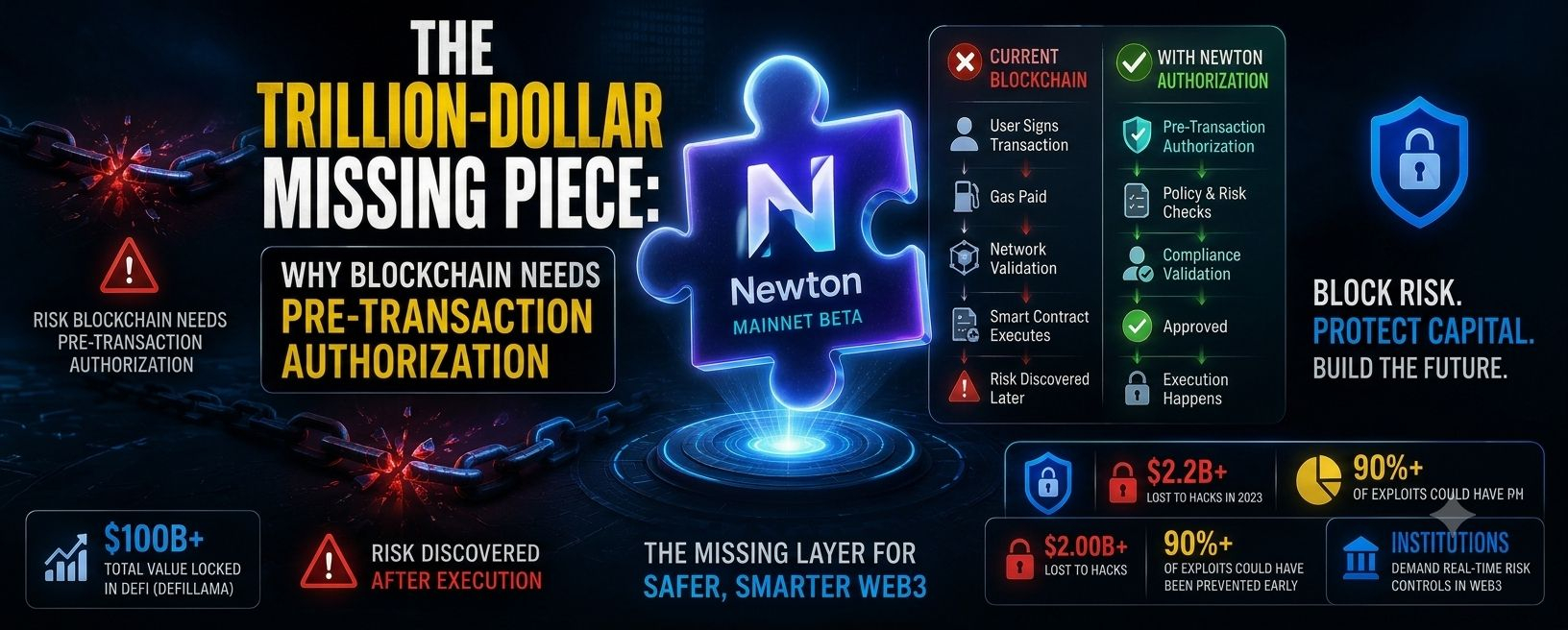
I keep coming back to a question that feels almost too obvious, which is usually a sign that an industry has learned to live around a missing piece instead of fixing it. Why is it that every time I tap my card at a coffee shop, my bank checks whether the payment should happen before money moves, yet on a blockchain, millions of dollars can be committed the moment gas is paid, even if the transaction was clearly risky from the start?
That difference isn't just technical. It's quietly shaping the economics of Web3.
Traditional finance built authorization layers decades ago because experience taught banks that preventing bad transactions is cheaper than cleaning them up afterward. Every card payment, wire transfer, or online purchase passes through a pre-flight check. Is the account funded? Does the behavior match historical patterns? Does it trigger compliance rules? Most of those checks happen in milliseconds, but underneath, they represent decades of risk management becoming infrastructure rather than an optional feature.
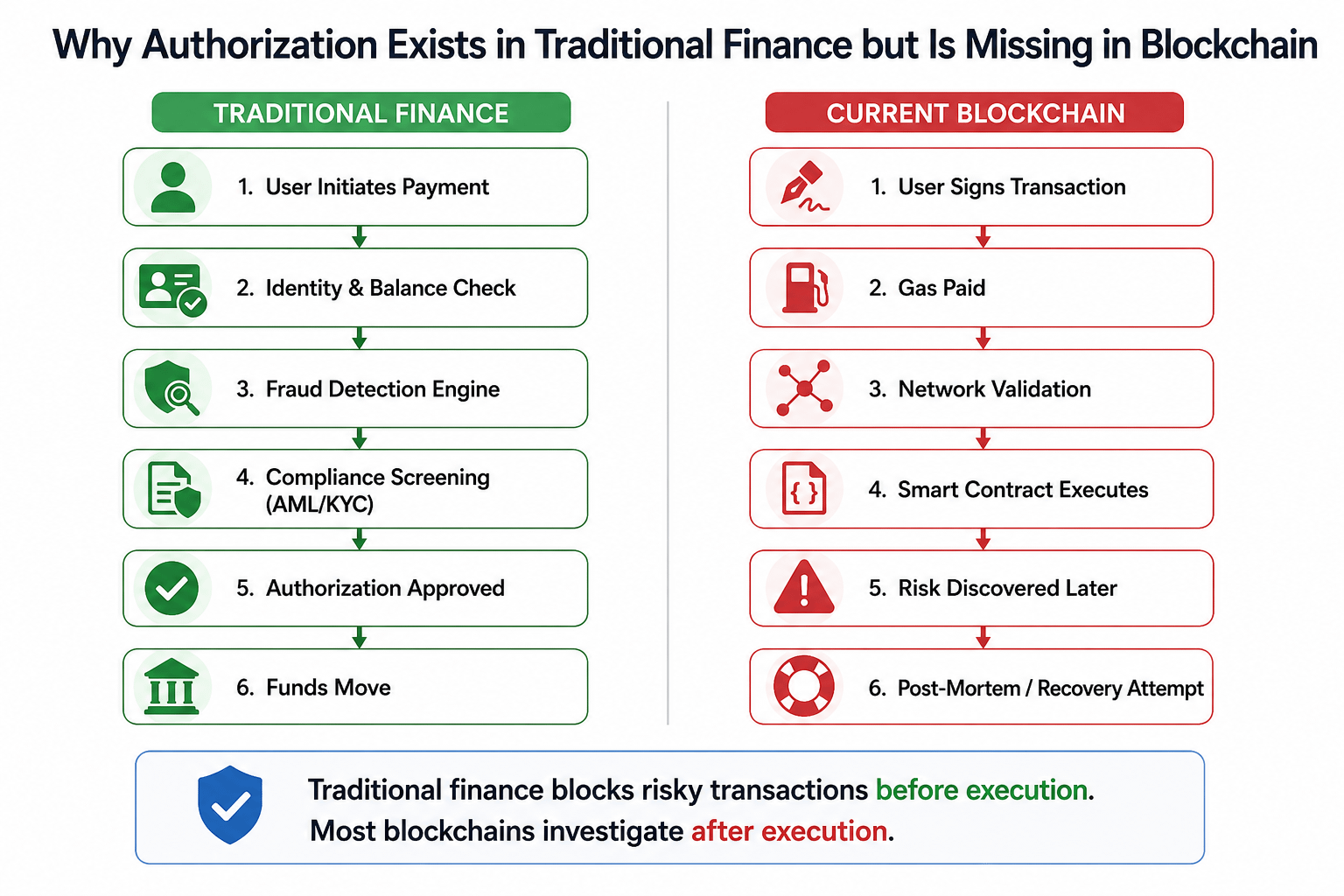
Blockchain took a different path. Once a transaction is signed and reaches the network with sufficient gas, execution is largely unconditional. The protocol verifies that the transaction is valid according to consensus rules, not whether it is sensible, compliant, or obviously dangerous. That distinction matters more today than it did five years ago because the value flowing through these systems has grown dramatically.
According to DeFiLlama, decentralized finance still secures well over $100 billion in total value locked, even after the market cooled from its peak. That number tells us something important. Web3 is no longer experimenting with pocket money. It's managing capital at a scale where the absence of preventative controls becomes increasingly expensive.
You can see the consequences every few weeks. A smart contract exploit is discovered. A phishing wallet drains assets. A protocol publishes a post-mortem explaining exactly how funds were lost. The analysis is often excellent, but it arrives after the capital has already moved. The industry has become remarkably good at forensic investigation while remaining surprisingly limited at stopping many preventable transactions before execution.
Some argue that's simply the cost of decentralization. If users control their own assets, they should also carry the responsibility for every transaction they sign. There's truth in that. Self-custody is valuable precisely because it removes centralized permission. But permission and authorization are not the same thing. One decides who controls assets. The other evaluates whether a transaction satisfies predefined conditions before irreversible execution. Those concepts can coexist.
That distinction helps explain why conversations around transaction authorization have become noticeably louder in developer circles this year. As regulators continue focusing on compliance standards and institutional participants look for familiar operational safeguards, the pressure is no longer just about making blockchains faster. It's about making them safer without sacrificing their core properties.
This is where the Newton Mainnet Beta introduces an interesting shift. Rather than treating risk management as an external monitoring problem, it introduces pre-transaction authorization directly into the transaction flow itself. On the surface, that means transactions can be evaluated against configurable policies before execution. Underneath, it creates an entirely different security model where suspicious behavior can be blocked instead of merely recorded. That also opens the door for programmable compliance, institutional controls, and smarter wallet protections without requiring every application to reinvent its own security framework.
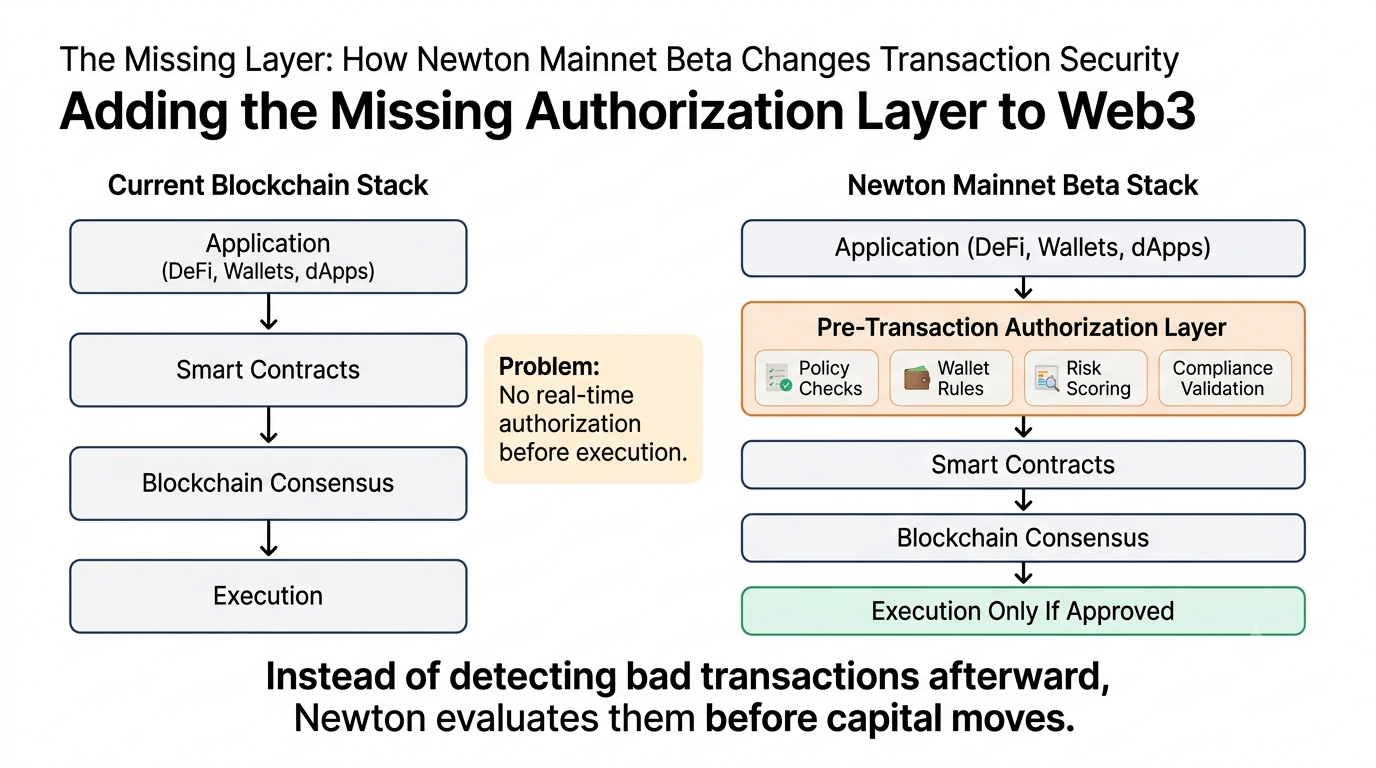
Whether this approach becomes a broader industry standard remains to be seen. Early signs suggest developers increasingly recognize that post-incident reports are not a substitute for preventative infrastructure. The steady rise of institutional interest only reinforces that conversation because capital at scale tends to demand predictable safeguards.
The deeper pattern is hard to ignore. Blockchain spent years proving it could move value without intermediaries. The next phase may depend less on moving assets faster and more on deciding, quietly and intelligently, which transactions should never move at all.
