
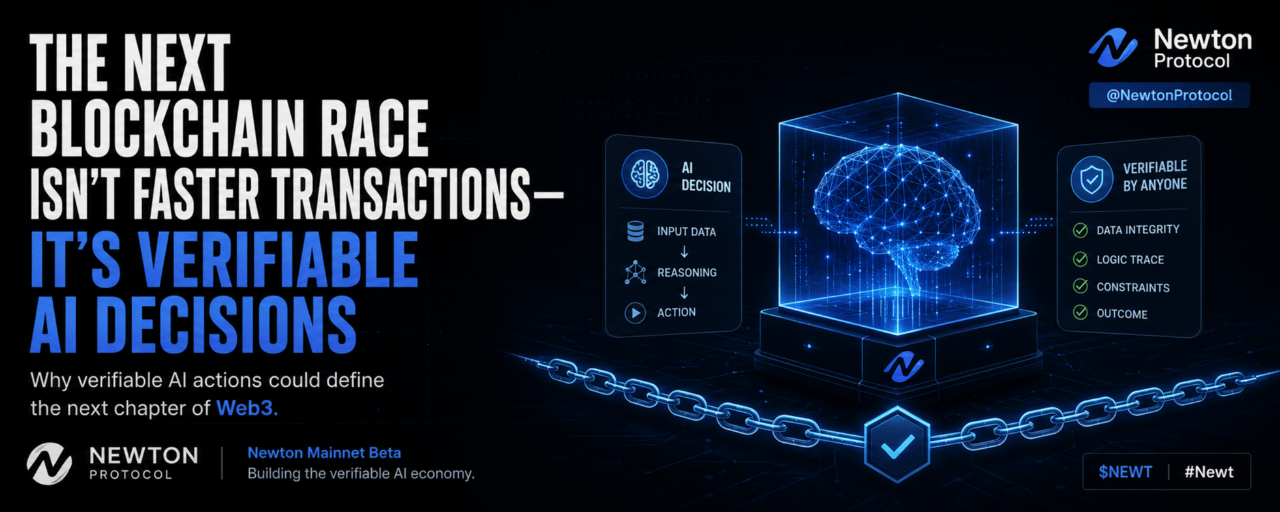
The first thing that caught my attention while reading #NewtonProtocol 's technical documentation wasn't the discussion around AI agents or blockchain performance. It was the repeated emphasis on making AI actions verifiable rather than simply executable. At first glance, that feels like a subtle wording choice. After spending more time with the architecture, I began to think it might actually describe the next competitive frontier for decentralized systems.
Crypto has spent years racing to process transactions faster. AI, meanwhile, has spent years racing to produce smarter outputs. Neither race completely addresses a more difficult question: how do we know an autonomous decision can be trusted after it has already been made?
That overlooked distinction is why I find @NewtonProtocol and the Newton Mainnet Beta more interesting than another infrastructure launch. The discussion around $NEWT and #Newt seems likely to become less about transaction throughput and more about whether AI-driven activity can leave behind evidence that independent participants can examine.
The mechanism is surprisingly straightforward in principle, even if the engineering underneath is complex. Instead of asking users to blindly trust an AI agent's decision, the protocol attempts to make that decision accompanied by information that allows others to verify what happened. The blockchain becomes less of a machine for moving assets and more of a ledger for recording accountable actions.
That shift matters because AI introduces uncertainty that traditional blockchain transactions rarely faced. A payment either happened or it didn't. An AI agent, however, continuously evaluates information, chooses among alternatives, and executes strategies that may not be immediately obvious to observers.
As AI systems become more autonomous, the value may not come from proving an action occurred. The greater value could come from proving why it occurred and whether it followed predefined constraints.
This changes trust in a subtle but important way.
Developers may begin designing applications that assume AI agents will make decisions on behalf of users. DAOs could eventually delegate operational tasks to automated systems. Enterprises might rely on AI for repetitive execution across decentralized infrastructure. None of these participants simply need faster block production. They need confidence that automated decisions remain auditable after the fact.
That is where Newton Protocol appears to be positioning itself differently.
Instead of treating verification as an optional feature added later, the protocol places accountability closer to the center of the system design. If successful, that changes incentives. Builders become encouraged to produce systems whose behavior can be inspected instead of merely observed. Trust moves away from reputation and toward evidence.
The investment question I keep returning to is surprisingly simple.
If autonomous AI becomes commonplace in Web3, which networks will developers choose to build upon: the ones that execute decisions the fastest, or the ones that make those decisions easiest to verify months later during an audit, governance dispute, or compliance review?
The answer isn't obvious today because most crypto activity still prioritizes speed, liquidity, and user growth. Yet infrastructure often becomes valuable only after users begin relying on it for more consequential tasks. Verification rarely creates excitement during a bull market, but it becomes indispensable when disagreements arise.
Of course, there are meaningful trade-offs.
Verifiability is not free. Additional proofs, records, and accountability mechanisms can introduce computational overhead, implementation complexity, and new design challenges. Some developers may decide those costs outweigh the benefits for simpler applications. Others may discover that proving every AI decision is unnecessary in practice. The protocol's long-term value therefore depends not only on technical capability but also on whether developers are willing to accept those trade-offs.
Crypto has a habit of solving one uncertainty only to reveal another. Blockchains reduced uncertainty around transaction history. AI now introduces uncertainty around autonomous reasoning. It seems increasingly clear that these are different problems requiring different infrastructure.
Reading @NewtonProtocol 's documentation left me thinking less about blockchain scalability and more about evidence. If decentralized AI continues evolving beyond experimentation into real operational responsibility, the next competitive advantage may not belong to the network that processes another thousand transactions per second. It may belong to the network that makes autonomous decisions understandable, reviewable, and accountable long after they have been executed. If the industry moves in that direction, verifiable AI decisions could become a more durable differentiator than raw transaction speed ever was.